Background
Phosphatidylcholine, a naturally occurring form of choline found in food, has gained increasing attention as a prenatal supplement because of its potential role in supporting fetal brain development. Choline is critical for brain growth and function, especially during pregnancy, and its supplementation may influence neurodevelopmental outcomes in children. This interest is partly driven by the role of the fetal α7-nicotinic cholinergic receptor gene (CHRNA7), which is involved in brain development and associated with neurodevelopmental disorders such as schizophrenia, attention deficit disorder (ADD), and autism spectrum disorder (ASD). Impaired development of this receptor pathway in the fetus may increase the risk of these conditions later in life.
Choline derived from maternal intake of phosphatidylcholine activates fetal α7-nicotinic receptors, which support the development of neurosynaptic pathways in the brain. This is observable after birth as enhanced cerebral neurophysiological inhibition—essentially a robust response that dampens neural reactivity to repeated stimuli, which is crucial for normal cognitive and behavioral functioning. An earlier smaller study indicated that prenatal supplementation with phosphatidylcholine significantly improved newborn neurophysiology and reduced early markers of attention and social withdrawal problems at 40 months old.
Objectives
This larger randomized clinical trial investigated whether maternal prenatal supplementation with phosphatidylcholine compared to placebo would enhance fetal brain development in a way that decreases childhood attention problems and social behavioral difficulties while increasing cognitive performance through age four. The study aimed to confirm the safety and efficacy of this intervention to better guide prenatal nutritional advice.
Study Design and Methods
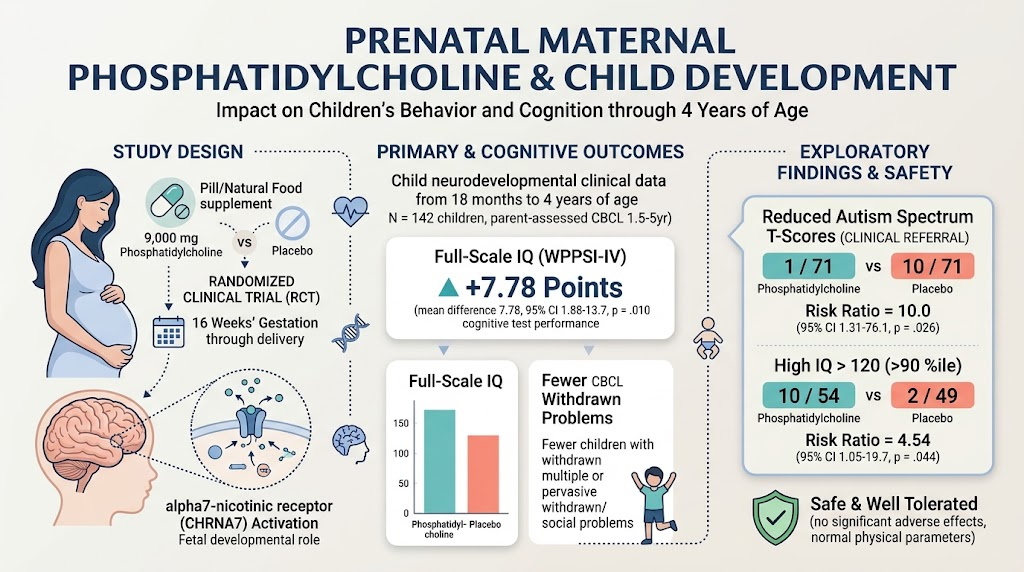
Conducted at the University of Colorado Hospital Prenatal Clinics and affiliated community hospitals, the trial enrolled 206 pregnant women. Participants were randomly assigned to receive either 9000 mg of phosphatidylcholine daily or a placebo, starting at 16 weeks of gestation and continuing until delivery.
Children born to these mothers were followed longitudinally. Between 18 months and 4 years, 142 children were evaluated using the Child Behavior Checklist (CBCL 1.5–5 years version), focusing primarily on Withdrawn behavior and Attention Problems. A secondary measure, the Wechsler Preschool and Primary Scale of Intelligence-Fourth Edition (WPPSI-IV), was used to assess the children’s cognitive abilities through a full-scale IQ score.
Shortly after birth, cerebral neurophysiological inhibition was measured to objectively assess the neurodevelopmental impact of prenatal phosphatidylcholine.
Results
Children whose mothers received phosphatidylcholine prenatal supplements exhibited significantly fewer pervasive or multiple withdrawn behaviors compared to those whose mothers received placebo. This suggests better social engagement and fewer signs of social withdrawal issues. Cognitive testing showed a meaningful improvement in full-scale IQ scores among the phosphatidylcholine group (mean difference of 7.78 points; 95% confidence interval [CI] 1.88 to 13.7; p = .010).
Attention problems did not show a statistically significant reduction overall.
Exploratory analyses brought attention to some notable findings related to autism spectrum disorder (ASD) features. Among the children, 11 reached clinical referral levels for ASD-related behavioral concerns and language deficits; 10 of these children were from the placebo group, and only 1 was from the phosphatidylcholine group. This translates to a risk ratio of 10.0 (95% CI 1.31 to 76.1; p = .026), indicating a substantially reduced risk for ASD-like features with phosphatidylcholine supplementation.
Additionally, among children tested, 12 achieved full-scale IQ scores above 120 (greater than the 90th percentile). Of these, 10 were from the phosphatidylcholine group, versus 2 from the placebo group—a risk ratio of 4.54 (95% CI 1.05 to 19.7; p = .044).
These positive effects appeared independent of whether mothers had preexisting mental health disorders.
Importantly, the trial reported no significant adverse effects related to phosphatidylcholine supplementation for mothers or children. Common pregnancy-related symptoms like nausea, vomiting, dizziness, and hypertension did not increase. Infants displayed normal physical parameters at birth and throughout early childhood.
Limitations
Several factors temper these promising results. The improvement in attention problems did not reach statistical significance, possibly due to sample size or assessment method limitations. Social behavior was assessed solely by parental report, which can introduce bias or subjective variability. Moreover, a notable proportion (approximately one-third) of enrolled women dropped out before their children’s 4-year assessments, potentially affecting outcome robustness and generalizability.
Conclusions
Prenatal supplementation with phosphatidylcholine appears to provide safe and effective support for fetal brain development, leading to improved social behavior and cognitive outcomes in early childhood. Current evidence supports starting supplementation as early in gestation as possible, with doses around 6300 mg phosphatidylcholine (or 900 mg choline) daily, aligning with this and previous studies.
These findings suggest that ensuring sufficient maternal choline intake, particularly in phosphatidylcholine form, could be a promising public health strategy to reduce neurodevelopmental challenges linked to social withdrawal and cognitive deficits. However, further larger and longer-term studies are needed to confirm these benefits and to explore mechanisms affecting attention-related outcomes.
Implications for Practice and Future Research
For healthcare providers in obstetrics and pediatrics, these results underscore the importance of prenatal nutritional counseling that includes choline intake considerations. Currently, choline is not consistently included in standard prenatal vitamin formulations, and awareness among patients and clinicians about its potential benefits remains limited.
Future research should focus on identifying the optimal timing, dosing, and form of choline supplementation, as well as its effects on a broader range of neurodevelopmental outcomes. Understanding interactions with maternal mental health and other prenatal exposures will also be valuable.
This trial contributes important evidence towards establishing choline as a crucial nutrient for prenatal brain development, supporting healthier child cognitive and behavioral trajectories up to at least age four.
Reference
Hunter SK, Hoffman MC, Law AJ, Christians U, D'Alessandro A, Freedman R. Prenatal Maternal Phosphatidylcholine and Children's Behavior and Cognition through 4 Years of Age: Randomized Clinical Trial. Am J Obstet Gynecol. 2026 Oct 19:S0002-9378(26)00561-2. doi: 10.1016/j.ajog.2026.10.017. Epub ahead of print. PMID: 42896815.