We use cookies

Our website uses essential cookies and, with your consent, additional cookies to measure performance and improve our services. Cookie Policy.

You can change your choice at any time.

MMedXYNews
HomeVideos
MedXY AI/MedXY News/Section: Diabetes & Endocrinology

Practical Inpatient Use of CGM, Insulin Pumps, and AID Systems: Key Recommendations from an International Position Statement
MedXY Editorial Team•Sep 25, 2026•Diabetes & Endocrinology
Insulin Pumpinpatient CGMautomated insulin deliveryhospital diabetes

Introduction and Context

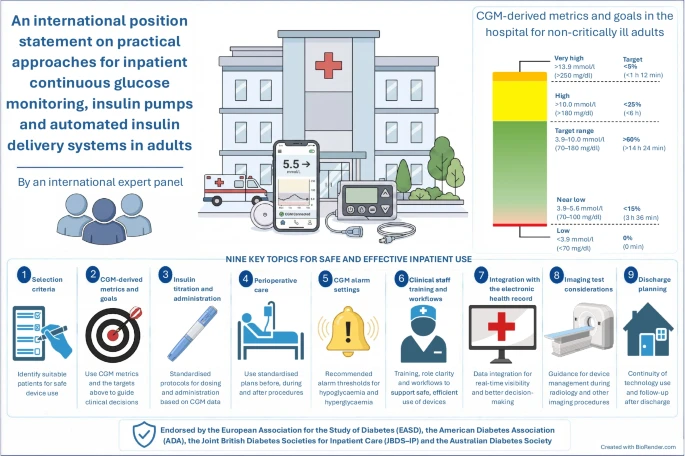
Hospitals increasingly encounter patients who manage diabetes with continuous glucose monitoring (CGM), insulin pumps, and automated insulin delivery (AID) systems. These technologies—once confined to outpatient care—offer real‑time glycemic data and precise insulin delivery that can improve glucose control. But their inpatient use raises clinical, operational, safety, and legal questions: when can devices be continued, when should they be stopped, how should staff interpret CGM metrics in the hospital setting, and how should data be integrated into electronic health records (EHRs)?

The international position statement led by Olsen MT and colleagues (Diabetes Care, 2026) responds to this urgent need for actionable, hospital‑facing guidance. It synthesizes expert consensus from endocrinology, inpatient medicine, nursing, biomedical engineering, and health systems leadership to produce practical recommendations for non‑critically ill adults. This article summarizes those core recommendations and highlights operational implications for clinicians and hospital systems.

MedXY registered readers

Sign in free to continue reading

Create or use your MedXY account to unlock the complete article.

This article was created using several editorial tools, including AI, as part of the process. Human editors reviewed this content before publication.

Related articles

Open language-specific specialty feeds and department pages.

Menstrual Cycle Influence on Insulin Sensitivity in Type 1 Diabetes: Insights from Automated Insulin Delivery UsersThis study elucidates how insulin sensitivity and glucose control in menstruating individuals with type 1 diabetes fluctuate across menstrual cycle phases, emphasizing gaps in current automated insulin delivery systems and guidelines.Sep 4, 2026Diabetes Tech Roundup: Dexcom Acquisition, Stelo AI, Omnipod 5 Update, and iLet Real-World DataDexcom buys Nutrisense and updates Stelo app with AI; Insulet lowers Omnipod 5 target to 100 mg/dL; Beta Bionics shares real-world iLet HbA1c data.Jul 29, 2026Transitioning to Tubeless Automated Insulin Delivery: Clinical Insights from the RADIANT Trial and Contemporary Management of Type 1 DiabetesThis review synthesizes the landmark RADIANT trial findings, demonstrating the efficacy of transitioning patients from multiple daily injections to tubeless automated insulin delivery, while integrating broader evidence on genetic susceptibMar 9, 2026Breaking the C-Peptide Barrier: New Evidence Shows Automated Insulin Delivery Benefits All Adults with Type 2 Diabetes
Loading comments...
MedXY briefing

Get the free newsletter

Evidence-led clinical news, trends, and analysis—delivered to your inbox.

Ask MedXY AI

Most popular

Intimate Health
Five Benefits for Women Continuing Sexual Activity After Menopause
Intimate Health
Why Some Women Have a Strong Sex Drive—And Why Men Shouldn't Worry About It
Nursing & care
How often should a couple have sex?
General Surgery
Optimizing Postoperative Opioid Prescriptions After Intra-Abdominal Cancer Surgery: Comparing the 5x-Multiplier and 3-Tier Models
Intimate Health
Classic Intimacy Recommendations: How to Help Women Reach Orgasm and Enjoy Mutual Pleasure
© 2026 MedXY
Contact usAbout usPrivacy PolicyMedXY story
A landmark study reveals that automated insulin delivery systems significantly improve blood sugar control for adults with type 2 diabetes, regardless of their C-peptide levels, challenging current insurance restrictions that limit access t
Jan 10, 2026
Automated Insulin Delivery in Insulin-Treated Type 2 Diabetes: A Comprehensive Review of Randomized Controlled Trial Evidence and Clinical ImplicationsAutomated insulin delivery (AID) significantly improves glycemic control in insulin-treated type 2 diabetes, demonstrating greater HbA1c reduction and increased time in target glucose range compared to traditional insulin delivery methods.Oct 7, 2025
Automated Insulin Delivery in Young Children with Type 1 Diabetes: Insights from the LENNY TrialThe LENNY trial demonstrates that the MiniMed 780G automated insulin delivery system improves glycaemic control and maintains safety in children aged 2–6 years with type 1 diabetes.Oct 1, 2025