Post-Tonsillectomy Hemorrhage in Lebanon: Prevalence, Risks, and Implications for Adult Patients
Highlight
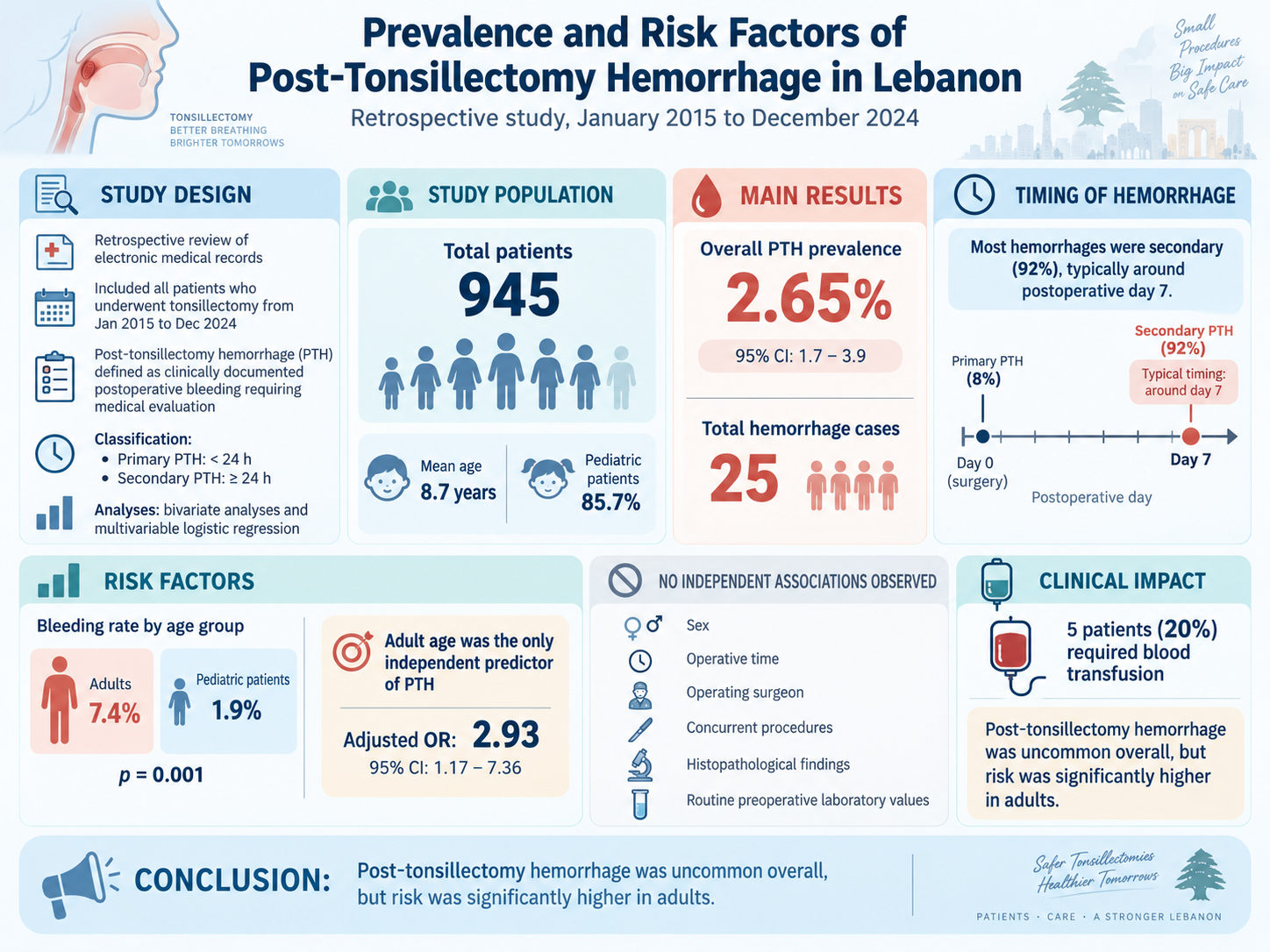
– Post-tonsillectomy hemorrhage (PTH) in a Lebanese tertiary center presents a prevalence of 2.65%.
– The majority (92%) of bleeding episodes were secondary, occurring typically around postoperative day 7.
– Adult patients demonstrated significantly higher rates of PTH (7.4%) compared with pediatric cases (1.9%).
– Adult age was the sole independent predictor of PTH on multivariable analysis, informing patient counseling and postoperative care strategies.
Study Background
Tonsillectomy remains one of the most common surgical procedures performed worldwide, primarily indicated for recurrent tonsillitis and obstructive sleep apnea. Although generally safe, post-tonsillectomy hemorrhage represents the most serious and potentially life-threatening complication, contributing to significant morbidity, hospital readmissions, and occasionally, blood transfusion requirements. The prevalence of PTH and its risk factors vary by population, surgical technique, and patient demographics. Detailed epidemiological data from the Middle Eastern region, particularly Lebanon, remain scarce. Understanding local bleeding rates and determinants is essential to optimize perioperative management and improve patient outcomes.
Study Design
This retrospective cohort study encompassed 945 consecutive patients who underwent tonsillectomy at a single tertiary care center in Lebanon between January 2015 and December 2024. The cohort was predominantly pediatric, with a mean age of 8.7 years and 85.7% classified as children. The study extracted comprehensive data from electronic medical records, including demographic information, operative details (operative time, surgeon), concurrent procedures, histopathologic findings, and preoperative laboratory values. Post-tonsillectomy hemorrhage was defined as any clinically documented postoperative bleeding episode necessitating medical evaluation, categorized into primary hemorrhage occurring within 24 hours after surgery, and secondary hemorrhage manifesting 24 hours or later postoperatively. The study employed bivariate analyses to explore associations between variables and PTH, followed by multivariable logistic regression to adjust for confounders and identify independent predictors.
Key Findings
Out of 945 patients, 25 experienced post-tonsillectomy hemorrhage, reflecting an overall prevalence of 2.65% (95% confidence interval [CI]: 1.7–3.9%). Secondary hemorrhages accounted for 92% of these cases, most commonly presenting near postoperative day 7, consistent with the natural course of tonsillar wound healing and sloughing of the eschar. Notably, adult patients demonstrated a significantly higher bleeding rate of 7.4%, compared to only 1.9% in pediatric patients (p=0.001).
Multivariate logistic regression analysis identified adult age as the only independent risk factor for PTH, with an adjusted odds ratio (aOR) of 2.93 (95% CI: 1.17–7.36). Other factors such as sex, operative time, operating surgeon, concurrent procedures, histopathologic findings, and routine preoperative laboratory values showed no significant independent association with hemorrhage risk. This delineation highlights an intrinsic vulnerability among adults undergoing tonsillectomy, potentially related to anatomical, physiological, and healing differences.
Clinically, five patients (20% of PTH cases) required blood transfusion, emphasizing that while uncommon, post-tonsillectomy hemorrhage can have significant consequences needing prompt intervention and careful monitoring.
Expert Commentary
This study reinforces the well-documented observation that adults experience a higher risk of post-tonsillectomy hemorrhage than pediatric patients, a finding corroborated by multiple global reports. The predominance of secondary hemorrhage, often occurring around day 7, aligns with the period of tissue sloughing and granulation, a vulnerable phase needing vigilant postoperative surveillance. The lack of association with other factors such as surgical technique proxy variables or preoperative laboratory parameters suggests that patient age should be a central consideration in risk stratification rather than procedural variables.
From a pathophysiological perspective, adult tonsillar tissue tends to be more fibrotic and scarred, possibly impairing healing and predisposing to bleeding. Moreover, adult patients may have more comorbidities or use medications influencing hemostasis, although these variables were not specifically addressed in the current study.
Limitations of retrospective designs include potential unmeasured confounding, reliance on clinical documentation accuracy, and lack of granular data on surgical technique variations or perioperative management protocols that may influence hemorrhage risk. Nonetheless, the large sample size and systematic evaluation provide robust prevalence and predictor data for this population.
Conclusion
This Lebanese retrospective study documents a low overall prevalence of post-tonsillectomy hemorrhage, with a marked predominance of secondary bleeding. Adult patients are nearly three times more likely to experience hemorrhage compared to children, underscoring the importance of tailored counseling and close postoperative monitoring for this group to mitigate risks.
Clinicians should prioritize vigilant follow-up protocols for adults undergoing tonsillectomy and consider enhanced perioperative hemostatic measures. Future prospective studies are warranted to explore detailed mechanisms, the influence of surgical techniques, and the role of comorbidities or medications in PTH risk within this demographic.
Funding and ClinicalTrials.gov
No funding sources were declared for this study. The retrospective design did not involve clinical trial registration.
References
1. Windfuhr JP, Chen YS, Remmert S. Post-tonsillectomy hemorrhage: clinical review. Curr Opin Otolaryngol Head Neck Surg. 2005;13(6):395-399.
2. Steward DL. Post-tonsillectomy hemorrhage: incidence, prevention, and treatment. Curr Opin Otolaryngol Head Neck Surg. 2015;23(6):486-491.
3. Cohen NA, Doukas AG, Kriett JM, et al. Post-tonsillectomy hemorrhage: a methodologic review. Otolaryngol Head Neck Surg. 2012;147(4):703-708.
4. Bhattacharyya N. Contemporary assessment of the epidemiology and hospital care burden of adult tonsillectomy. Otolaryngol Head Neck Surg. 2010;143(4):486-491.
5. Kosko JR, Soubra SH, Graham SM, et al. Post-tonsillectomy hemorrhage: analyzing risk and interventions in adults and children. Int J Pediatr Otorhinolaryngol. 2019;126:109615.
6.Saad M, Oustah D, Kaddah W, Daoud D, AbdulFattah M, Merheb A, Abbas A, Al Mallah A, Bou Dargham B. Prevalence and Risk Factors of Post-Tonsillectomy Hemorrhage in Lebanon: A Retrospective Study. Laryngoscope. 2026 Sep 16. doi: 10.1002/lary.70929. Epub ahead of print. PMID: 42747150.
This article was created using several editorial tools, including AI, as part of the process. Human editors reviewed this content before publication.