Highlight
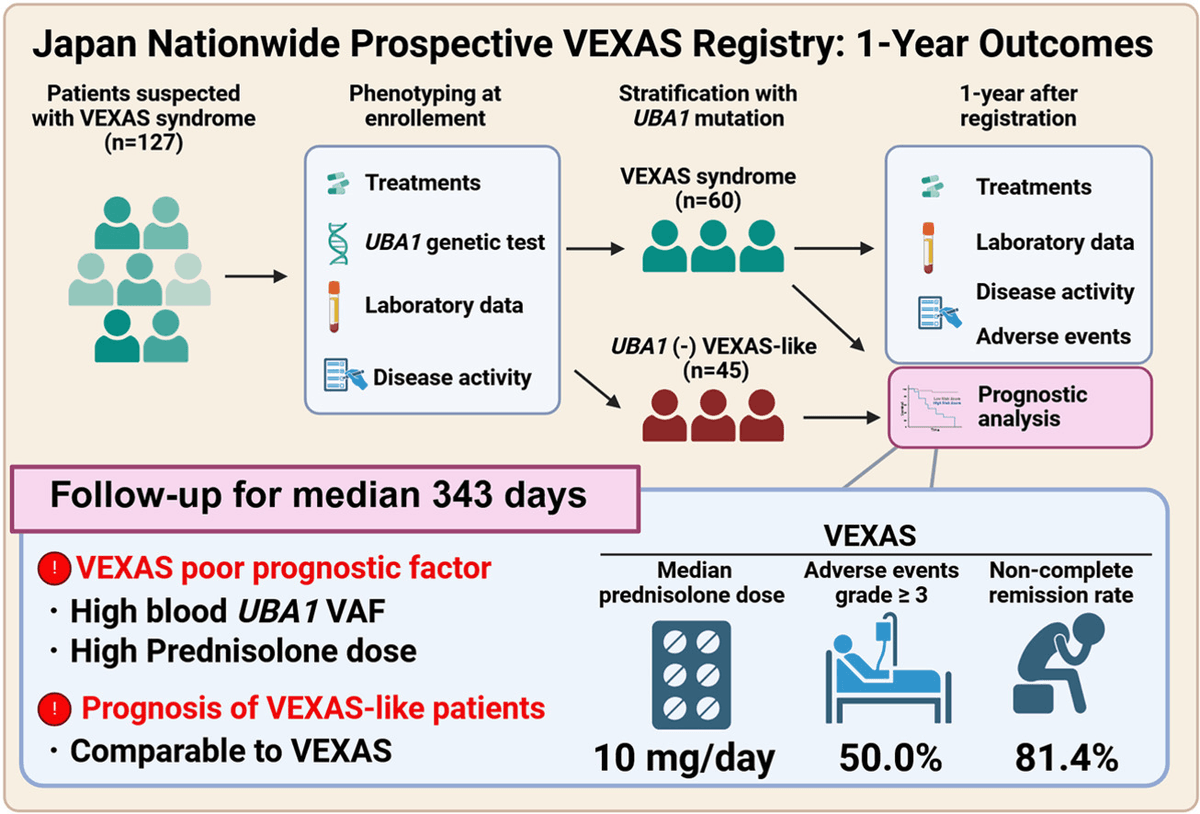
This nationwide prospective study from Japan demonstrates that the variant allele frequency (VAF) of pathogenic UBA1 mutations in peripheral blood is a significant predictor of mortality and transfusion dependence in patients with VEXAS syndrome (VS). Higher baseline VAF and higher prednisolone doses independently correlate with poorer outcomes. Notably, patients carrying the UBA1 p.Met41Leu variant showed improved survival, and a similarly poor prognosis was observed in VEXAS-like patients without identifiable UBA1 variants.
Study Background
VEXAS syndrome is a recently characterized adult-onset autoinflammatory disorder caused by somatic mutations in the UBA1 gene located on the X chromosome. It manifests with systemic inflammation, hematologic abnormalities, and high mortality, predominantly affecting men in later life. Current clinical management is complicated by heterogeneity in disease presentation and outcomes, with limited biomarkers to guide prognosis or therapeutic decisions. Understanding predictors of disease progression and outcomes remains a critical unmet need to optimize patient management and tailor interventions.
Study Design
This study represents a prospective nationwide registry conducted in Japan, enrolling male patients suspected of VEXAS syndrome. Peripheral blood samples from all cases underwent next-generation sequencing to detect pathogenic UBA1 variants and quantify their variant allele frequency (VAF) at baseline. The cohort included 60 patients confirmed to carry pathogenic UBA1 variants (median age 74 years) and 45 UBA1-negative patients with VEXAS-like syndromes as controls. Evaluations were performed every three months over a 1-year follow-up, monitoring disease activity via the VEXAS Current Activity Form (VEXASCAF), serum C-reactive protein (CRP) levels, prednisolone (PSL) dosing, adverse event incidence, mortality, and transfusion dependency. Additional validation was conducted in an independent cohort of 34 patients with VEXAS syndrome.
Key Findings
During follow-up (median 343 days), inflammatory markers such as VEXASCAF scores and CRP levels decreased, while median PSL doses remained stable. Despite apparent control of inflammation, grade 3 or higher adverse events occurred in 50% of patients, underscoring the disease’s severity and treatment-related toxicity.
Multivariable Cox regression analysis identified two independent predictors of poor prognosis—defined as death or transfusion dependence—at baseline:
Higher UBA1 variant allele frequency (VAF): A greater proportion of mutated alleles in peripheral blood was robustly associated with deteriorated survival outcomes. This association was validated in a separate independent cohort.
Higher prednisolone dosage: Increased PSL dose at baseline predicted worse prognosis, likely reflecting more severe disease or corticosteroid-related adverse effects.
The study also evaluated the influence of specific UBA1 variants on prognosis. Patients harboring the UBA1 p.Met41Leu mutation exhibited better survival outcomes after adjusting for disease onset, suggesting a genotype-phenotype correlation that may influence disease course.
Interestingly, patients with VEXAS-like syndrome who did not carry UBA1 mutations had prognoses similar to patients with confirmed VEXAS syndrome, indicating clinical overlap and highlighting the need for further genetic and mechanistic investigations.
Expert Commentary
This study provides compelling evidence that the quantitative assessment of UBA1 mutation burden via variant allele frequency in peripheral blood constitutes a valuable prognostic biomarker in VEXAS syndrome. The findings help stratify patients at diagnosis, potentially guiding intensity of monitoring and therapeutic strategies.
The independent association of higher corticosteroid dose with poor outcomes emphasizes the challenge of managing VS with immunosuppression and the need for more effective and less toxic treatment options.
The improved survival of patients with the p.Met41Leu variant suggests that not all UBA1 mutations carry the same clinical significance, supporting personalized medicine approaches.
However, the study is limited by its relatively short follow-up and exclusive recruitment of male patients, reflecting the X-linked nature of UBA1 mutations but limiting generalizability. Additional studies are needed to understand mechanisms driving variant burden expansion and treatment resistance.
Conclusion
This nationwide prospective study conclusively identifies baseline peripheral blood UBA1 variant allele frequency as a potent prognostic biomarker that independently predicts poor outcomes in VEXAS syndrome. Incorporating VAF assessment into routine diagnostic evaluation may enable better risk stratification and tailored management. These findings also underscore the heterogeneous nature of VEXAS and the imperative to develop novel therapeutics targeting the underlying pathogenic mechanisms beyond corticosteroids.
Funding and ClinicalTrials.gov
The study was supported by collaborative governmental and academic funding in Japan. Clinical trial registration details were not specified in the publication but pertain to prospective nationwide registries in VEXAS syndrome.
References
Kirino Y, Maeda A, Higashitani K, Horita N, Asano T, Migita K, et al. Peripheral blood UBA1 variant burden predicts poor outcomes in VEXAS syndrome: a nationwide prospective study. Ann Rheum Dis. 2026 Apr 1;85(10):2033–43. doi:10.1136/annrheumdis-2025-xxx. PMID: 41927375.
Beck DB, Ferrada MA, Sikora KA, Ombrello AK, Collins JC, Pei W, et al. Somatic Mutations in UBA1 and Severe Adult-Onset Autoinflammatory Disease. N Engl J Med. 2020 Jan 30;382(5): 417-428. doi:10.1056/NEJMoa1916858.