Introduction and Context
Hair disorders in children—ranging from androgenetic‑type miniaturization and hair cycle abnormalities to congenital or acquired hair shaft disorders—can cause psychosocial distress for patients and families. Low‑dose oral minoxidil (LDOM), an oral vasodilator repurposed at subantihypertensive doses for hair growth, has grown in popularity among clinicians treating hair loss in adults and adolescents. Yet until now, standardized guidance for use in younger children (under age 12) was limited.
In response to this clinical gap, an international group of pediatric hair experts used a modified Delphi process to produce an evidence‑informed consensus addressing patient selection, dosing, safety, monitoring, contraindications, and long‑term management of LDOM in patients aged <12 years (Akiska YM et al., JAMA Dermatology, 2026). This article distills that consensus into actionable recommendations for clinicians and pediatric dermatology teams, highlighting where practice is changing and where uncertainty remains.
Why the Consensus Was Needed
– Rapid off‑label uptake: LDOM is increasingly prescribed off‑label for pediatric hair disorders despite limited standardized pediatric protocols. Clinicians varied widely in dosing, monitoring, and patient selection.
– Newer data and clinical experience: Growing adult and adolescent literature, plus accumulating pediatric case series and clinical experience, enabled experts to define practical approaches and harmonize practices internationally.
– Safety and formulation issues: Pediatric patients present unique considerations—weight variability, differences in cardiovascular reserve, co‑medications, and caregiver concerns (including pets’ exposure to topical formulations)—creating a need for explicit pediatric guidance.
New Guideline Highlights
Major themes from the international consensus (Akiska et al., 2026):
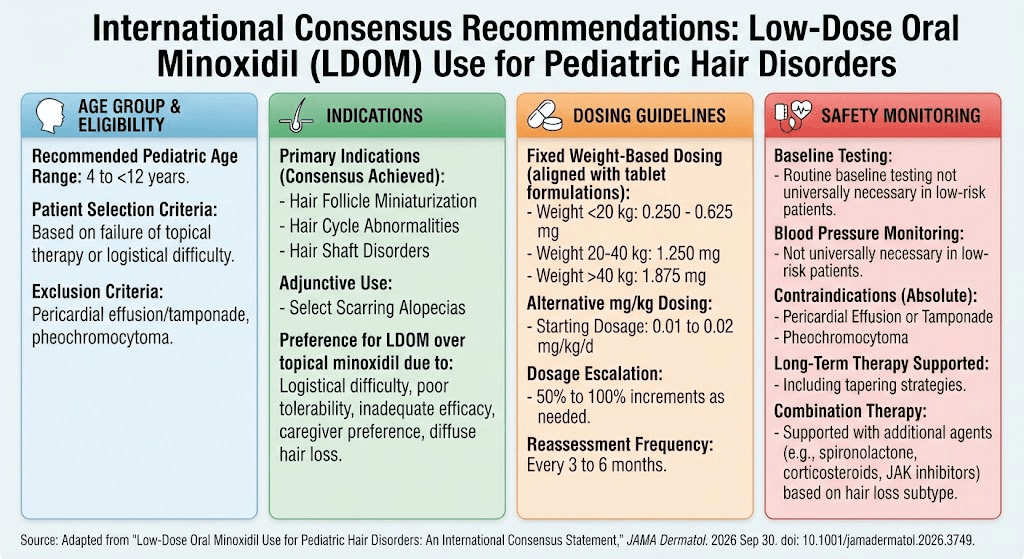
– Age range: LDOM supported for children aged ≥4 to <12 years for selected hair disorders.
– Indications: Strong support for use in hair follicle miniaturization (100%) and hair cycle abnormalities (100%), high support for hair shaft disorders (84%), and adjunctive use in select scarring alopecias (98%).
– Dosing strategies: Two acceptable approaches — fixed weight‑aligned dosing linked to available tablet strengths, and a flexible mg/kg starting dose (0.01–0.02 mg/kg/day).
– Escalation and review: Dose escalation by 50%–100% when needed, with reassessment every 3–6 months.
– Monitoring and testing: Routine baseline cardiovascular testing and frequent blood‑pressure monitoring are not universally required for low‑risk patients, but individualized risk assessment is key.
– Contraindications and cautions: Pericardial effusion/tamponade and pheochromocytoma considered contraindications; caution with cardiac disease, inadequate caregiver follow‑up, and certain co‑medications.
– Long‑term use and combination therapy: LDOM can be used long‑term with tapering strategies and in combination with other nonimmunosuppressive or immunomodulatory agents when clinically appropriate.
Key takeaway for clinicians: LDOM is now supported by an expert international consensus as a flexible, pediatric‑specific, nonimmunosuppressive therapeutic option for selected children aged 4–11, with clear practical guidance on dosing and monitoring.
Updated Recommendations and Key Changes
This consensus introduces pediatric‑specific recommendations where prior guidance was adult‑focused or absent. Important advances include:
– Explicit minimum age: prior literature and adult recommendations lacked a clear lower age bound; consensus supports starting at age 4 years for select indications.
– Weight‑aligned fixed dosing: a pragmatic approach that aligns prescribed doses with existing tablet formulations to ease administration for children.
– Flexible mg/kg alternative: clinicians can choose an individualized starting dose of 0.01–0.02 mg/kg/day when fine titration is needed.
– Monitoring pragmatism: unlike adult practice where baseline cardiovascular testing is more common, experts agreed that routine testing is not mandatory for low‑risk children—reducing unnecessary investigations while preserving safety.
These updates are driven largely by aggregate clinical experience, emerging pediatric case series, and practical constraints (tablet formulations, adherence, caregiver preferences), rather than large randomized pediatric trials, which remain an unmet need.
Topic‑by‑Topic Recommendations
Below are the core recommendations from the international consensus, arranged by clinical topic.
Indications (who and what):
– Supported indications (consensus achieved):
– Hair follicle miniaturization (eg, early pediatric androgenetic‑type changes) — 100% agreement.
– Hair cycle abnormalities (telogen‑effluvium spectrum, chronic diffuse telogen effluvium in select cases) — 100%.
– Hair shaft disorders (eg, monilethrix, loose anagen hair with reduction in shedding) — 84%.
– Adjunctive use in select scarring alopecias when inflammation is controlled — 98%.
– Relative indications: diffuse hair loss where topical treatment is impractical or poorly tolerated (sensory issues, difficulty applying topical solutions).
Contraindications and cautions:
– Absolute or strong contraindications:
– Known pericardial effusion or history of pericardial tamponade.
– Uncontrolled pheochromocytoma (risk of hypertensive crises due to catecholamine effects).
– Relative contraindications/cautions:
– Significant structural cardiac disease, baseline symptomatic hypotension or bradycardia/tachyarrhythmia without cardiology input.
– Concomitant medications that interact to raise risk of fluid retention or cardiac adverse effects.
Dosing strategies (consensus approaches):
– Fixed weight‑aligned doses (pragmatic, aligns with tablet options):
– Weight 40 kg: 1.875 mg daily.
– This fixed dosing strategy achieved 80% agreement among experts.
– Mg/kg approach (flexible alternative):
– Starting dose 0.01–0.02 mg/kg/day (73.5% agreement).
– Provides fine titration for small children or those with comorbidities.
– Dose escalation and maintenance:
– Dose increases of 50%–100% may be used depending on clinical response and tolerability.
– Reassess response and adverse effects every 3–6 months; consider maintenance dosing once clinical response is achieved.
Monitoring and testing:
– Baseline assessment: focused clinical history and exam with attention to cardiovascular history, growth and developmental status, concurrent medications, and family history.
– Baseline testing and routine monitoring:
– For children judged low cardiovascular risk: routine baseline ECG or echocardiography not required; baseline blood pressure and heart rate measurement recommended; follow‑up vitals at intervals determined by clinical judgment.
– For higher‑risk patients (cardiac history, symptoms suggestive of fluid retention, on interacting medications): baseline ECG, echocardiography or cardiology referral as indicated.
– Laboratory testing not routinely required unless clinical indications or concurrent medications warrant (eg, electrolyte monitoring when combined with diuretics).
– Safety signals that prompt urgent review: new peripheral edema, unexplained weight gain, worsening tachycardia, symptomatic hypotension, syncope, chest pain, or concerning ECG findings.
Adverse effects and management:
– Most common: hypertrichosis (increased vellus or terminal hair), which is usually dose‑related and may be acceptable to some families but cosmetically troubling to others.
– Cardiovascular: mild increases in heart rate and fluid retention can occur; symptomatic or severe events are rare at low doses but vigilance is required.
– Serious but rare: pericardial effusion—hence the specific contraindication.
– Management: reduce dose, consider tapering, or discontinue if adverse effects are unacceptable; refer to cardiology for significant cardiac findings.
Duration of therapy and tapering:
– LDOM can be used as long‑term therapy when clinically effective.
– Tapering strategies are supported rather than abrupt cessation; gradual dose reduction helps assess relapse risk and minimize rapid hair shedding.
Combination therapy:
– LDOM can be combined with other agents as clinically indicated: topical minoxidil (if tolerated), antiandrogens for postpubertal patients when appropriate, corticosteroids or immunosuppressants for inflammatory scarring disease (as adjuncts), and selective use with agents like spironolactone in older children/adolescents under specialist supervision.
Special populations and practical issues:
– Children with sensory or behavioral challenges: LDOM may be preferable to topical minoxidil when application is impractical or poorly tolerated.
– Pets: the group noted caregiver concerns about topical minoxidil toxicity to domestic animals; oral therapy avoids this household risk.
– Medication formulation: because many pediatric doses require partial tablets or compounding, clinicians should work with pharmacists to ensure accurate dosing and stability.
Expert Commentary and Insights
The consensus reflects international practice realities and multidisciplinary input. Key expert perspectives include:
– Practicality over perfection: experts emphasized realistic approaches that parents and caregivers can follow—hence the acceptance of fixed tablet‑aligned dosing despite imperfect mg/kg precision.
– Safety pragmatism: while cardiology testing remains critical for higher‑risk children, routine extensive screening for every low‑risk child was seen as unnecessary and potentially burdensome.
– Evidence gaps: panelists uniformly noted the lack of randomized pediatric trials and the need for longer‑term safety data on growth, puberty, and cardiac outcomes. They called for prospective cohorts and registries to track pediatric LDOM use.
– Controversies: some experts remain cautious about broader LDOM use given unknown long‑term effects; others view it as a valuable, nonimmunosuppressive tool when topical therapy is insufficient or impractical. The consensus reflects compromise and pragmatic safeguards.
Practical Implications for Clinical Practice
– Shared decision‑making: clinicians should discuss the off‑label nature of LDOM, expected benefits, common and rare risks, monitoring plan, and alternative options (topical therapies, watchful waiting, other systemic agents).
– Workflow integration: clinics should establish simple protocols for baseline vitals, weight documentation, dosing pathways (fixed vs mg/kg), and a schedule for follow‑up visits at 3–6 months.
– Pharmacy coordination: because many recommended pediatric doses require tablet manipulation or compounding, collaborate with pharmacists to ensure accurate and safe formulations.
– Documentation and registries: clinicians are encouraged to contribute to registries and prospective reporting to build pediatric safety and efficacy data.
Clinical vignette (illustrative):
– Patient: 8‑year‑old Maya, with diffuse shedding after an extended febrile illness and persistent thinning over 9 months, difficulty tolerating topical minoxidil due to skin irritation, and no cardiac history.
– Approach per consensus: after counseling and baseline vitals (BP, HR), Maya’s weight is 28 kg. The clinician may choose the fixed‑dose option and start LDOM 1.25 mg daily (20–40 kg category) or the mg/kg option at 0.02 mg/kg/day (~0.56 mg) using a compounded preparation; given the need for practical dosing and availability of tablet formulations, the fixed 1.25 mg was chosen. The family is advised about hypertrichosis and instructed to check weekly for peripheral edema or palpitations. Follow‑up is arranged at 3 months to assess response and tolerability; if insufficient response, dose escalation by ~50% may be considered with renewed assessment and possible cardiology review if symptoms arise.
Research Needs and Future Directions
– Prospective pediatric safety studies and registries to track cardiac, growth, developmental, and reproductive outcomes.
– Randomized controlled trials comparing LDOM with topical therapies or placebo in pediatric populations for specific indications.
– Pharmacokinetic studies clarifying dose–exposure relationships in young children to refine mg/kg dosing.
– Standardized outcome measures for pediatric hair disorders to harmonize research and clinical reporting.
References
– Akiska YM, Fu J, Castelo‑Soccio L, Mathes E, Mirmirani P, Jamerson T, Sibbald C, and The Pediatric Low‑Dose Oral Minoxidil Consensus Expert Group; Spagnol Abraham L, et al. Low‑Dose Oral Minoxidil Use for Pediatric Hair Disorders: An International Consensus Statement. JAMA Dermatology. 2026 Sep 30. PMID: 42814435. https://pubmed.ncbi.nlm.nih.gov/42814435/
– U.S. Food and Drug Administration. Rogaine (minoxidil topical) prescribing information and labeling. FDA Drugs. https://www.fda.gov (product labeling for minoxidil topical formulations).
– Ramos PM, Miot HA. Oral minoxidil for hair loss: systematic review. Journal of the European Academy of Dermatology and Venereology. 2020;34(8):1496–1506. (Review summarizing adult and pediatric experience to date).
– Olsen EA. Female pattern hair loss. Journal of the American Academy of Dermatology. 2001;45(5 Suppl):S70‑S80. (Background on hair miniaturization and therapeutic approaches.)
Note: The consensus statement (Akiska et al., 2026) is the primary source for the pediatric recommendations summarized here. Where adult data were referenced by the panel to inform pediatric approaches, representative reviews and product labeling were used to support clinical context.
Bottom Line
The 2026 international consensus provides the first structured, pediatric‑specific guidance for LDOM in children aged 4 to <12 years. It supports LDOM as a flexible, pragmatic option for selected hair disorders, offers practical fixed and mg/kg dosing strategies, and balances safety oversight with avoidance of unnecessary testing for low‑risk children. Clinicians should use shared decision‑making, individualize monitoring for cardiac risk, coordinate pharmacy compounding when needed, and contribute to prospective data collection to strengthen the evidence base for pediatric LDOM use.