We use cookies

Our website uses essential cookies and, with your consent, additional cookies to measure performance and improve our services. Cookie Policy.

You can change your choice at any time.

MMedXYNews
HomeVideos
MedXY AI/MedXY News/Section: Cardiology

PCSK9 Inhibitors and Their Protective Role Against Retinal Vascular Occlusions in Hyperlipidemic Patients

MedXY Editorial Team•Oct 11, 2026•Cardiology
hyperlipidemiaretinal artery occlusionretinal vascular occlusionretinal vein occlusionthuốc ức chế PCSK9
Highlight

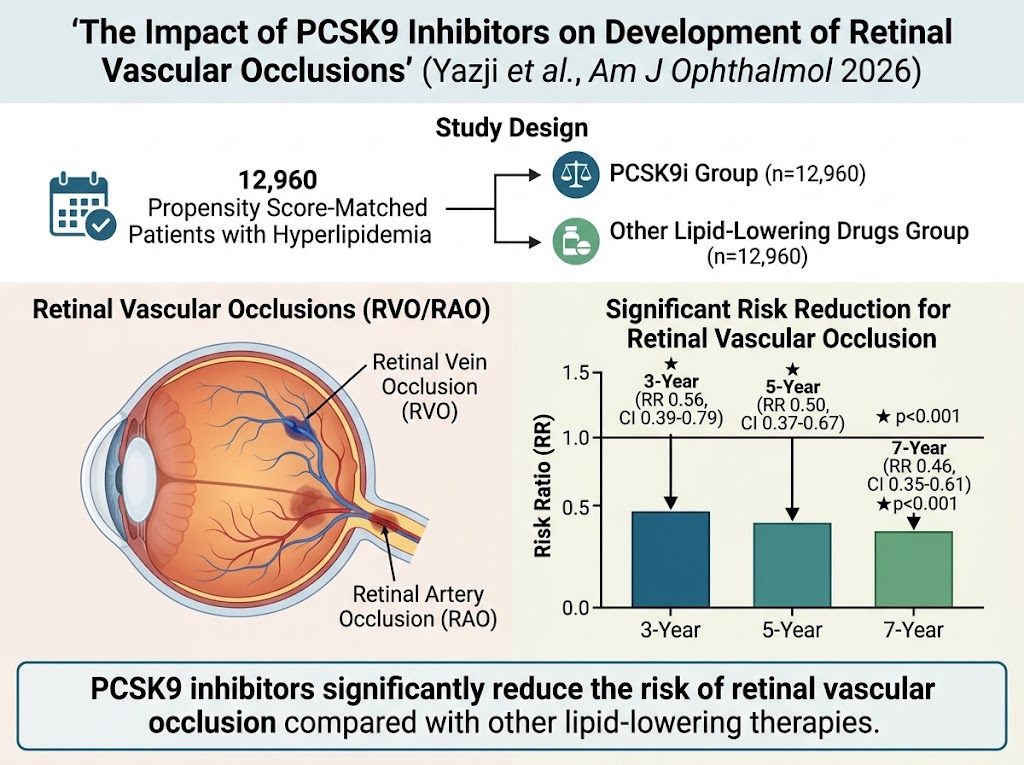
This retrospective cohort study demonstrated that treatment with PCSK9 inhibitors in hyperlipidemic patients significantly lowers the risk of retinal vascular occlusions, including both retinal artery and vein occlusions, over 3-, 5-, and 7-year periods compared to other lipid-lowering agents. The most pronounced risk reductions were observed for retinal vein occlusions (RVO) and central retinal vein occlusions (central RVO), suggesting robust vascular protective effects.

Study Background

MedXY registered readers

Sign in free to continue reading

Create or use your MedXY account to unlock the complete article.

This article was created using several editorial tools, including AI, as part of the process. Human editors reviewed this content before publication.

Related articles

Open language-specific specialty feeds and department pages.

Evaluating PCSK9 Inhibitor Effects on Outcomes in ASCVD Patients Without Prior Ischemic Events: Real-World InsightsThis observational study shows PCSK9 inhibitor monoclonal antibodies significantly reduce ischaemic events and mortality over five years in patients with ASCVD but no prior ischemic events, highlighting their preventive potential in routineAug 17, 2026Evolution and Future Frontiers of PCSK9 Inhibition: From Genetic Discovery to Genomic MedicineThis review synthesizes the trajectory of PCSK9 inhibitors, from pivotal monoclonal antibody trials to emerging RNA interference and gene-editing technologies, emphasizing their role in achieving ultra-low LDL-C levels and reducing major adMar 25, 2026Beyond Statins: The Evolution and Clinical Impact of PCSK9 Inhibition in Cardiovascular Risk ManagementThis article explores the transformation of lipid management through PCSK9 inhibitors. From genetic discovery to landmark cardiovascular outcomes trials, we examine how monoclonal antibodies, RNA interference, and gene editing are redefininMar 21, 2026
Loading comments...
MedXY briefing

Get the free newsletter

Evidence-led clinical news, trends, and analysis—delivered to your inbox.

Ask MedXY AI

Most popular

Intimate Health
Five Benefits for Women Continuing Sexual Activity After Menopause
Intimate Health
Why Some Women Have a Strong Sex Drive—And Why Men Shouldn't Worry About It
Nursing & care
How often should a couple have sex?
Cardiology
Precision Medicine for Long QT Syndrome Type 2: Lumacaftor Corrects Trafficking Defects and Shortens QT Interval
General Surgery
Optimizing Postoperative Opioid Prescriptions After Intra-Abdominal Cancer Surgery: Comparing the 5x-Multiplier and 3-Tier Models
© 2026 MedXY
Contact usAbout usPrivacy PolicyMedXY story
High Lipoprotein(a) Predicts Recurrent ASCVD — Intensified LDL‑Lowering, Especially PCSK9 Inhibitors, May Attenuate Risk
In 273,770 US patients with established ASCVD, rising lipoprotein(a) (nmol/L) was steadily associated with higher risk of recurrent events; the excess risk was partially blunted in those receiving high‑impact LDL‑lowering therapy, most nota
Dec 2, 2025
PCSK9 Inhibition Prevents First Major Cardiovascular Events: VESALIUS‑CV trialIn the VESALIUS‑CV trial, evolocumab reduced first major adverse cardiovascular events by 25% (3‑point MACE) and 19% (4‑point MACE) versus placebo over 4.6 years in patients with atherosclerosis or diabetes and no prior MI or stroke.Nov 9, 2025