We use cookies

Our website uses essential cookies and, with your consent, additional cookies to measure performance and improve our services. Cookie Policy.

You can change your choice at any time.

MMedXYNews
HomeVideos
MedXY AI/MedXY News/Section: Clinical Updates

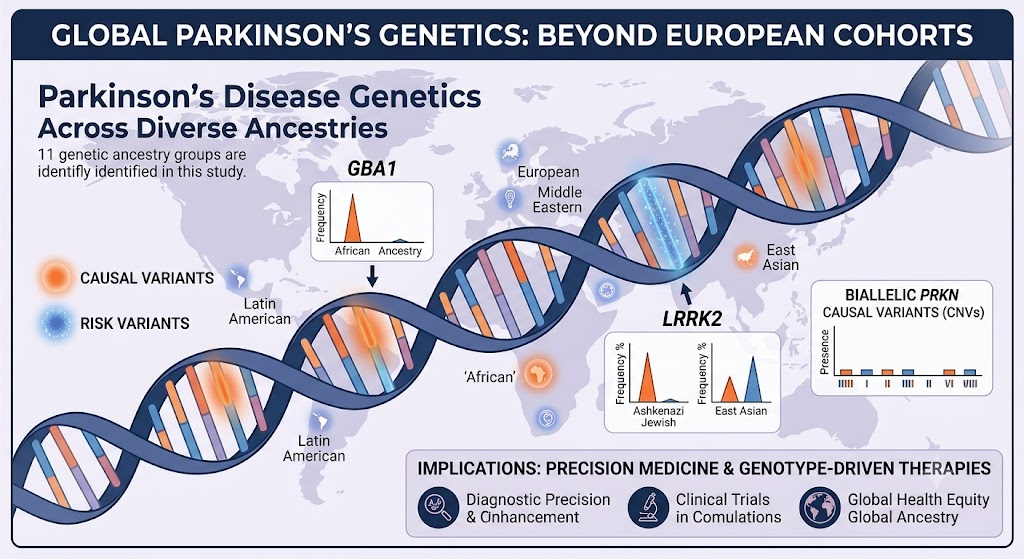
Parkinson’s Disease Genetics Across Diverse Ancestries: An Observational Genetic Study of Causal and Risk Variants with Translational Implications
MedXY Editorial Team•Aug 4, 2026•Clinical Updates
geneticsParkinson's diseaseGBA1LRRK2转化医学multi-ancestry

Highlights

  • Distinct causal and risk genetic variants for Parkinson’s disease exhibit substantial variation across ancestries, with Ashkenazi Jewish and African ancestries showing marked differences in variant frequencies.

  • Risk variants in GBA1 and LRRK2 are prevalent across diverse populations but show ancestry-specific enrichment patterns influencing disease risk and therapeutic targeting.

  • Carriers of biallelic PRKN causal variants, including copy number variants, were detected across most ancestries, underscoring the need to consider structural variants in genetic screening.

  • Expanding genetic studies beyond European cohorts is essential for improving diagnostic precision and equitable development and application of genotype-driven Parkinson’s disease therapies.

Background

MedXY registered readers

Sign in free to continue reading

Create or use your MedXY account to unlock the complete article.

This article was created using several editorial tools, including AI, as part of the process. Human editors reviewed this content before publication.

Related articles

Open language-specific specialty feeds and department pages.

Genetically Mediated LDL Cholesterol Variations and Their Limited Impact on Venous Thromboembolism RiskThis study reveals that lifelong genetic differences in LDL cholesterol levels do not significantly affect the risk of venous thromboembolism (VTE), suggesting LDL-C may not be a major causal factor in VTE development.Sep 25, 2026Reevaluating Levodopa’s Role in Freezing of Gait Among Parkinson’s Disease Patients: Insights from NS-Park and PPMI CohortsAnalysis of two large cohorts reveals no significant association between levodopa use and freezing of gait in Parkinson’s disease after adjusting for disease severity and duration, emphasizing the primary role of disease progression in thisSep 15, 2026Genotype-Dependent Risk and Impact of Atrial Fibrillation in Dilated Cardiomyopathy: Insights from the SHaRe RegistryThis study reveals genotype-specific differences in atrial fibrillation (AF) risk among dilated cardiomyopathy (DCM) patients, highlighting LMNA mutations as a major predictor of incident AF and its association with worse clinical outcomes,Sep 15, 2026
Loading comments...
MedXY briefing

Get the free newsletter

Evidence-led clinical news, trends, and analysis—delivered to your inbox.

Ask MedXY AI

Most popular

Intimate Health
Five Benefits for Women Continuing Sexual Activity After Menopause
Intimate Health
Why Some Women Have a Strong Sex Drive—And Why Men Shouldn't Worry About It
Nursing & care
How often should a couple have sex?
General Surgery
Optimizing Postoperative Opioid Prescriptions After Intra-Abdominal Cancer Surgery: Comparing the 5x-Multiplier and 3-Tier Models
Intimate Health
Classic Intimacy Recommendations: How to Help Women Reach Orgasm and Enjoy Mutual Pleasure
© 2026 MedXY
Contact usAbout usPrivacy PolicyMedXY story
Expanding Horizons in Dilated Cardiomyopathy: A Comprehensive Genetic Reassessment in 2024
The 2024 update of the Clinical Genome Resource elucidates a rapidly expanding genetic landscape for dilated cardiomyopathy, enhancing clinical genetic interpretation with 35 genes classified as high evidence, including nine novel discoveri
Sep 12, 2026
Smoking, Exhaled Carbon Monoxide, and Parkinson’s Disease Risk: Epidemiological Insights and Mechanistic PerspectivesThis review explores evidence linking smoking and exhaled carbon monoxide levels to reduced Parkinson’s disease risk, emphasizing a potential protective role of carbon monoxide, supported by recent large-scale cohort data and biologicSep 12, 2026
Common MC1R Variants and Parkinson Disease ProgressionThis study links MC1R loss-of-function variants to faster motor decline and phenoconversion in Parkinson’s disease, suggesting their value for prognosis and clinical trial design in European descent patients.Sep 12, 2026