We use cookies

Our website uses essential cookies and, with your consent, additional cookies to measure performance and improve our services. Cookie Policy.

You can change your choice at any time.

MMedXYNews
HomeVideos
MedXY AI/MedXY News/Section: news

Optimizing Monitoring in Head and Neck Squamous Cell Carcinoma: Tissue-Informed ctDNA Assay Shows High Accuracy and Feasibility
MedXY Editorial Team•Sep 7, 2026•news
Xét nghiệm sinh thiết lỏngtissue-informed assaycirculating tumor DNAHead and Neck Squamous Cell Carcinoma

Highlight

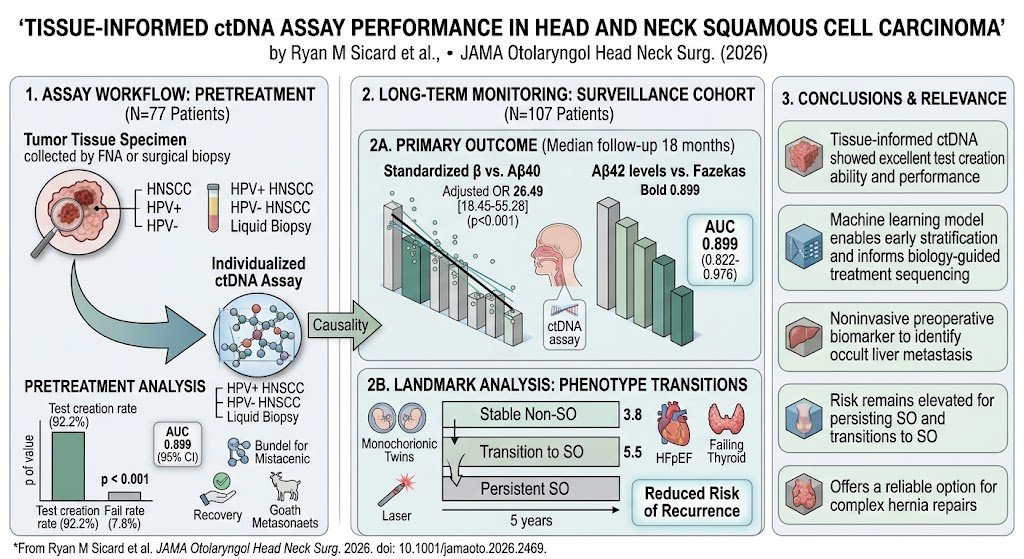
This retrospective cohort study evaluated the performance of a commercially available tissue-informed circulating tumor DNA (ctDNA) assay in patients with head and neck squamous cell carcinoma (HNSCC) across both pretreatment and surveillance contexts. Key findings include: a 92.2% assay creation rate in pretreatment analysis, and in surveillance settings, per-test sensitivity of 95.2%, specificity and positive predictive value (PPV) of 100%, and negative predictive value (NPV) of 99.4%. These metrics were mirrored on a per-patient basis. The assay showed excellent potential for sensitive, specific monitoring of both HPV-positive and HPV-negative HNSCC, particularly overcoming challenges of tissue-agnostic approaches in HPV-negative cases.

Study Background

MedXY registered readers

Sign in free to continue reading

Create or use your MedXY account to unlock the complete article.

This article was created using several editorial tools, including AI, as part of the process. Human editors reviewed this content before publication.

Related articles

Open language-specific specialty feeds and department pages.

Real-World Impact of Post-Treatment Circulating Tumor DNA Monitoring in Large B-Cell Lymphoma Using an Immunoglobulin-Based AssayThis study demonstrates that detection of circulating tumor DNA (ctDNA) after treatment in large B-cell lymphoma predicts progression-free survival, highlighting the clinical utility of a rapid immunoglobulin rearrangement-targeted assay foAug 25, 2026Enhanced Pathologic Response in Head and Neck Squamous Cell Carcinoma with Neoadjuvant ChemoimmunotherapyNeoadjuvant chemoimmunotherapy significantly improves pathologic response rates in resectable head and neck squamous cell carcinoma compared to immunotherapy alone, potentially transforming preoperative treatment strategies.Aug 25, 2026Advancing Early Triple Negative Breast Cancer Care: Tissue-Free Circulating Tumor DNA Assays for Molecular Residual Disease DetectionA recent study comparing tissue-free and tumor-informed ctDNA assays in early triple negative breast cancer reveals comparable accuracy and earlier detection of molecular residual disease, supporting tissue-free approaches for routine cliniAug 17, 2026
Loading comments...
MedXY briefing

Get the free newsletter

Evidence-led clinical news, trends, and analysis—delivered to your inbox.

Ask MedXY AI

Most popular

Intimate Health
Five Benefits for Women Continuing Sexual Activity After Menopause
Intimate Health
Why Some Women Have a Strong Sex Drive—And Why Men Shouldn't Worry About It
Nursing & care
How often should a couple have sex?
Intimate Health
Classic Intimacy Recommendations: How to Help Women Reach Orgasm and Enjoy Mutual Pleasure
Intimate Health
What Makes a Woman "Physiologically Addicted" Is Never Money, But These Two Relationship Qualities
© 2026 MedXY
Contact usAbout usPrivacy PolicyMedXY story
Enhancing Mutation Detection in NSCLC: Evaluating Concurrent EBUS-TBNA and Liquid Biopsy NGS Approaches
This study assesses the diagnostic benefits of concurrent EBUS-TBNA tissue sampling and liquid biopsy for next generation sequencing in NSCLC, highlighting complementary roles and implications for clinical practice.
Jul 24, 2026
Circulating Tumor DNA Status and Adjuvant Chemotherapy in Resected Colorectal Liver MetastasesThis study reveals that circulating tumor DNA (ctDNA) status after colorectal liver metastasis surgery predicts survival outcomes and benefits from adjuvant chemotherapy, guiding personalized treatment.Jul 4, 2026
Long-Term Efficacy and ctDNA Dynamics in Early-Stage ERBB2-Positive Breast Cancer Treated with Neoadjuvant Paclitaxel, Trastuzumab, and Pertuzumab: Insights from the DAPHNe TrialThe DAPHNe trial demonstrates excellent 5-year outcomes for stage II–III ERBB2-positive breast cancer patients treated with an abbreviated neoadjuvant paclitaxel, trastuzumab, and pertuzumab regimen, with ultrasensitive ctDNA monitoring shoJun 28, 2026