Retire 'Negative' Cancer Names Like Triple-Negative Breast Cancer, Oncology Experts Urge
On 22 September 2026, Annals of Oncology, the official journal of the European Society for Medical Oncology (ESMO), published an editorial online arguing that oncology should start retiring “negative” disease names — labels that define a cancer mainly by what it lacks rather than by what drives it. The piece, “What's in a Name? A Call to Retire Negative Nomenclature in Oncology,” is by Subbiah V and Nabhan C, authors affiliated with Stanford and the University of South Carolina.
The authors are not arguing about vocabulary for its own sake. Their claim is technical: molecularly guided treatment has outrun the classification system, so names such as “triple-negative breast cancer” and “non-small cell lung cancer” no longer carry the information a treating team needs. The editorial recommends defining disease entities by biological features, letting names follow the classification rather than replace it, and piloting the change in those two tumour types using hybrid transitional names before any broader standardisation.
An Annals of Oncology editorial published 22 September 2026 calls for oncology to retire “negative” nomenclature that defines tumours by absent markers.
Triple-negative breast cancer and non-small cell lung cancer are proposed as the first pilot examples, using hybrid transitional names.
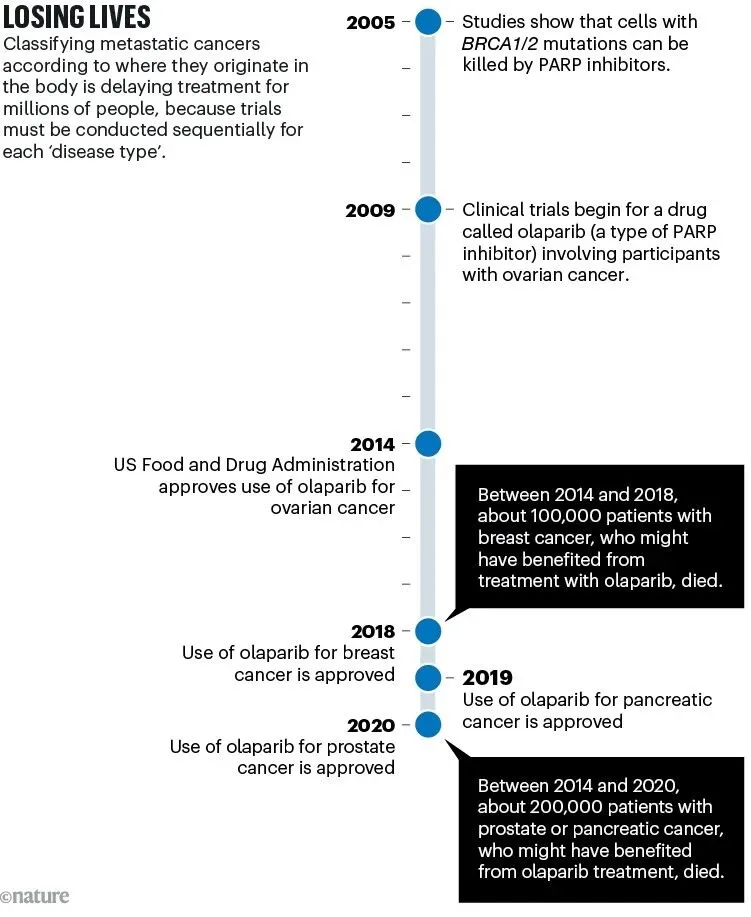
Under one “triple-negative” label sit BRCA1/2-mutant or homologous recombination-deficient tumours, basal-like tumours, TIL-rich/PD-L1-high tumours and a minority of androgen receptor-positive tumours — each pointing to different drugs.
“HER2-negative” is already being split into low and ultralow expression, subgroups that may benefit from newer antibody-drug conjugates.
The editorial is a classification proposal, not a new treatment guideline; existing names will remain in clinical, pathology and regulatory use.
Why “negative” names blur treatment information
The editorial's core example is triple-negative breast cancer (TNBC), defined as tumours negative for oestrogen receptor, progesterone receptor and HER2 — in the source material, typically ER/PR expression below 1% with HER2 negative — accounting for roughly 15% to 20% of breast cancers. That single name, however, covers biologically distinct groups.
Triple-negative breast cancer is not one disease
Within the same diagnostic label, some tumours carry germline or somatic BRCA1/2 mutations with homologous recombination deficiency, a setting in which PARP inhibitors or platinum agents may be considered. Others show basal-like gene expression. Others are rich in tumour-infiltrating lymphocytes with high PD-L1 expression, a context in which immune checkpoint inhibitors may be evaluated. A smaller subset is androgen receptor-positive, pointing in a different classification direction.
The practical consequence, according to the editorial's argument, is that a report saying only “triple-negative” forces clinicians to order additional BRCA, HRD, PD-L1 and TIL testing, and leaves patients without an intuitive explanation of why the same disease name leads to different drugs.
“HER2-negative” is already splitting
HER2 classification is also moving past a simple positive/negative binary. In advanced breast cancer, HER2-low is defined as immunohistochemistry 1+, or 2+ with negative in situ hybridisation; HER2-ultralow is defined as IHC 0 with incomplete, faint membrane staining in 10% or fewer tumour cells. The source bundle attributes to a domestic consensus an estimate that roughly 45% to 55% of breast cancers are HER2-low and 10% to 20% HER2-ultralow, and notes that some patients with HER2-low or ultralow advanced disease may benefit from newer antibody-drug conjugates. In other words, “HER2-negative” is itself a container that still needs opening.
Non-small cell lung cancer: a diagnosis by exclusion
Non-small cell lung cancer (NSCLC) is the sharper illustration. The category was originally defined by excluding small cell carcinoma, yet treatment is now chosen according to EGFR mutations, ALK and ROS1 rearrangements, MET exon 14 skipping, KRAS G12C, RET fusions, NTRK fusions, HER2 mutations and PD-L1 expression. Reporting only “non-small cell,” the editorial argues, omits precisely the information that determines which therapy a patient receives.
What the editorial proposes
The authors recommend that disease entities be defined by biological features, with names derived from the classification rather than substituting for it. They single out triple-negative breast cancer and non-small cell lung cancer as pilot areas, favouring hybrid transitional names first and standardisation later. In clinical terms, the source material reduces this to three practical moves.
Reporting format: main histological type plus molecular labels, for example “triple-negative breast cancer, BRCA1-mutant/homologous recombination-deficient” or “triple-negative breast cancer, TIL-rich/PD-L1 CPS ≥10”; and “NSCLC, EGFR exon 19 deletion,” “NSCLC, ALK fusion” or “NSCLC, PD-L1 TPS ≥50%.”
Advanced triple-negative breast cancer: assess BRCA1/2, HRD, PD-L1 and TILs, with NGS where indicated; at recurrence or metastasis, prioritise retesting of primary or metastatic tissue because receptor status can change.
Advanced NSCLC: routinely assess EGFR, ALK, ROS1, MET, KRAS, RET, NTRK and HER2, plus PD-L1; liquid biopsy may supplement when tissue is insufficient but does not unconditionally replace tissue testing.
Tissue-agnostic therapy: reserved for clear markers — MSI-H/dMMR tumours may be considered for pembrolizumab, and NTRK fusions for larotrectinib or entrectinib — and not extrapolated proportionally across all cancers.
Governance: naming reform requires societies, the WHO/IARC classification project, pathology and oncology societies, regulators, diagnostic companies and patient organisations to build standards before changing reports, trial enrolment and guidelines.
1. Report a main type plus molecular labels
The editorial's first practical recommendation is a reporting convention: keep the established histological name, then append the molecular descriptor that drives the decision. A reader — clinician or patient — can then see why a PARP inhibitor, an immune checkpoint inhibitor, a targeted tyrosine kinase inhibitor or chemotherapy is being proposed, rather than inferring it from a vague category.
2. Test for treatment decisions, not to justify a rename
The second move is to let the therapeutic question determine the panel. In advanced triple-negative disease that means BRCA1/2, HRD, PD-L1 and TIL assessment, with broader sequencing where warranted; in advanced NSCLC it means the driver-gene panel plus PD-L1. The editorial also stresses retesting at recurrence, because receptor and marker status can shift between the primary tumour and a metastasis, and it is explicit that tissue-agnostic indications apply only to well-defined markers rather than being generalised across tumour types.
3. Explain the regimen by molecular cause
The third move is communication. Saying “because your tumour has a BRCA defect, we are using a PARP inhibitor” is more actionable than “because it is triple-negative, we are using this drug.” The same applies in lung cancer: “because there is an EGFR mutation, we are using an EGFR-TKI” carries more information than “because it is non-small cell.”
What this is — and what it is not
It is important to be precise about the status of this material. This is an editorial and a classification initiative. It is not a new treatment guideline, and it does not report new trial data or new efficacy or safety results. Current names — triple-negative breast cancer, non-small cell lung cancer, HER2-negative — will continue to be used in clinical practice, pathology reporting and regulatory documents for the foreseeable future.
The realistic path the editorial sketches is not immediate renaming. It is to append molecular labels to existing histological names so that “what it is called” and “how it is treated” move into alignment. For patients, the bundle's practical takeaway is a question to raise at a consultation: have my ER/PR/HER2 status, BRCA/HRD status, PD-L1 and driver genes been tested?
MedXY analyst view: adoption is the hard part
Interpretation, not source fact. The clinical logic of the editorial is difficult to dispute: a diagnostic label that does not distinguish BRCA-mutant from basal-like from PD-L1-high disease cannot carry treatment meaning. The harder problem is operational.
First, nomenclature is embedded in infrastructure, not only in prose. Pathology report templates, structured data fields, electronic health records, tumour registries, coding systems, clinical trial eligibility criteria, companion-diagnostic labels and payer policies all reference the legacy terms. Hybrid labels can be adopted quickly in narrative reports and much more slowly in the systems that govern trial entry and reimbursement.
Second, molecular labels depend on testing capacity, turnaround time, tissue adequacy and reimbursement. A nomenclature that assumes broad sequencing availability risks deepening inequity between centres that can profile tumours comprehensively and those that cannot — an implementation risk the editorial's governance list implicitly acknowledges.
Third, there is a trade-off between precision and usability. Long composite labels can be accurate and unwieldy; registries and coding systems will need rules for what goes in which field, and clinicians will need shorthand that does not reintroduce ambiguity. The sensible sequence, consistent with the editorial's own framing, is standards first, then reporting, then trial enrolment and guidelines — not the reverse.
What the editorial signals for the wider field is that oncology's classification debate has shifted from whether molecular features matter to how the formal vocabulary should absorb them. If pilot hybrid naming in breast and lung cancer is taken up by professional societies and the WHO/IARC classification project, molecularly annotated reporting could become a reporting norm rather than an enthusiast's preference. If it is not, the gap between what pathology reports say and what oncologists need to know will keep being closed informally, test by test, patient by patient.
What to watch
Whether pathology and oncology societies formally adopt main-type-plus-molecular-label reporting conventions.
Whether any hybrid transitional naming appears in the WHO/IARC classification process, as the editorial proposes.
How tumour registries, coding systems and trial eligibility definitions absorb molecular descriptors.
Whether comprehensive profiling is reimbursed widely enough that molecular names describe routine practice rather than selected centres.
Whether regulators and diagnostic companies align companion-diagnostic labelling with the new descriptors.
References
Subbiah V, Nabhan C. What's in a Name? A Call to Retire Negative Nomenclature in Oncology. Annals of Oncology. Published online 22 September 2026. DOI: 10.1016/j.annonc.2026.09.007. PMID: 42772679.
Source bundle: secondary-language summary of the above editorial, including cited domestic consensus estimates for triple-negative, HER2-low and HER2-ultralow breast cancer proportions.
This article was created using several editorial tools, including AI, as part of the process. Human editors reviewed this content before publication.