Highlight
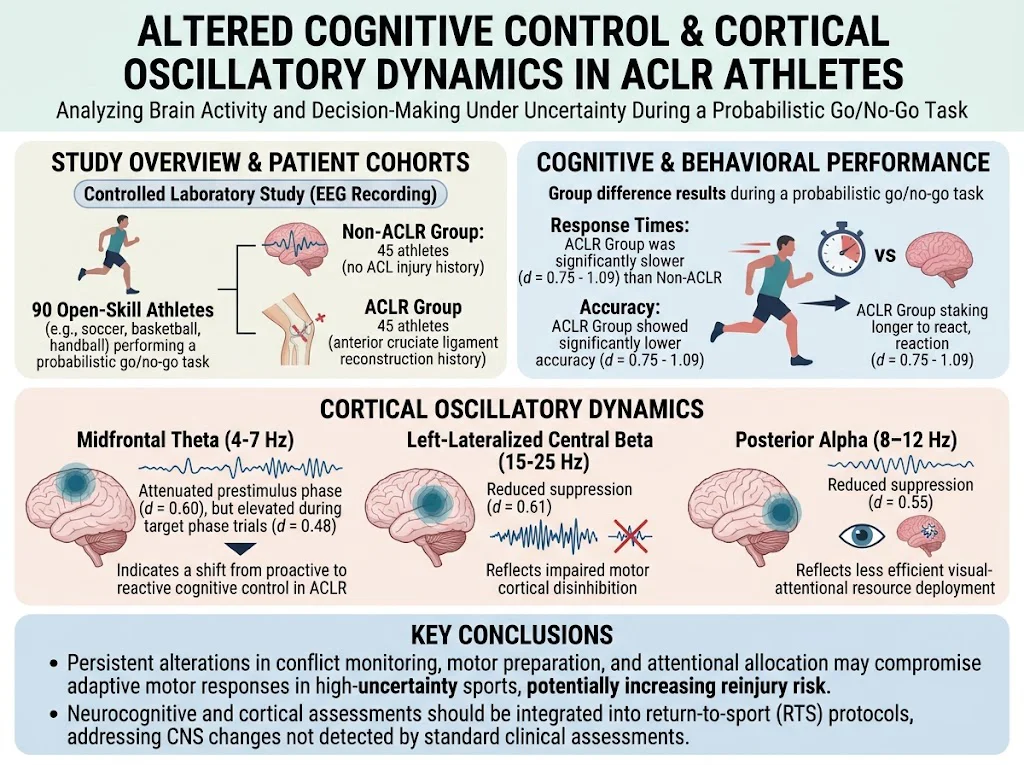
Athletes with anterior cruciate ligament reconstruction (ACLR) demonstrate slower response times and reduced accuracy during probabilistic decision-making tasks compared to non-injured peers.
Altered cortical oscillatory activity includes diminished midfrontal theta during the prestimulus phase and increased theta responses during task execution, indicating a shift from proactive to reactive cognitive control.
Reduced suppression of left-lateralized central beta and posterior alpha oscillations in ACLR athletes reflects impaired motor preparation and visual-attentional resource allocation, particularly under uncertainty.
These persistent neurocognitive changes suggest integrating CNS function assessment into return-to-sport protocols to mitigate reinjury risks.
Study Background
Anterior cruciate ligament (ACL) tears are among the most common and debilitating sports injuries, often requiring surgical reconstruction and prolonged rehabilitation. Beyond mechanical joint instability, emerging evidence indicates that ACL injury induces neuroplastic changes within the central nervous system (CNS) that persist post-reconstruction. These alterations may affect cognitive control processes critical for sensorimotor integration and adaptive decision-making in dynamic, uncertain sports environments. Despite functional recovery of the knee, athletes post-ACL reconstruction (ACLR) may exhibit subtle yet impactful deficits in cortical processing, which standard physical assessments may fail to detect. Understanding how ACLR affects neurocognitive function during decision-making under uncertainty is essential, as impaired cognitive-motor integration could elevate the risk for reinjury and affect performance.
Study Design
This controlled laboratory study enrolled 90 open-skill athletes—participants engaged in sports requiring dynamic responses to unpredictable stimuli, such as soccer, basketball, or handball. The cohort was divided equally: 45 athletes with a history of ACL reconstruction and 45 age-, sex-, and sport-matched control athletes without ACL injury history.
Participants performed a probabilistic go/no-go task designed to induce decision-making under uncertainty while undergoing electroencephalographic (EEG) recording. This task required participants to respond to ‘go’ stimuli with a motor action and to inhibit responses to ‘no-go’ stimuli, with uncertain probabilistic cues incorporated to simulate real-world decision demands.
The neurophysiological analysis focused on time-frequency EEG dynamics of three cortical oscillatory bands: midfrontal theta (4–7 Hz), associated with conflict monitoring and cognitive control; left-lateralized central beta (15–25 Hz), linked with motor cortical disinhibition and preparation; and posterior alpha (8–12 Hz), reflecting visual-attentional resource allocation.
Using linear mixed-effects models, the study compared behavioral performance measures and cortical oscillatory power between groups across prestimulus and target stimulus phases, with effect sizes calculated to reflect magnitude of differences.
Key Findings
Behavioral Performance: Athletes with ACLR demonstrated significantly slower response times and reduced accuracy compared to controls (effect sizes d=0.75–1.09), evidencing impaired processing speed and response inhibition under uncertainty.
Cortical Oscillatory Dynamics:
Midfrontal Theta Power: During the prestimulus window (anticipatory phase), ACLR athletes exhibited attenuated theta power (d=0.60), indicating reduced proactive cognitive control. Conversely, during target stimulus processing (reactive phase), these athletes showed elevated midfrontal theta (d=0.48), suggesting a compensatory shift towards reactive control mechanisms.
Central Beta Suppression: Reduced suppression of left-lateralized central beta oscillations (d=0.61) was observed in ACLR athletes, consistent with impaired motor cortical disinhibition and delayed motor preparation necessary for efficient response execution.
Posterior Alpha Suppression: ACLR athletes showed diminished posterior alpha suppression (d=0.55), particularly in high uncertainty task conditions, reflecting less efficient allocation of visual-attentional resources critical for stimulus discrimination and decision accuracy.
The combined neural profile indicates persistent disruption of neurocognitive processes underlying conflict monitoring, motor readiness, and attentional deployment during decision-making under uncertainty, despite clinical knee recovery.
Expert Commentary
The results underscore the significance of CNS alterations following ACL injury and reconstruction, reinforcing that rehabilitation should extend beyond musculoskeletal healing to include cognitive and neurophysiological domains. The observed shift from proactive to reactive control may lead to delayed motor responses in dynamic sporting contexts, potentially elevating reinjury risk. This aligns with current literature revealing sensorimotor integration deficits and altered brain activation patterns post-ACLR.
Methodological strengths include the use of a well-matched athletic cohort and rigorous EEG time-frequency analysis providing mechanistic insight beyond traditional behavioral assessments. Limitations include the cross-sectional design precluding causal inference, and the absence of long-term reinjury follow-up correlations.
Future research should explore longitudinal changes from injury through rehabilitation and develop targeted neurocognitive training interventions to restore optimal cortical dynamics.
Conclusion
This study provides compelling evidence that athletes with ACL reconstruction exhibit persistent neurocognitive deficits during uncertain decision-making tasks, characterized by altered cortical oscillatory activities implicating compromised cognitive control, motor preparation, and attention. These findings highlight the limitations of current return-to-sport evaluations that traditionally focus on physical metrics alone.
Incorporation of neurocognitive assessments assessing cortical oscillatory dynamics into rehabilitation programs and return-to-sport protocols could better identify athletes at risk of reinjury and guide personalized interventions. Addressing these CNS alterations may facilitate more comprehensive recovery, enhancing safe athletic performance in environments demanding rapid, adaptive decision-making under uncertainty.
References
Jiménez-Martínez J, Gutiérrez-Capote A, Alarcón-López F, Cárdenas-Vélez D. Altered Cognitive Control and Cortical Oscillatory Dynamics in Athletes With ACL Reconstruction During Decision-Making Under Uncertainty. Am J Sports Med. 2026 Nov 3:3635465261494772. doi: 10.1177/03635465261494772. Epub ahead of print. PMID: 42975142.