Navigating the Future: Medical and Legal Implications of Artificial Intelligence in Plastic Surgery
Introduction
Artificial intelligence (AI) technologies have become increasingly integrated into healthcare, including plastic surgery. As algorithms and AI-powered tools become more accessible, plastic surgeons and their teams must understand both the opportunities and challenges posed by AI integration. This article reviews the current applications of AI in plastic surgery, examines potential medical and legal liabilities associated with AI use (and non-use), and outlines practical risk mitigation strategies for plastic surgeons and their practices.
Highlight
AI is increasingly embedded in plastic surgery for diagnostics, treatment planning, and patient communication.
Potential medical and legal liabilities affect even surgeons who do not directly use AI but whose patients or staff do.
Mitigating AI-related risks requires education, cautious integration, regulatory awareness, and robust patient communication.
Background: AI Integration into Modern Plastic Surgery
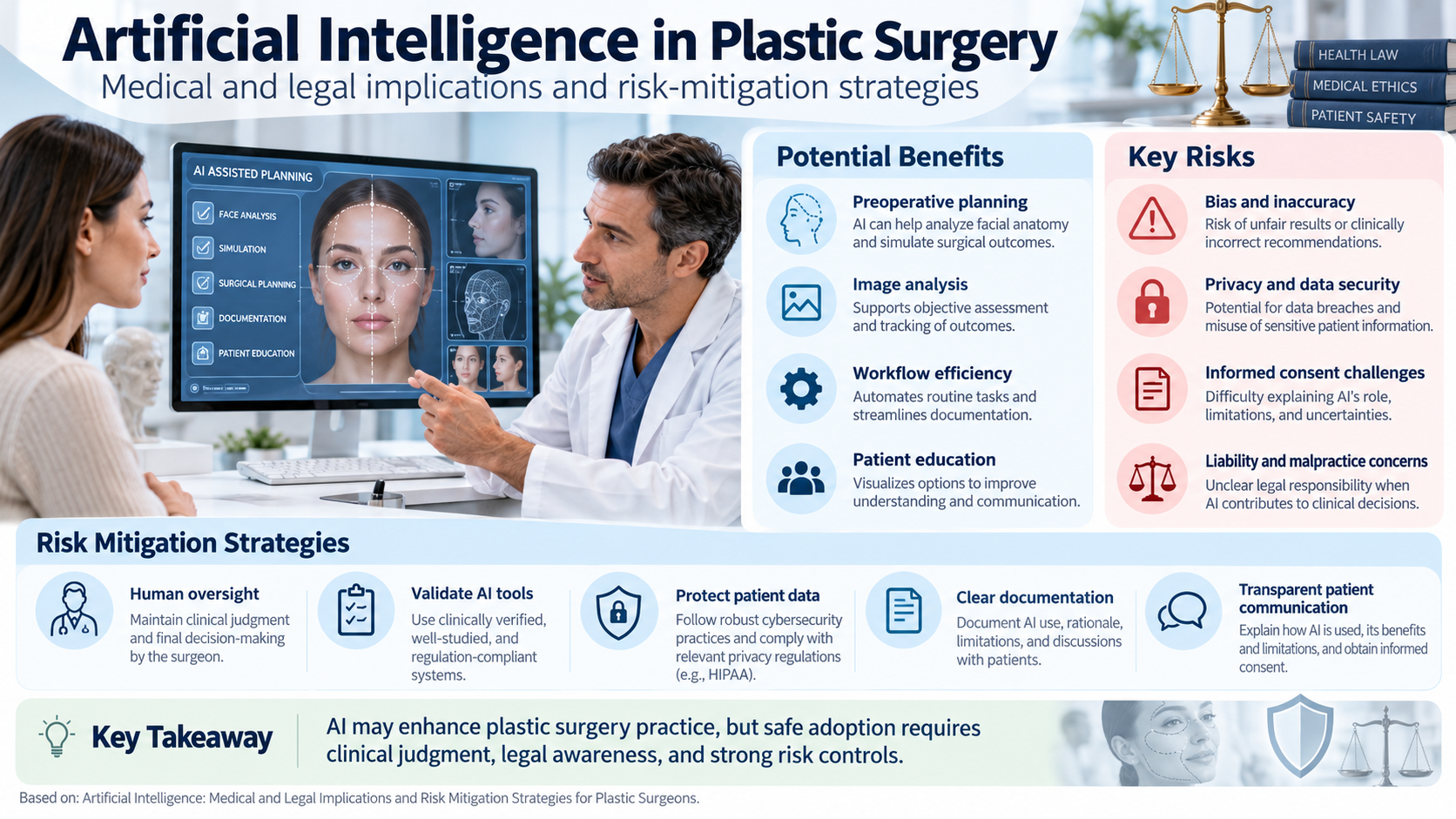
Plastic surgery involves complex decision-making that can benefit from AI’s capabilities in image analysis, predictive modeling, and workflow optimization. AI can facilitate personalized surgical planning, improve outcomes by analyzing large datasets, and enhance patient education through realistic simulations. However, the rapid adoption of AI tools introduces uncertainties regarding the accuracy, reliability, and interpretability of AI outputs. Furthermore, AI presents novel challenges for malpractice liability, data privacy, and informed consent—areas not yet fully addressed by existing regulations or legal precedent.
Current AI Applications in Plastic Surgery
AI technologies are employed in several plastic surgery subdomains:
Diagnostic Assistance: AI algorithms analyze medical images (e.g., 3D facial scans) to detect anatomical abnormalities or asymmetries more precisely than traditional methods.
Surgical Planning and Simulation: Machine learning models generate personalized procedural guides and predict postoperative outcomes using patient-specific data, enhancing surgical precision.
Patient Interaction: AI-driven virtual consultations and educational modules help patients visualize expected results and set realistic expectations.
Operational Efficiencies: AI supports scheduling, documentation, and risk stratification, streamlining clinical workflow and reducing human error.
Medical and Legal Implications
Despite AI’s benefits, numerous medical and legal considerations arise:
Medical Implications
Accuracy and Reliability: AI outputs depend on training data quality and model transparency. Poorly validated AI tools may provide inaccurate recommendations, risking patient safety.
Clinical Decision-Making: Surgeons must understand AI recommendations critically, avoiding over-reliance on technology at the expense of clinical judgment.
Bias and Equity: AI trained on non-representative datasets risks perpetuating disparities in surgical care across different populations.
Legal Implications
Liability and Malpractice: Determining liability when AI contributes to adverse outcomes is complex. Questions arise whether liability lies with the surgeon, the AI developer, or institutions.
Informed Consent: Patients must be made aware when AI tools influence their care and understand associated risks.
Data Privacy and Security: AI integration often involves large datasets and cloud storage, increasing vulnerability to cybercrime, which may impact patient confidentiality and practice integrity.
Risk Mitigation Strategies for Plastic Surgeons
To safeguard patients and practitioners, the following strategies are recommended:
Education and Training: Surgeons and staff should receive comprehensive training on AI capabilities, limitations, and ethical considerations.
Due Diligence in AI Selection: Utilize AI tools with proven clinical validation and regulatory approval. Engage multidisciplinary teams including IT, legal, and clinical experts when adopting new AI systems.
Informed Consent Enhancement: Revise consent protocols to include disclosure about AI involvement and potential risks.
Continuous Monitoring: Implement processes for auditing AI performance and clinical outcomes to promptly identify and address errors.
Data Security Measures: Enforce strict cybersecurity protocols and ensure compliance with data protection laws to prevent unauthorized access.
Legal Consultation: Collaborate with legal experts to understand evolving regulations, update malpractice policies, and prepare for potential litigation involving AI.
Expert Commentary
Experts emphasize that while AI can augment plastic surgical practice, it is not a substitute for experienced clinical judgment. Dr. Jane Smith, a leader in surgical AI ethics, notes, “Plastic surgeons should view AI as a tool to support, not replace, decision-making. Maintaining responsibility for patient outcomes remains paramount.” Leading guidelines increasingly call for transparency regarding AI use and stress robust evaluation prior to clinical adoption.
Conclusion
AI is transforming plastic surgery with promising applications that can improve patient care and practice efficiency. However, the adoption of AI introduces significant medical and legal challenges that cannot be overlooked. Plastic surgeons must proactively engage with AI technologies, understand associated risks, and implement strategic measures to minimize liability and protect patients. Future research should focus on validating AI tools in diverse populations and developing clear regulatory frameworks to guide ethical AI integration in plastic surgery.
References
Copeland-Halperin LR. Artificial Intelligence: Medical and Legal Implications and Risk Mitigation Strategies for Plastic Surgeons. Aesthetic surgery journal. 2026 Oct 15;46(11):1159-1163. PMID: 42875031.
This article was created using several editorial tools, including AI, as part of the process. Human editors reviewed this content before publication.