Mid- to Long-term Clinical Outcomes of B-Lite Lightweight Breast Implants in Primary Augmentation: A Prospective Multicenter Study
Highlight
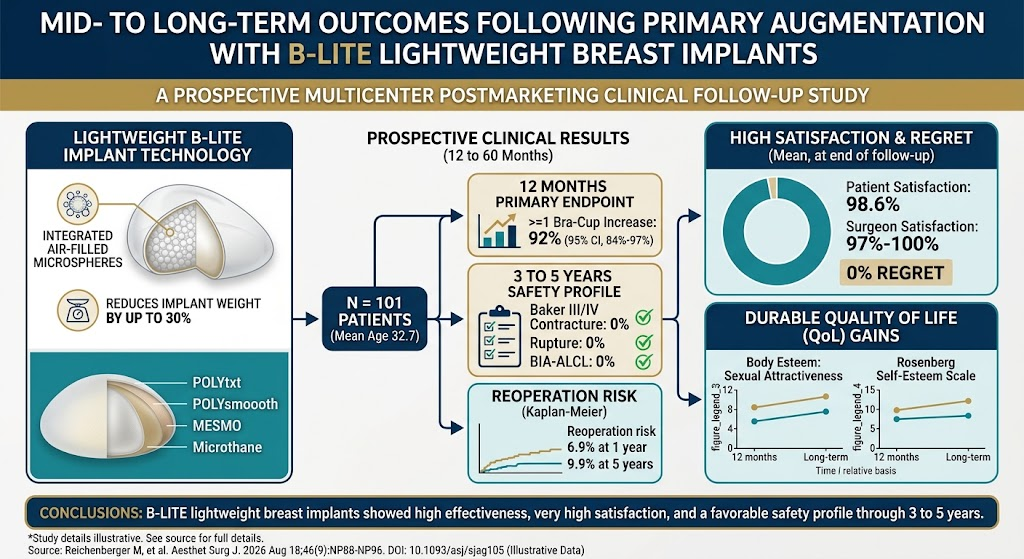
– B-Lite lightweight breast implants reduce implant weight by approximately 30% while maintaining volume and mechanical integrity.
– In a prospective multicenter study, 92% of patients achieved at least a one-bra-cup size increase at 12 months.
– No cases of Baker grade III or IV capsular contracture, implant rupture, or BIA-ALCL occurred during follow-up of up to 5 years.
– Patient satisfaction was exceptionally high (98.6%) with 0% regret, supported by stable quality of life improvements.
Study Background
Breast augmentation remains one of the most commonly performed aesthetic surgical procedures worldwide. However, concerns about complications linked to implant weight, such as implant displacement, capsular contracture, and patient discomfort, persist. Traditional silicone gel implants can contribute to mechanical strain on breast tissues due to their weight, potentially impacting long-term outcomes and satisfaction.
The development of the B-Lite lightweight breast implant, incorporating air-filled microspheres within the silicone gel, aims to reduce the implant’s weight by nearly 30% without compromising its shape, volume, or mechanical properties. This innovation intends to mitigate weight-related complications while preserving aesthetic results.
Despite promising technical characteristics, long-term prospective clinical data assessing safety, efficacy, patient satisfaction, and quality of life (QoL) following primary breast augmentation with B-Lite implants have been limited. This study sought to fill this evidence gap.
Study Design
This was a multicenter, prospective, single-arm postmarketing clinical follow-up (PMCF) study sponsored by the implant manufacturer, enrolling 101 genetically female patients aged 18 to 60 years undergoing bilateral primary breast augmentation.
Implants were B-Lite lightweight silicone gel devices available in various shapes (round or anatomical) and surface textures (POLYsmoooth, POLYtxt, MESMO, Microthane) with volumes ranging from 200 to 755 cc. All implants were inserted via inframammary incisions using a standardized surgical technique to reduce procedural variability.
The primary efficacy endpoint was defined as achieving at least a one-bra-cup size increase at 12 months post-augmentation. Secondary endpoints included patient-reported outcomes on satisfaction and quality of life, measured through validated tools such as the Body Esteem Scale, Rosenberg Self-Esteem Scale, the shortened Tennessee Self-Concept Scale, and RAND SF-36 health survey. Safety assessments focused on adverse events (AEs), notably capsular contracture of Baker grade III or IV severity, implant rupture, breast implant-associated anaplastic large cell lymphoma (BIA-ALCL), and reoperation rates.
Key Findings
Efficacy: At 12 months follow-up, 92% (95% confidence interval [CI], 84%–97%) of patients attained the primary endpoint of one or more bra-cup size increase. This indicates effective volume restoration and patient-perceived breast enhancement consistent with surgical goals.
Safety: Notably, there were no reported cases of Baker grade III-IV capsular contracture or implant rupture during the study duration, suggesting a favorable biocompatibility and mechanical integrity profile for B-Lite implants. Additionally, no occurrences of BIA-ALCL were observed. The most frequently reported adverse event was transient sensory alteration (8.9%), predominantly resolving without intervention. Other adverse events were infrequent and largely related to the surgical procedure rather than the implant itself.
Reoperation Rates: Kaplan-Meier analysis demonstrated cumulative reoperation risks of 6.9% at 1 year and 9.9% at 5 years, which are within or below rates reported in literature for traditional implants, underscoring a durable clinical outcome.
Patient and Surgeon Satisfaction: Patients reported an impressive average satisfaction rate of 98.6% with no recorded regrets concerning the procedure or implant choice. Surgeons similarly rated satisfaction highly, ranging from 97% to 100%, reflecting concordance between clinical assessment and patient experience.
Quality of Life: Measures from the Body Esteem Scale demonstrated sustained improvements in sexual attractiveness perception, while the Rosenberg Self-Esteem Scale also showed notable durability in self-esteem enhancements. RAND SF-36 composite scores remained stable, suggesting no detrimental impact on general health-related quality of life.
Expert Commentary
This study provides well-structured prospective evidence supporting the clinical utility of lightweight B-Lite implants in primary breast augmentation. The reduction in implant weight is a biologically plausible intervention to reduce mechanical stress on breast tissue, potentially explaining the absence of significant capsular contracture and implant-related complications reported here.
The very low incidence of serious adverse events, stable QoL measures, and high satisfaction from both patients and surgeons highlight a significant advance in implant technology with positive translational potential.
Nonetheless, limitations include the single-arm, non-randomized design without a contemporary control group using standard implants, which may limit direct comparative inference. Although the study is multicenter and prospective with moderate sample size and a follow-up extending up to 5 years, longer-term data would further clarify durability and late-emerging complications.
Comparisons with similar postmarketing data on conventional silicone implants suggest that B-Lite implants may offer diminished mechanical-related complications, but head-to-head randomized controlled trials would strengthen this evidence base.
Conclusion
The findings from this prospective multicenter postmarketing study confirm that B-Lite lightweight breast implants are an effective and safe option for primary breast augmentation, delivering reliable volume enhancement and substantial satisfaction over a mid- to long-term horizon (up to 5 years). Their favorable safety profile coupled with stable quality of life improvements supports their clinical adoption as a potential innovation in implant technology addressing implant weight-related issues.
Future research should focus on comparative effectiveness trials, long-term surveillance for rare complications such as BIA-ALCL, and mechanistic studies to better understand how reduced implant weight influences tissue remodeling and patient outcomes.
Funding and Registration
This postmarketing study was sponsored by the implant manufacturer. Clinical trial registration details were not provided in the abstract. The study has been published in the Aesthetic Surgery Journal (2026;46(9):NP88-NP96).
References
1. Reichenberger M, Hedén P, Germann G. Mid- to Long-term Outcomes Following Primary Augmentation With B-Lite Lightweight Breast Implants: A Prospective Multicenter Postmarketing Clinical Follow-up Study. Aesthet Surg J. 2026;46(9):NP88-NP96. PMID: 42517198.
2. Mofid MM, Sajjadian A. Capsular contracture and biofilm: the challenge continues. Aesthet Surg J. 2013;33(5):749-751.
3. Hall-Findlay EJ. Breast implant illness: a review of the literature. Plast Reconstr Surg Glob Open. 2021;9(2):e3439.
4. RAND Corporation. RAND 36-Item Health Survey 1.0 (SF-36). Available from: https://www.rand.org/health-care/surveys_tools/mos/36-item-short-form.html (accessed 2026).
This article was created using several editorial tools, including AI, as part of the process. Human editors reviewed this content before publication.