Inpatient Care Can Retraumatize Patients with Medical Trauma
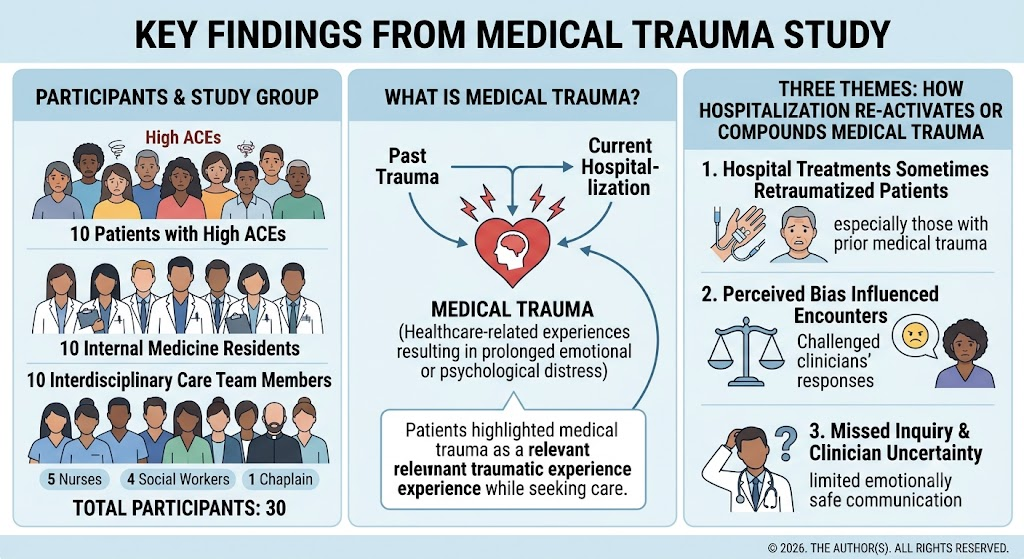
Medical trauma—healthcare experiences that result in prolonged emotional or psychological distress—can be reactivated or compounded during inpatient stays, particularly for patients with a history of trauma. A new qualitative study from a U.S. academic medical center explores how recently hospitalized adults, internal medicine residents, and interdisciplinary care team members perceive safety, trust, and distress in the general medicine ward.
Medical trauma is often reinforced through routine inpatient care.
Three core themes: retraumatization from treatments, perceived bias affecting encounters, and missed inquiry about prior trauma.
Embedding trauma-informed strategies—screening, bias review, communication—may help reduce distress and build trust.
Study Overview | |
Design | Qualitative study with semi-structured interviews and focus groups |
|---|---|
Setting | Urban academic internal medicine inpatient service |
Participants | 10 recently hospitalized patients (all with high ACEs), 10 internal medicine residents, 10 interdisciplinary team members (5 nurses, 4 social workers, 1 chaplain) |
Primary Method | Quasi-inductive descriptive analysis of transcripts |
Main Findings | Three themes: hospital treatments can retraumatize; perceived bias shapes encounters; missed inquiry and clinician uncertainty limit trauma-informed communication |
Why This Study Matters
Trauma is increasingly recognized as a determinant of health, but its impact on adult inpatient experiences is underexplored. Patients with prior trauma—especially those with high adverse childhood experiences (ACEs)—may be vulnerable to distress during hospitalization. Understanding how medical trauma manifests on general medicine services is a critical step toward delivering truly patient-centered, trauma-informed care.
How the Study Was Conducted
Investigators at the University of Chicago conducted a qualitative study involving three groups: recently hospitalized adults who screened high on the Philadelphia ACEs survey, internal medicine residents, and interdisciplinary care team members (nurses, social workers, and a chaplain). Patients completed semi-structured interviews about their recent hospitalization, focusing on distress, safety, and trust. Residents and team members participated in separate focus groups about caring for patients with trauma histories. All transcripts were analyzed using a quasi-inductive descriptive approach to identify recurring themes.
What the Researchers Found
Three overarching themes emerged from the patient and clinician narratives:
Hospital treatments sometimes retraumatized patients, especially those with prior medical trauma. Routine procedures, physical examinations, and even interactions with staff could evoke feelings of powerlessness and fear, echoing earlier traumatic healthcare experiences.
Perceived bias influenced encounters for patients and challenged clinicians' responses. Patients reported that perceived discrimination—related to race, socioeconomic status, or other factors—added to their distress, while clinicians acknowledged difficulty addressing bias in the moment.
Missed inquiry about prior medical trauma and clinicians' uncertainty about broaching it limited emotionally safe communication. Patients wanted their trauma history acknowledged but rarely were asked. Clinicians expressed discomfort initiating these conversations without training or clear protocols.
These themes underscore how standard inpatient care can inadvertently re-activate or compound existing medical trauma, eroding trust and safety.
What the Findings May Mean
The results suggest that medical trauma is not merely a historical note but an active force that can be reinforced by the very care meant to heal. Patients described how simple acts—like being touched without explanation or feeling dismissed—triggered intense distress. For clinicians, the findings highlight a gap between awareness and practice: they recognize trauma's importance but lack structured tools to address it.
Strengths and Limitations
Strengths include the multi-perspective design (patients, residents, and interdisciplinary team) and the focus on a vulnerable patient group with high ACEs. However, the study is limited by its small sample size, single institution setting, and restriction to patients with high ACEs, which may not represent all inpatient experiences. As a qualitative study, it generates hypotheses and rich description but cannot establish causation or prevalence.
Implications for Practice and Research
The authors recommend several trauma-informed strategies: routine screening for prior trauma, systematic review of clinical documentation to reduce biased language, and training clinicians in trauma-informed communication. Future research should test whether such interventions reduce patient distress and improve trust across diverse inpatient settings.
Funding, Disclosures, and Registration
Not reported in the abstract. The study was conducted at the University of Chicago.
References
Singh R, Mokhtar IB, Chakraborty Y, et al. Medical Trauma on the Inpatient Medicine Service: Perspectives of Recently Hospitalized Patients, Residents, and the Interdisciplinary Care Team. Journal of General Internal Medicine. 2026 Jul 16. PMID: 42463626.
This article was created using several editorial tools, including AI, as part of the process. Human editors reviewed this content before publication.