Highlights
Lonvoguran ziclumeran (lonvo-z) is the first in vivo CRISPR gene-editing therapy demonstrating robust clinical efficacy in hereditary angioedema (HAE) due to C1 inhibitor deficiency.
A single intravenous infusion of lonvo-z significantly lowered monthly HAE attack rates by 87% compared to placebo in a phase 3 randomized trial.
Lonvo-z displayed a manageable safety profile with mostly mild-to-moderate infusion-related adverse events and no serious or grade 3+ toxicities.
Complementary CRISPR therapies targeting kallikrein B1 (KLKB1), such as NTLA-2002, show congruent reductions in attack frequency and kallikrein protein levels, supporting gene-editing as a disease-modifying strategy.
Background
Hereditary angioedema (HAE) is a rare autosomal dominant disorder characterized by recurrent, self-limited episodes of subcutaneous and submucosal edema. Most cases arise from mutations causing C1 inhibitor (C1-INH) deficiency or dysfunction (HAE types 1 and 2). Attacks manifest as painful, disfiguring swelling of the extremities, gastrointestinal tract, and airway, posing substantial morbidity and mortality risks including fatal laryngeal obstruction. Conventional therapies like C1-INH replacement, kallikrein inhibitors, and bradykinin receptor antagonists require frequent administration and do not prevent lifelong attacks fully, underscoring unmet treatment needs.
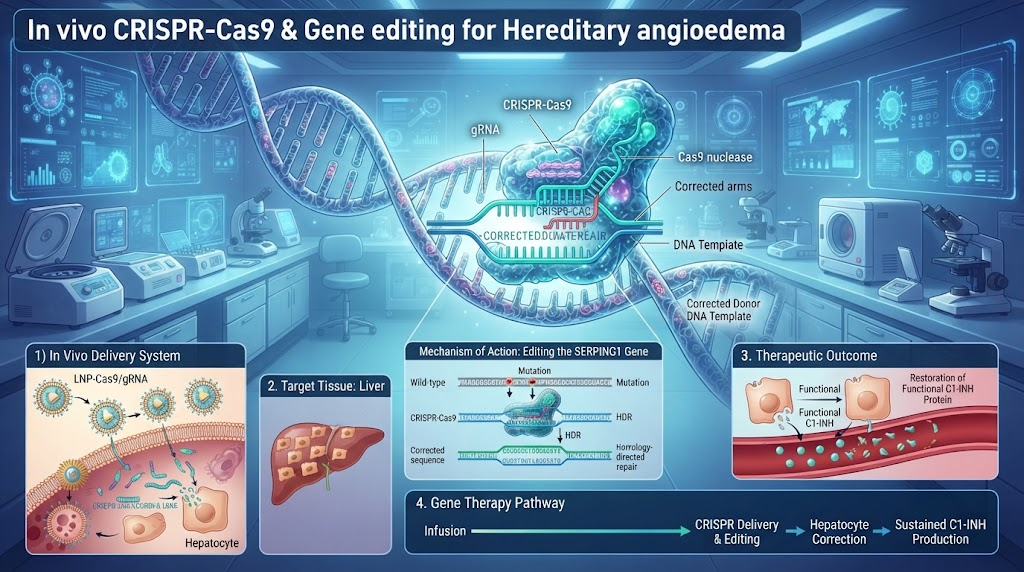
Recent advances in molecular biology have enabled CRISPR-Cas9 based genome editing to correct disease-causing mutations or silence pathogenic genes in vivo. Lonvoguran ziclumeran (lonvo-z) is an investigational CRISPR-based therapy targeting the underlying genetic drivers of HAE, intended as a single-dose curative intervention. This review synthesizes the current clinical evidence for lonvo-z and related therapies, focusing on safety, efficacy, and translational implications.
Key Content
Chronological Development of CRISPR Therapies in HAE
Preclinical studies showed that in vivo CRISPR delivery systems could specifically edit hepatocyte genomes, reducing pathogenic kallikrein and bradykinin pathways. Early-phase clinical trials explored safety and proof-of-concept for in vivo editing targeting KLKB1 (kallikrein B1 gene) to blunt bradykinin release.
A phase 1-2 trial of NTLA-2002 (a similar CRISPR therapeutic targeting KLKB1) enrolled 27 adults with HAE (Cohn et al., NEJM 2025). Single infusions of 25 mg or 50 mg yielded approximately 75% reductions in monthly attack rates and in total plasma kallikrein levels up to 16 weeks, with more than 70% of patients on the higher dose being attack-free during this period. Adverse events were mild and included headache, fatigue, and nasopharyngitis.
Building on these promising findings, lonvo-z entered a phase 3 randomized, double-blind, placebo-controlled trial. This pivotal study randomized 80 patients with C1-INH deficiency HAE at a 2:1 ratio to receive 50 mg lonvo-z or placebo intravenously. The primary endpoint was the monthly attack rate between weeks 5 and 28 post-infusion (Cohn DM et al., NEJM 2026).
Efficacy Outcomes
Lonvo-z achieved a profound and statistically significant reduction in attack frequency. The mean monthly attack rate was 0.26 (95% CI, 0.15 to 0.45) in the lonvo-z group versus 2.10 (95% CI, 1.55 to 2.86) in placebo, equating to an 87% relative reduction (P<0.001). The treatment effect was durable over a median 7.5-month follow-up (range, 4.9–12.8 months).
Compared to NTLA-2002’s 75% reduction at 16 weeks, lonvo-z demonstrated deeper and more sustained control extending beyond 6 months. Such durable efficacy suggests effective in vivo gene editing with persistent suppression of pathological pathways driving HAE attacks.
Safety and Tolerability
Adverse events were common but predominantly mild or moderate. Lonvo-z recipients reported infusion-related reactions, headache, fatigue, back pain, and upper respiratory tract infections each in over 10% of patients. No serious or grade 3+ toxicities occurred. The placebo group showed a similar overall adverse event incidence (86%). Safety data support the tolerability of single-dose in vivo CRISPR editing in this patient population.
These findings align with NTLA-2002 results, which noted primarily headache, fatigue, and nasopharyngitis as adverse events without severe complications. The favorable safety profile for both agents is encouraging for the advancement of gene editing therapeutics.
Mechanistic Insights and Translational Implications
Lonvo-z utilizes CRISPR-Cas9 technology to inactivate pathogenic gene targets implicated in hereditary angioedema, likely affecting kallikrein-kinin system regulation to prevent bradykinin overproduction, the effector molecule in HAE swelling episodes.
The durable ~87% reduction in attacks with a single infusion reflects permanent editing in relevant hepatic cells, contrasting with frequent chronic use of biologics or small molecule drugs. This provides a paradigm shift toward disease modification rather than symptomatic control. Furthermore, the reduction in attack frequency translates to improved quality of life and reduced healthcare utilization.
Expert Commentary
The introduction of lonvo-z marks a milestone in precision medicine for hereditary angioedema. Phase 3 evidence demonstrates that in vivo CRISPR gene editing can achieve sustained clinical benefit and a manageable safety profile, supporting regulatory advancement.
Comparative data from NTLA-2002 reinforce the concept that targeting kallikrein B1 gene via CRISPR yields robust attenuation of attacks. Differences in study design and follow-up notwithstanding, both agents highlight gene editing as an emerging transformative therapeutic class.
Remaining challenges include confirming long-term durability beyond one year, monitoring for rare off-target effects, and evaluating applicability in heterogeneous HAE subtypes. Additionally, the cost-effectiveness and accessibility of this novel therapy must be addressed.
Clinical guidelines will likely evolve to incorporate CRISPR gene-editing as a preferred approach for patients with frequent or severe attacks refractory to conventional therapies. Multidisciplinary collaboration and real-world evidence will be critical to optimizing integration and managing long-term surveillance.
Conclusion
Lonvoguran ziclumeran is the first in vivo CRISPR-based therapeutic to demonstrate significant, durable reduction in hereditary angioedema attack rates with a favorable safety profile in a phase 3 trial. This breakthrough heralds a new era of one-time, gene-editing treatments offering potential functional cures for rare genetic disorders such as HAE.
Corroborative data from NTLA-2002 underscore the promise of CRISPR modalities targeting kallikrein-kinin pathway components. While further long-term and broad population studies are warranted, lonvo-z exemplifies the clinical translation of gene editing from bench to bedside.
Future directions should focus on refining delivery mechanisms, expanding indications, and establishing long-term safety and cost-effectiveness to fully realize the transformative potential of in vivo CRISPR therapy in hereditary angioedema and beyond.
References
Cohn DM, Gurugama P, Longhurst HJ, et al. Lonvoguran Ziclumeran – In Vivo CRISPR Gene Editing in Hereditary Angioedema. N Engl J Med. 2026;395(15):1471-1482. doi:10.1056/NEJMoa2600931. PMID: 42294842.
Banerji A, Sutherland A, Miller CR, et al. CRISPR-Based Therapy for Hereditary Angioedema. N Engl J Med. 2025;392(5):458-467. doi:10.1056/NEJMoa2405734. PMID: 39445704.