Long-Term Visual Field Outcomes in Eyes with Failed Trabeculectomy: Evaluating Repeat Trabeculectomy versus Ahmed Glaucoma Valve Implantation
Highlight
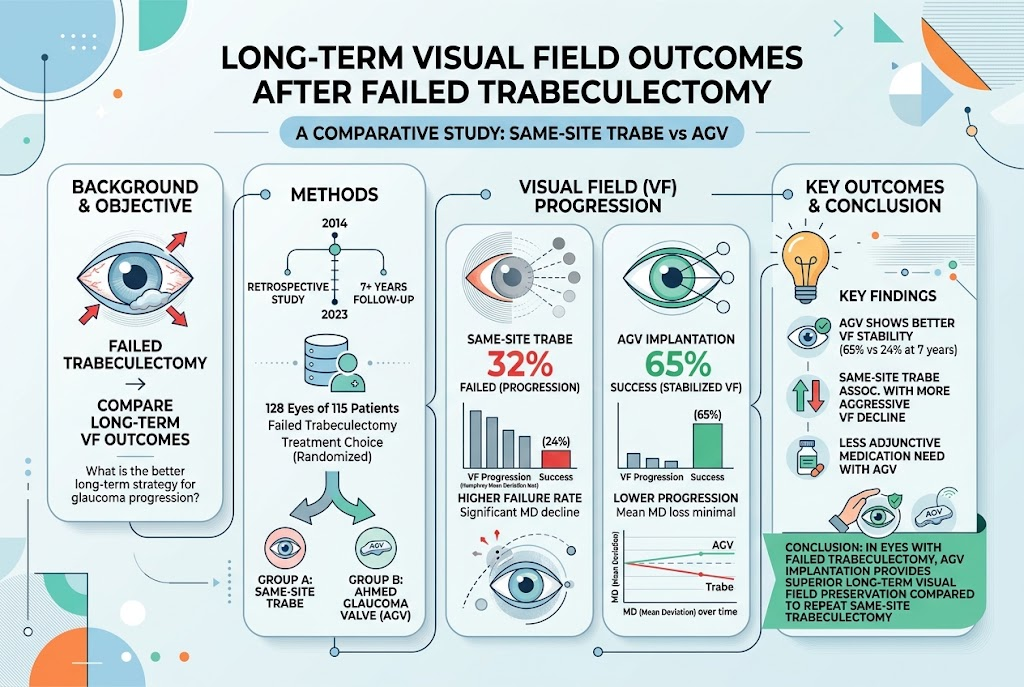
- Visual field progression rates after repeat trabeculectomy and Ahmed glaucoma valve (AGV) implantation are comparable in eyes with failed initial trabeculectomy.
- Repeat trabeculectomy achieves greater intraocular pressure reduction and fewer postoperative medications than AGV implantation.
- Postoperative peak intraocular pressure (IOP), rather than mean IOP, is a significant risk factor for visual field deterioration.
- Compared with preoperative rates, visual field progression slows more after repeat trabeculectomy than after AGV implantation.
Study Background
Glaucoma is a leading cause of irreversible blindness worldwide, with intraocular pressure (IOP) reduction being the cornerstone in preventing progression of visual field loss. Trabeculectomy remains the gold-standard filtration surgery for lowering IOP, but failure rates increase over time due to scarring and wound healing responses. After initial trabeculectomy failure, surgical options include repeat trabeculectomy at the same site or implantation of glaucoma drainage devices such as the Ahmed Glaucoma Valve (AGV). However, long-term visual outcomes comparing these approaches, particularly regarding visual field progression, have not been fully elucidated. Understanding which intervention better preserves visual function post-failure is critical for guiding clinical decision-making and improving glaucoma management outcomes.
Study Design
This was a retrospective clinical cohort study including 186 eyes with documented failed trabeculectomy who subsequently underwent either repeat trabeculectomy (94 eyes) or AGV implantation (92 eyes). Inclusion criteria required a minimum of four postoperative visual field (VF) evaluations and at least two years of follow-up. Visual field progression was rigorously assessed by analyzing mean deviation (MD) slope, Glaucoma Rate Index (GRI), and pointwise linear regression (PLR). An eye was considered progressing if at least two of the three VF methods indicated deterioration. A subset of patients with sufficient preoperative data was analyzed to compare VF progression rates before and after surgery.
Key Findings
Both repeat trabeculectomy and AGV implantation significantly lowered IOP from baseline (P < 0.001). Notably, the trabeculectomy group achieved lower mean postoperative IOP and required fewer glaucoma medications than the AGV group (P < 0.001). Despite this, visual field progression rates postoperatively were similar between groups: 35% of AGV eyes and 31% of trabeculectomy eyes met criteria for progression (P = 0.6).
Median MD decline rates were -0.43 dB/year in the AGV cohort and -0.29 dB/year in the repeat trabeculectomy group, a difference that was not statistically significant (P = 0.9). However, when comparing preoperative to postoperative VF progression slopes, only the trabeculectomy group exhibited a significant reduction in progression rates (P = 0.03), suggesting greater neuroprotective benefit associated with repeat trabeculectomy.
Importantly, multivariate analysis identified postoperative peak IOP as a significant predictor of visual field deterioration, with an 11% increased risk of progression per mmHg increase in peak IOP. Mean postoperative IOP was not similarly predictive, highlighting the clinical relevance of controlling IOP spikes.
Expert Commentary
The study by Khaliliyeh et al. provides valuable, long-term comparative data on visual functional outcomes after surgical intervention for failed trabeculectomy. Although AGV implantation is often favored for its technical feasibility and perceived lower risk of bleb-related complications, this study challenges the assumption that repeat trabeculectomy is less effective or safe.
The superior IOP control achieved with repeat trabeculectomy likely contributes to the observed stabilization of VF progression compared to preoperative trends. Controlling peak IOP appears paramount, as transient pressure elevations may induce further optic nerve damage even if mean IOP appears controlled. Clinicians should note that repeat trabeculectomy, when feasible, remains a valuable surgical option especially for patients at higher risk of progression.
Limitations include the retrospective design, potential selection bias, and a lack of randomized treatment allocation. Generalizability may be limited to specialized glaucoma centers with surgical expertise in repeat filtration surgery. Further prospective, randomized trials would be valuable to confirm these findings and optimize surgical algorithms.
Conclusion
In eyes with failed initial trabeculectomy, repeat trabeculectomy and Ahmed Glaucoma Valve implantation yield similar long-term visual field progression rates. Nonetheless, repeat trabeculectomy provides superior IOP reduction, fewer medications, and a more pronounced slowing of preoperative visual field deterioration. Given the critical role of postoperative peak IOP in visual outcomes, repeat trabeculectomy should be seriously considered as a viable surgical intervention in appropriate patients. Optimal surgical planning and vigilant IOP spike control postoperatively remain essential for preserving vision in glaucoma patients following filtration surgery failure.
Funding and Clinical Trial Registration
The study did not specify external funding sources or clinical trial registration details.
References
1. Khaliliyeh D, Morales E, Caprioli J. Long-Term Visual Field Outcomes after failed trabeculectomy: Same site Trabeculectomy versus Ahmed Glaucoma Valve Implantation. Am J Ophthalmol. 2026 Sep 12; PMID: 42731770.
2. Weinreb RN, Aung T, Medeiros FA. The pathophysiology and treatment of glaucoma: a review. JAMA. 2014 May 14;311(18):1901-11.
3. Gedde SJ, Herndon LW, Brandt JD, et al. Postoperative complications in the Tube Versus Trabeculectomy (TVT) study during five years of follow-up. Am J Ophthalmol. 2012 Oct;153(5):804-814.e1.
4. Gedde SJ, Feuer WJ, Lim KS, et al. Treatment outcomes in the Tube Versus Trabeculectomy (TVT) study after five years of follow-up. Am J Ophthalmol. 2012 Oct;153(5):789-803.e2.
5. Chen PP, Beck AD, Hall RW. Glaucoma drainage implants: a critical review and current perspectives. Curr Opin Ophthalmol. 2017 Mar;28(2):102-107.
This article was created using several editorial tools, including AI, as part of the process. Human editors reviewed this content before publication.