We use cookies

Our website uses essential cookies and, with your consent, additional cookies to measure performance and improve our services. Cookie Policy.

You can change your choice at any time.

MMedXYNews
HomeVideos
MedXY AI/MedXY News/Section: news

Long-Term Recurrence of Hypertropia After Surgery in Sagging Eye Syndrome: Insights and Implications
MedXY Editorial Team•Sep 22, 2026•news
recurrencestrabismus surgeryHypertropiaSagging Eye Syndrome

Highlight

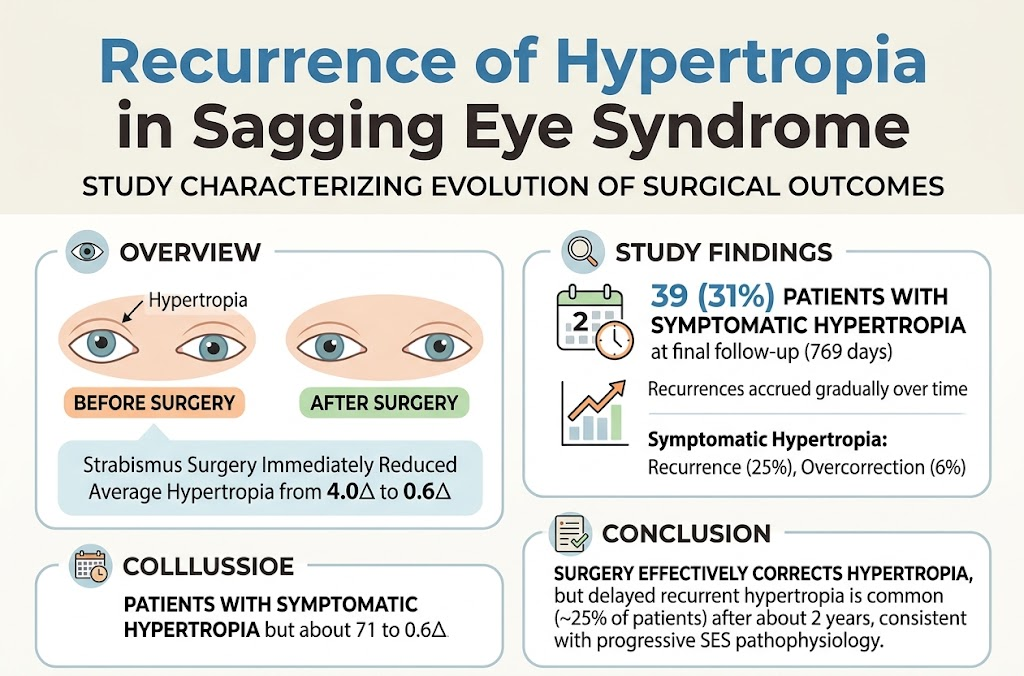
  • Strabismus surgery significantly reduces hypertropia in patients with sagging eye syndrome (SES) immediately postoperatively.
  • Approximately one-quarter of patients develop symptomatic recurrent hypertropia within about two years after surgery.
  • Neither patient’s demographic factors nor magnitude of preoperative hypertropia predict recurrence or overcorrection risk.
  • Surgical overcorrection events are uncommon and may be misclassified due to compensatory changes in the fellow eye over time.

Study Background: Clinical Context and Disease Burden

MedXY registered readers

Sign in free to continue reading

Create or use your MedXY account to unlock the complete article.

This article was created using several editorial tools, including AI, as part of the process. Human editors reviewed this content before publication.

Related articles

Open language-specific specialty feeds and department pages.

Recurrent Dupuytren Contracture: Comparing Surgical Fasciectomy and Collagenase Injection for Optimal ManagementThis randomized controlled trial compares surgical fasciectomy and collagenase injection for recurrent Dupuytren contracture, revealing similar functional outcomes at 2 years but higher adverse events with surgery.Sep 27, 2026Real-World Five-Year Survival After Neoadjuvant Therapy and Surgery in Localized Pancreatic Ductal AdenocarcinomaThis study reveals that over one-third of patients with localized PDAC receiving neoadjuvant therapy and surgery achieve actual five-year survival, highlighting the impact of early systemic failure and identifying factors predicting long-teSep 15, 2026Incidence, Survival, and Symptomatology of Recurrence in Vulvar Cancer: Insights from Population-Based Cohort Studies and Contemporary EvidenceVulvar cancer exhibits significant recurrence rates, predominantly local, with survival declining sharply after recurrence. Awareness of recurrence-associated symptoms enhances early detection. Surgery remains pivotal in management, with frSep 12, 2026
Loading comments...
MedXY briefing

Get the free newsletter

Evidence-led clinical news, trends, and analysis—delivered to your inbox.

Ask MedXY AI

Most popular

Intimate Health
Five Benefits for Women Continuing Sexual Activity After Menopause
Intimate Health
Why Some Women Have a Strong Sex Drive—And Why Men Shouldn't Worry About It
Nursing & care
How often should a couple have sex?
General Surgery
Optimizing Postoperative Opioid Prescriptions After Intra-Abdominal Cancer Surgery: Comparing the 5x-Multiplier and 3-Tier Models
Intimate Health
Classic Intimacy Recommendations: How to Help Women Reach Orgasm and Enjoy Mutual Pleasure
© 2026 MedXY
Contact usAbout usPrivacy PolicyMedXY story
Evaluating Quality of Life and Recurrence in Recurrent Diverticulitis: A Prospective Multicenter Study Comparing Colectomy and Observation
This multicenter prospective study reveals that colectomy in recurrent sigmoid diverticulitis improves disease-specific quality of life and reduces 1-year recurrence compared to observation, informing surgical decision-making.
Sep 8, 2026
Revisiting HER2 Status in Recurrent Cervical Cancer: Clinical Implications of Dynamic Expression for Targeted TherapyHER2 expression in recurrent cervical cancer varies notably by histology and recurrence site, underscoring the importance of reassessment to guide HER2-targeted treatments effectively.Aug 18, 2026
Impact of Surgical Unit Volume on Recurrence and Complications after Open Mesh Groin Hernia Repair: Insights from a Nationwide Swedish CohortA large nationwide Swedish study reveals that surgical unit volume has minimal impact on recurrence rates after elective open anterior mesh groin hernia repair, but low-volume units face higher risks during emergency repairs.Aug 11, 2026