Long-Term Outcomes of Intervention Versus Conservative Management in Symptomatic Cerebral Cavernous Malformations: Insights from a Population-Based Cohort Study
Highlight
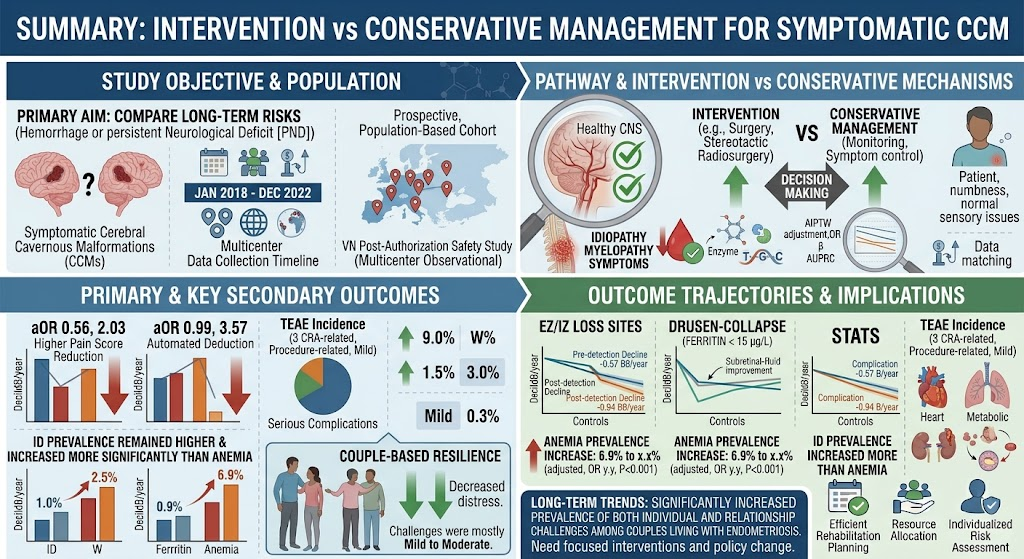
This prospective, population-based cohort study involving 190 symptomatic cerebral cavernous malformation (CCM) patients with a median follow-up of 16 years evaluates the long-term safety and effectiveness of CCM interventions versus conservative management. CCM intervention, primarily microsurgical resection, was associated with a higher risk of severe functional impairment or death, potentially mediated by increased rates of intracranial hemorrhage or focal neurological deficits. No significant association was observed between intervention and seizure outcomes. These results highlight the urgency for randomized controlled trials to define optimal management strategies.
Study Background
Cerebral cavernous malformations (CCMs) are vascular anomalies in the central nervous system characterized by clusters of abnormally dilated capillaries prone to hemorrhage. Clinical manifestations include intracranial hemorrhages (ICH), focal neurological deficits (FND), and epileptic seizures. The natural history of CCMs is variable, and treatment strategies span conservative management, microsurgical resection, and stereotactic radiosurgery.
Clinical equipoise persists regarding the optimal approach for symptomatic CCMs, balancing the risks of intervention against progressive morbidity or mortality due to hemorrhagic or epileptic complications. Observational data on long-term outcomes comparing intervention with conservative management have been limited, particularly in population-based cohorts. This study aims to elucidate the causal relationship between CCM intervention and clinically meaningful outcomes over extended follow-up.
Study Design
This was a prospective, population-based cohort study conducted in Scotland, encompassing patients aged 16 years or older newly diagnosed with CCM between two periods: 1999-2003 and 2006-2010. Diagnosis was established via brain magnetic resonance imaging (MRI) or pathological confirmation. The study population comprised 306 patients, of whom 190 were symptomatic based on clinical presentation with either symptomatic ICH/FND (47%) or epileptic seizures (53%).
Interventions included microsurgical resection (n=35) and stereotactic radiosurgery (n=2), with 37 patients receiving intervention during the median 16-year follow-up (interquartile range 14-21 years). The rest were managed conservatively. The primary outcome was persistent functional impairment or death, operationalized as at least two consecutive annual Oxford Handicap Scale (OHS) scores ≥2; sensitivity analyses used OHS ≥3. Secondary outcomes included a composite of symptomatic intracranial hemorrhage or new persistent/progressive nonhemorrhagic focal neurological deficits (ICH/FND), definitely or possibly related to CCM or its intervention, and epileptic seizures linked to CCM.
The authors employed Cox regression modeling with CCM intervention treated as a time-dependent covariate, accounting for baseline differences and confounders.
Key Findings
Among the 190 symptomatic patients (median age 40 years; 50% female), those undergoing CCM intervention were younger (median 33 vs 43 years), more likely to have presented with hemorrhage (49% vs 23%), and less likely to have brainstem CCMs (8% vs 24%) relative to the conservatively managed group.
Primary Outcome: Intervention was not significantly associated with persistent functional impairment or death when defined by OHS ≥2. However, when a more stringent criterion (OHS ≥3) was applied, CCM intervention was associated with a significantly increased risk (adjusted hazard ratio [HR] 2.66; 95% confidence interval [CI] 1.19–5.94; p=0.017), indicating higher rates of severe disability or death.
Secondary Outcomes: CCM intervention was independently associated with increased risk of symptomatic ICH/FND definitely related to CCM or intervention during follow-up (adjusted HR 3.59; 95% CI 1.05–12.20; p=0.041). Conversely, intervention did not significantly impact seizure outcomes (adjusted HR 1.56; 95% CI 0.49-4.99; p=0.45).
These findings suggest that intervention may lead to greater risk of serious neurological events resulting in persistent disability or mortality, potentially through procedure-related complications or the natural course exacerbated by intervention.
Expert Commentary
This rigorously conducted population-based cohort study provides important insights into the long-term outcomes of CCM management strategies. The use of time-dependent covariate analysis strengthens causal inference over previous observational work. The finding that intervention is associated with worse functional outcomes and increased hemorrhagic/focal neurological events challenges assumptions that surgical or radiosurgical therapy unequivocally benefits patients with symptomatic CCMs.
However, inherent limitations of observational design remain, including potential selection bias—intervention patients were younger and had a higher prevalence of hemorrhagic presentation—factors that may independently influence prognosis. The relatively small number of interventions, especially radiosurgery, limits subgroup analyses, and unmeasured confounding cannot be excluded.
Notably, seizure outcomes were not significantly altered by intervention, reflecting the complex pathophysiology of CCM-related epilepsy and the possibility that surgery or radiosurgery does not adequately address epileptogenic substrates.
Current guidelines recognize microsurgical resection as an option for accessible, symptomatic CCMs, particularly following hemorrhage, yet recommendations vary widely due to limited high-quality data. This study underscores the urgent need for well-powered randomized controlled trials to resolve treatment equipoise and guide personalized care decisions.
Conclusion
This large, prospective cohort study reveals that intervention for symptomatic cerebral cavernous malformations, predominantly microsurgical resection, is associated with increased risk of severe functional impairment or death during long-term follow-up. The excess risk appears mediated by a higher incidence of symptomatic hemorrhages or focal neurological deficits related to CCM or its treatment. Intervention did not improve seizure outcomes, suggesting a nuanced benefit-risk balance.
These findings highlight the complex clinical decision-making inherent in CCM management and emphasize the necessity of randomized controlled trials to clarify indications for intervention versus conservative approaches, thereby optimizing patient outcomes in this population.
Funding and ClinicalTrials.gov
The study was conducted under the auspices of Neurology journal affiliates and research teams in Scotland. No specific industry funding or clinical trial registration details were disclosed in the abstract.
References
Sandmann ACA, Verbaan D, Coutinho JM, Vandertop WP, White PM, Al-Shahi Salman R. Intervention or Conservative Management for Symptomatic Cerebral Cavernous Malformations: A Prospective, Population-Based Cohort Study. Neurology. 2026 Aug 12;107(5):e2184-442. PMID: 42585604.
Al-Shahi Salman R, Berg MJ, Morrison L, et al. Hemorrhage Risk of Cerebral Cavernous Malformations: A Systematic Review and Meta-analysis. Neurology. 2012;78(11):1003-1010.
Nelson J, McDonald D, Bugden S, et al. Cerebral Cavernous Malformations: Review of Clinical Presentation, Diagnosis, and Management. Stroke. 2020;51(3):624-633.
This article was created using several editorial tools, including AI, as part of the process. Human editors reviewed this content before publication.