We use cookies

Our website uses essential cookies and, with your consent, additional cookies to measure performance and improve our services. Cookie Policy.

You can change your choice at any time.

MMedXYNews
HomeVideos
MedXY AI/MedXY News/Section: news

Long-Term Opioid Use After Radiation Therapy in Head and Neck Cancer: Prevalence, Risk Factors, and Clinical Implications
MedXY Editorial Team•Oct 5, 2026•news
head and neck cancerOpioid StewardshipOpioid Useradiation therapy

Highlight

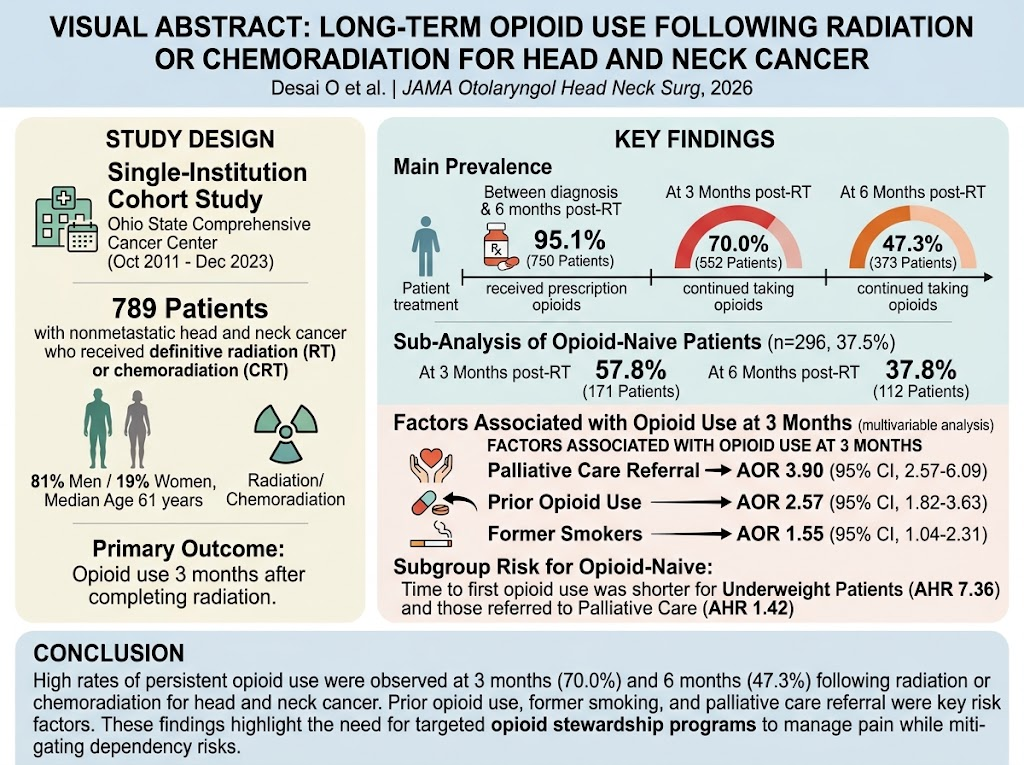
  • Approximately 70% of patients with head and neck cancer continued opioid use at 3 months post-radiation or chemoradiation, with nearly half still using opioids at 6 months.
  • Key factors associated with persistent opioid use include prior opioid use, former smoking status, and referral to palliative care.
  • Among opioid-naive patients prior to radiation, those who were underweight or referred to palliative care experienced earlier initiation of opioid use.
  • Findings emphasize the critical need for targeted opioid stewardship programs balancing effective pain management with minimizing long-term dependency.

Study Background

MedXY registered readers

Sign in free to continue reading

Create or use your MedXY account to unlock the complete article.

This article was created using several editorial tools, including AI, as part of the process. Human editors reviewed this content before publication.

Related articles

Open language-specific specialty feeds and department pages.

Evaluating the Effectiveness of Preoperative Patient Education on Opioid Use and Postoperative Pain Management: Insights from a Randomized TrialA randomized trial found that preoperative analgesic education did not significantly reduce opioid consumption or improve pain scores and satisfaction after surgery, highlighting the need for more intensive interventions.Oct 5, 2026EHR-Integrated Synoptic Operative Reporting: Enhancing Documentation in Head and Neck Oncologic SurgeryThis study evaluates the development, implementation, and performance of EHR-integrated synoptic operative reporting templates in head and neck cancer surgery, highlighting improved documentation quality and variable adherence.Sep 27, 2026Immunotherapy in Head and Neck Squamous Cell Carcinoma with Low PD-L1 Expression: A Meta-Analytic Insight into Survival OutcomesA meta-analysis reveals immune checkpoint inhibitors may reduce survival in head and neck squamous cell carcinoma patients with PD-L1 combined positive scores less than 1, signaling caution in this subgroup’s treatment.Sep 21, 2026
Loading comments...
MedXY briefing

Get the free newsletter

Evidence-led clinical news, trends, and analysis—delivered to your inbox.

Ask MedXY AI

Most popular

Intimate Health
Five Benefits for Women Continuing Sexual Activity After Menopause
Intimate Health
Why Some Women Have a Strong Sex Drive—And Why Men Shouldn't Worry About It
Nursing & care
How often should a couple have sex?
Cardiology
Precision Medicine for Long QT Syndrome Type 2: Lumacaftor Corrects Trafficking Defects and Shortens QT Interval
General Surgery
Optimizing Postoperative Opioid Prescriptions After Intra-Abdominal Cancer Surgery: Comparing the 5x-Multiplier and 3-Tier Models
© 2026 MedXY
Contact usAbout usPrivacy PolicyMedXY story
Enhancing Care for Head and Neck Cancer Patients: Insights from a Novel Subspecialty Outpatient Palliative Medicine Clinic
A surgeon-led outpatient palliative care clinic for head and neck cancer patients demonstrated significant symptom improvement, prolonged survival, and high rates of home or hospice deaths, underscoring its value in multidisciplinary cancer
Sep 3, 2026
MDADI Composite Score Thresholds for Efficient Screening of Swallowing Impairment in Head and Neck Cancer PatientsThis study validates the MD Anderson Dysphagia Inventory (MDADI) as a reliable screening tool for VFSS-graded swallowing impairment in head and neck cancer patients and proposes a concise four-item version to optimize clinical utility.Aug 27, 2026
Enhanced Pathologic Responses with Neoadjuvant Chemoimmunotherapy in Resectable Head and Neck Squamous Cell CarcinomaNeoadjuvant chemoimmunotherapy significantly improves pathologic complete and major responses compared to immunotherapy alone in resectable head and neck squamous cell carcinoma, suggesting a promising avenue to improve treatment outcomes.Aug 24, 2026