Long-Acting Injectable HIV Therapy: Improving Viral Suppression in African Adults with Adherence Challenges
Highlight
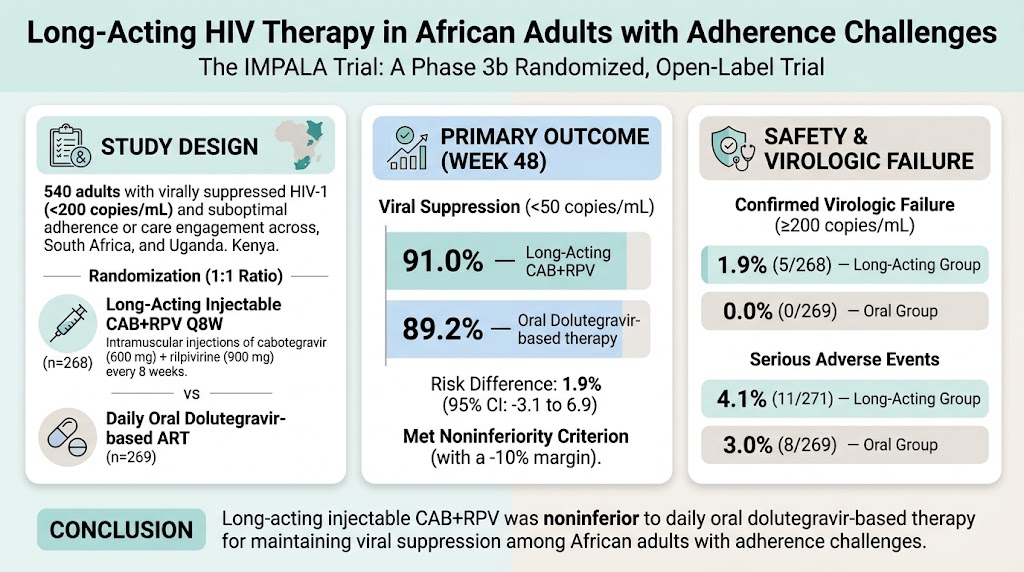
– Long-acting injectable cabotegravir plus rilpivirine maintains viral suppression as effectively as daily oral dolutegravir-based therapy in African adults with HIV facing adherence difficulties.
– At 48 weeks, 91.0% of participants on long-acting injections achieved viral suppression (<50 copies/mL), compared to 89.2% on oral therapy.
– Confirmed virologic failure occurred slightly more in the injectable group but remained low (1.9%).
– Serious adverse events were similar and infrequent in both treatment groups.
Study Background
Human immunodeficiency virus (HIV) remains a significant public health burden in eastern and southern Africa, with over one million individuals on oral antiretroviral therapy (ART) failing to achieve viral suppression primarily due to adherence challenges. Sustained viral suppression is critical both for individual health and to reduce transmission. Adherence to daily oral ART can be difficult due to multiple factors including drug side effects, stigma, healthcare access issues, and social determinants of health. Long-acting injectable antiretroviral formulations present a promising strategy to overcome these barriers by reducing dosing frequency and potentially improving treatment retention and virologic outcomes.
Study Design
This phase 3b, open-label, randomized clinical trial was conducted across seven sites in Kenya, South Africa, and Uganda. It enrolled 540 adults living with HIV type 1 who were virally suppressed (HIV RNA <200 copies/mL) but reported suboptimal adherence or engagement with care. Participants were randomized 1:1 to receive either long-acting injectable cabotegravir (600 mg) plus rilpivirine (900 mg) every eight weeks, following an initial phase of two injections four weeks apart, or to continue their current daily oral dolutegravir-based ART regimen. Baseline drug-resistance testing was not routinely performed. The primary endpoint was maintenance of viral suppression, defined as an HIV RNA level below 50 copies per milliliter at week 48. Noninferiority margin was set at -10 percentage points. Secondary endpoints included confirmed virologic failure, defined as two consecutive viral loads ≥200 copies/mL, and assessment of safety and adverse events.
Key Findings
Out of 540 enrolled, 537 participants were included in the primary efficacy analysis. At week 48, 244 of 268 participants (91.0%) assigned to long-acting injectables maintained viral suppression compared to 240 of 269 (89.2%) in the oral therapy group. The risk difference of 1.9 percentage points (95% confidence interval [CI], -3.1 to 6.9) confirmed noninferiority of long-acting injectable therapy. Similar results were affirmed in per-protocol analyses.
Confirmed virologic failure was noted in 5 participants (1.9%) in the long-acting group, while no virologic failures occurred in the oral therapy group (risk difference 1.9 percentage points; 95% CI, 0.3 to 3.5). Although more failures occurred with injectables, the absolute number remained small.
Serious adverse events were reported in 11 (4.1%) participants in the injectable arm and 8 (3.0%) in the oral arm (risk difference 1.1 percentage points; 95% CI, -1.1 to 4.2). These events were diverse and not clearly attributable to the study drugs. Injection-site reactions, a known occurrence with long-acting formulations, were anticipated but were not specified as causing significant discontinuation in this study.
Expert Commentary
This pivotal trial provides robust evidence supporting the use of long-acting injectable cabotegravir plus rilpivirine in African adults with HIV who face adherence challenges, a group often underrepresented in clinical trials. The finding that long-acting therapy is noninferior to oral daily dolutegravir-based regimens for maintaining viral suppression is clinically relevant, particularly given barriers associated with daily pill adherence in resource-limited settings.
The slightly higher rate of virologic failure in the injectable group warrants careful monitoring in clinical practice. Resistance testing was not performed at baseline, potentially affecting failure interpretation. Moreover, patient acceptability, injection tolerability, and infrastructure for delivering injectable therapies are critical considerations for scalability in low-resource environments.
Global HIV treatment guidelines are increasingly recognizing long-acting formulations as a valuable addition to the therapeutic arsenal. Their use could reduce pill burden and improve quality of life. However, implementation requires strategies to identify appropriate candidates, ensure retention in care for injections, and manage potential resistance development during treatment interruptions.
Conclusion
Long-acting injectable cabotegravir plus rilpivirine represents a viable and effective alternative to daily oral dolutegravir-based therapy in African adults living with HIV and experiencing adherence challenges. This regimen achieved high rates of viral suppression without significant safety concerns at 48 weeks. Adoption of long-acting treatment modalities could substantially improve management of HIV in resource-limited settings, provided logistical and clinical challenges are addressed through integrated healthcare approaches.
Funding and Clinical Trial Registration
This study was funded by Johnson & Johnson. The clinical trial is registered under ClinicalTrials.gov identifier NCT05546242 and Pan African Clinical Trials Registry number PACT202301600757432TMC278LAHTX3005.
Reference
Cresswell FV, Kitonsa J, Norcross C, Tumusiime V, Ombajo LA, Garrett N, Kassim S, Owarwo NC, Laker Odongpiny EA, Yawe I, Mahomed S, Mugerwa H, Kafeero PL, Nkuranga J, Bahemuka U, Nabbuto J, Ankunda V, Nabaggala P, Ogwang C, Kimbugwe G, Kakande A, Singh U, van der Vendt D, Onyango A, Koile E, Lawrence DS, Idahosa A, van Eygen V, Addo Boateng F, Eshun-Wilsonova I, Grint DJ, Ruzagira E; IMPALA Study Group. Long-Acting HIV Therapy in African Adults with Adherence Challenges. N Engl J Med. 2026 Oct 15;395(15):1505-1518. doi: 10.1056/NEJMoa2518753. PMID: 42874104.
This article was created using several editorial tools, including AI, as part of the process. Human editors reviewed this content before publication.