Highlight
Dual blockade of BAFF and APRIL with telitacicept leads to broad suppression of B-lineage cells but induces heterogeneous remodeling of antiphospholipid autoantibodies.
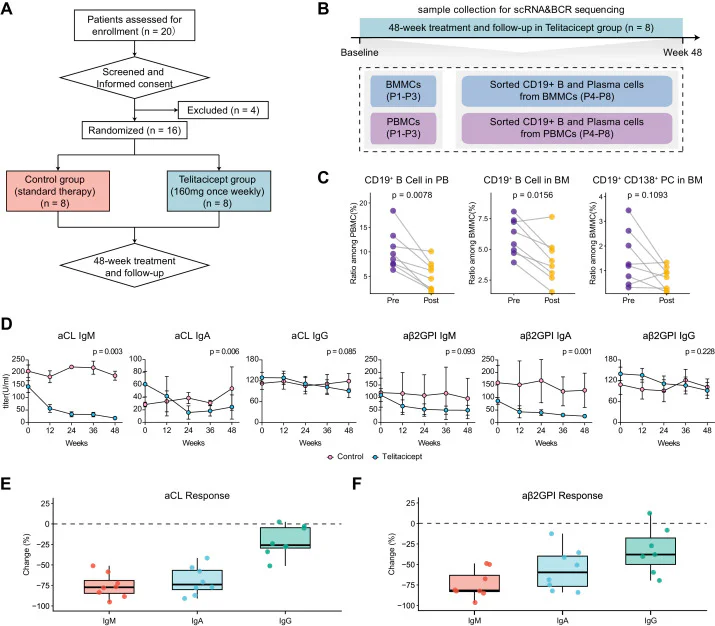
Significant reductions in IgM and IgA class antiphospholipid antibodies contrast with variable IgG suppression, highlighting isotype-specific effects.
Persistence of immunoglobulin heavy constant gamma (IGHG) positive clonotypes in bone marrow plasma cells correlates with incomplete IgG autoantibody suppression.
Peripheral B-cell and plasmablast turnover contrasts with clonal stability in marrow plasma cells, underscoring compartmental distinctions in treatment response.
Study Background
Antiphospholipid syndrome (APS) is an autoimmune disorder characterized by thrombosis and pregnancy morbidity, strongly associated with the presence of pathogenic antiphospholipid antibodies (aPL). Existing therapies primarily focus on anticoagulation but do not adequately address the underlying autoimmunity. Durable suppression of pathogenic autoantibodies remains a major therapeutic challenge in APS and other antibody-mediated diseases. B-cell survival and differentiation depend critically on soluble factors including B-cell activating factor (BAFF) and a proliferation-inducing ligand (APRIL). Targeting these cytokines offers a promising approach to remodelling pathogenic humoral responses. Telitacicept is a novel fusion protein that blocks both BAFF and APRIL, representing a targeted immunotherapeutic agent. However, the effects of BAFF-APRIL blockade on isotype-specific autoantibody dynamics and cellular immune compartments in APS have not been fully elucidated. This study aims to fill this gap by comprehensively profiling humoral and cellular responses in a high-risk triple-positive aPL cohort under telitacicept therapy.
Study Design
The investigation enrolled patients with high-risk, triple-positive antiphospholipid antibody profiles, including those with primary APS and asymptomatic aPL carriers. The intervention involved administering telitacicept to achieve dual blockade of BAFF and APRIL. Longitudinal assessment was conducted with detailed serologic measurements of aPL isotypes (IgM, IgA, and IgG) pre- and post-treatment. Complementing these analyses, paired peripheral blood and bone marrow samples were subjected to single-cell RNA sequencing and B-cell receptor (BCR) repertoire profiling to characterize B-lineage populations, clonal dynamics, and transcriptional programs. The primary endpoints focused on the magnitude and pattern of pathogenic autoantibody modulation and the cellular mechanisms underpinning these changes.
Key Findings
Telitacicept treatment induced a broad contraction of B-cell lineages, evidenced by marked reductions in peripheral B cells and plasmablasts. Notably, the remodeling of autoantibody profiles exhibited isotype specificity. IgM- and IgA-class aPL antibodies consistently decreased across the cohort, reflecting effective suppression of these classes by BAFF-APRIL blockade. In contrast, IgG-class aPL antibodies demonstrated heterogeneous responses; some patients experienced substantial declines, whereas others showed incomplete IgG suppression.
Single-cell profiling revealed extensive turnover among peripheral B cells and plasmablasts, consistent with active immune perturbation. However, analyses of bone marrow plasma cells—the long-lived source of antibody production—demonstrated greater clonal stability and persistence, particularly of class-switched IGHG⁺ plasma-cell clonotypes. Importantly, patients with baseline positive IgG aPL exhibiting incomplete IgG suppression post-treatment had higher persistence of these marrow IGHG⁺ clonotypes and their associated secretory transcriptional signatures.
Interestingly, residual marrow IGHG⁺ plasma-cell abundance alone did not distinctly discriminate responders from non-responders, suggesting that clonal identity and transcriptional activity bear more relevance than mere plasma cell quantity.
These findings implicate marrow-resident IGHG⁺ plasma cells as a key cellular correlate of refractory IgG autoantibody production despite peripheral immune remodeling. The differential impact on autoantibody isotypes underscores the complexity of targeting humoral immunity and highlights the need to consider compartment- and isotype-specific immune biology.
Expert Commentary
This study addresses an important unmet need in APS management by leveraging targeted BAFF-APRIL blockade to interrogate pathogenic autoantibody dynamics. The isotype-specific remodeling observed aligns with the biological roles of BAFF and APRIL in B-cell maturation and plasma cell survival, providing mechanistic insight into treatment effects. The persistence of marrow IGHG⁺ plasma-cell clonotypes as a correlate of incomplete IgG suppression likely reflects the challenge of depleting long-lived plasma cells deeply embedded in bone marrow niches, which are typically resistant to conventional B-cell-depleting therapies.
Limitations include the exploratory nature of post-hoc subgroup analyses and the focus on a high-risk triple-positive population, which may limit generalizability to broader APS subsets. Additionally, long-term clinical correlates of autoantibody remodeling, such as thrombosis recurrence or pregnancy outcomes, remain to be established. Future studies integrating functional assays and clinical endpoints will be essential to translate these immunophenotypic findings into therapeutic strategies.
Conclusion
In summary, dual BAFF-APRIL blockade via telitacicept in patients with antiphospholipid syndrome induces compartment- and isotype-specific remodeling of pathogenic autoantibody responses. IgM and IgA autoantibodies are uniformly suppressed, while IgG-class antibodies exhibit heterogeneous responses linked to persistent marrow IGHG⁺ plasma-cell clonotypes. These results advance our understanding of the humoral immunopathology in APS and highlight persistent marrow plasma cell clones as potential targets for more durable suppression of pathogenic IgG autoantibodies. This knowledge informs the development of precision-targeted therapies aiming to achieve sustained immunological remission and improved clinical outcomes in antibody-mediated autoimmune diseases.
Funding and Clinical Trials
Details on study funding and clinical trial registration were not provided in the source abstract. Prospective clinical trial registries and funding disclosures should be consulted for comprehensive information.
References
1. Pan H, Wei X, Gu S, et al. BAFF-APRIL blockade reveals isotype-specific pathogenic autoantibody remodelling in antiphospholipid syndrome. Ann Rheum Dis. 2026 Sep 28. PMID: 42805835.
2. Erkan D, Lockshin MD. Antiphospholipid syndrome: Clinical manifestations. In: Firestein GS, ed. Kelley’s Textbook of Rheumatology. 10th ed. Philadelphia, PA: Elsevier; 2017.
3. Mackay F, Browning JL. BAFF: a fundamental survival factor for B cells. Nat Rev Immunol. 2002 Nov;2(11):861-72.
4. Stohl W, Metyas S, Tan SM, et al. B cell-activating factor and related molecules in systemic autoimmune diseases. Arthritis Rheum. 2003 Oct;48(10):2795-806.