Highlights
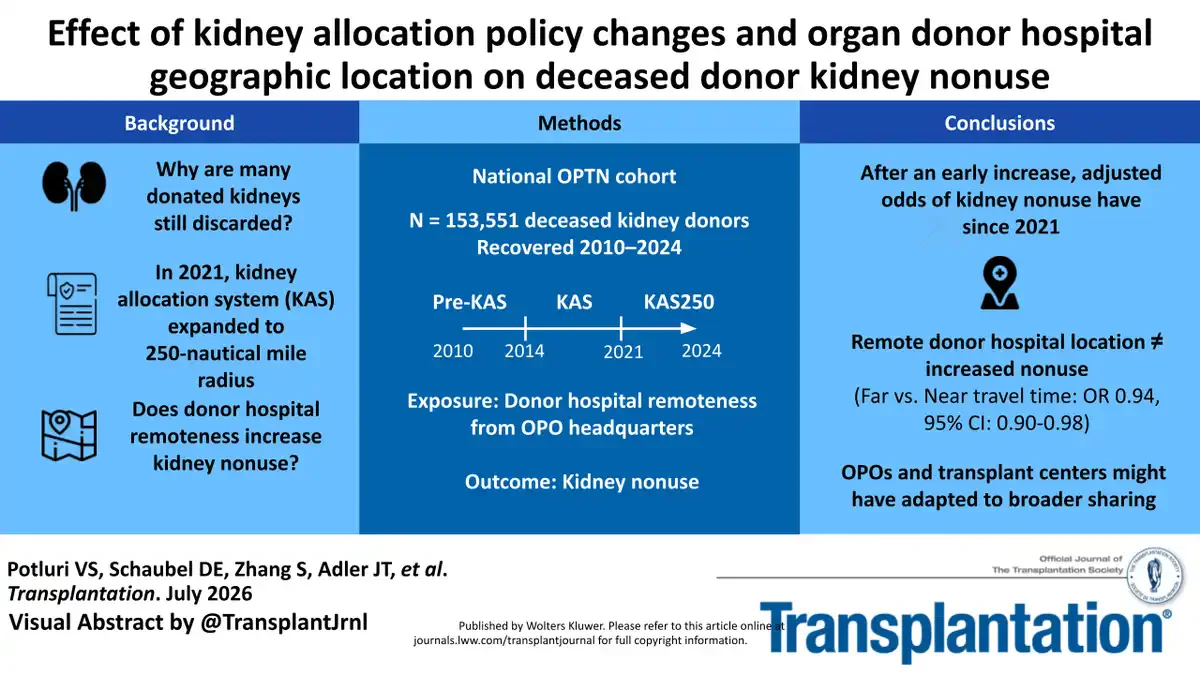
Geographic distance between donor hospitals and organ procurement organization (OPO) headquarters is not associated with increased deceased donor kidney nonuse.
Kidney Allocation System revision in 2021 (KAS250) initially increased kidney nonuse rates and cold ischemia times, but these metrics improved subsequently.
Nonuse of kidneys from more distant donor hospitals was surprisingly lower than from nearest hospitals, challenging assumptions about logistical challenges based on geography.
Policy and geographic factors interact subtly, underscoring the complexity of optimization in organ allocation and utilization.
Background
Kidney transplantation is the preferred treatment for end-stage renal disease, improving survival and quality of life compared to dialysis. The utilization of deceased donor kidneys depends on a complex multistep process requiring timely organ recovery, allocation, transportation, and implantation. Organ procurement organizations (OPOs) coordinate recovery from donor hospitals, and their geographic distribution may impact organ utilization due to logistical challenges associated with travel times and cold ischemia intervals.
The United States organ allocation landscape has evolved notably, with key policy changes such as the original Kidney Allocation System (KAS) introduced in 2014 to improve equity and utility, and the subsequent KAS250 revision in 2021, which expanded local allocation boundaries from 150 nautical miles to 250 nautical miles. These policies aim to optimize allocation fairness and improve transplantation outcomes but may have unintended effects on organ nonuse and ischemic times.
Understanding how donor hospital location relative to OPO headquarters affects kidney nonuse, and how evolving allocation policies influence these dynamics, is essential for refining organ recovery and allocation strategies to maximize transplantation rates and outcomes.
Key Content
Chronological Evidence on Kidney Allocation Policies and Nonuse
Prior to 2014 (pre-KAS), kidney allocation practices were heterogeneous and largely driven by geographic proximity and OPO-level discretion. The 2014 implementation of KAS introduced prioritization based on Estimated Post-Transplant Survival and kidney donor profile index (KDPI) to enhance graft survival and equity.
Potluri et al. (2026) utilized a large national cohort from the Organ Procurement and Transplantation Network (OPTN) encompassing 153,551 deceased kidney donors between 2010 and 2024 to investigate the influence of donor hospital distance from OPO headquarters and allocation era on kidney nonuse. The cohort was divided into pre-KAS (2010–2014), KAS (2014–2021), and KAS250 (2021–2024) eras. Estimated driving times from OPO headquarters to donor hospitals were categorized into quartiles for analytic clarity.
Contrary to the prevailing assumption that greater donor hospital distance would increase organ nonuse due to logistical difficulties, the analysis demonstrated a slightly lower odds of kidney nonuse in the farthest quartile compared with the nearest quartile (OR 0.94; 95% CI, 0.90–0.98). These findings suggest that geographic separation per se may not be a significant barrier to kidney utilization.
Regarding allocation policy impacts, the adjusted odds of kidney nonuse were marginally higher during the KAS250 era compared to the KAS era (OR 1.03; 95% CI, 1.0–1.06), yet this increase subsided by 2024 with nonuse rates reaching their lowest since 2010. This indicates that while initial policy shifts may transiently disrupt utilization, system adaptations can restore and improve outcomes over time.
Related Findings on Policy Changes and Transplant Metrics
A parallel study by Schold et al. (2024) evaluated the effects of the KAS250 policy on key transplant system metrics using the Scientific Registry of Transplant Recipients (SRTR) data. This study found that overall kidney nonuse rates rose from 19.7% to 26.4% following KAS250 implementation across all KDPI strata, alongside increased cold ischemia times and decreased donor-to-recipient hospital travel distances.
Interestingly, kidneys originating from small-metropolitan or nonmetropolitan hospitals had higher rates of nonuse irrespective of policy era, highlighting potential underlying disparities associated with hospital size and rurality beyond just driving distance. These outcomes underscore that geographic and institutional factors are distinct and may independently influence kidney utilization.
Mechanistic and Operational Considerations
The unexpected finding that kidneys from hospitals further from OPO headquarters had lower nonuse rates could reflect systematic prioritization or improved logistic planning for distant donors, recognizing the challenges entailed. Additionally, OPOs may allocate more resources or adopt different recovery protocols for distant donors to mitigate ischemic injury and optimize utilization.
KAS250’s expansion of allocation zones increased competition for kidneys and altered local distribution dynamics, contributing to initial increases in nonuse and ischemia times. These changes demanded adjustments in organ offer acceptance behaviors, transportation logistics, and recipient center coordination.
Furthermore, smaller or rural hospitals might face challenges such as limited surgical expertise, infrastructural constraints, or less aggressive organ recovery practices, which can negatively impact organ utilization independent of distance from OPOs.
Expert Commentary
These comprehensive analyses challenge the previously held dogma that increasing geographic distance between donor hospitals and OPO headquarters inherently limits kidney utilization. Instead, distance appears to be an inadequate proxy for logistical feasibility or organ use decisions.
The initial negative impact of broader allocation policies like KAS250 on nonuse and cold ischemia time warrants attention, although these effects appear transient, diminishing as transplant systems adapt. This evolution highlights the need for dynamic policy evaluation and continuous quality improvement within allocation frameworks.
Disparities associated with hospital locale and size suggest critical areas for targeted intervention, including enhanced resource allocation, surgical training, and infrastructure development in smaller or rural centers to improve usage rates of recovered kidneys.
From a policy standpoint, optimizing allocation must balance equity, utility, and logistic practicability. Detailed data integration and metrics beyond mere geographic distance—such as donor hospital capabilities and transportation modalities—are essential to refine predictive models for kidney utilization.
Conclusion
Recent large-scale national data indicate that donor hospital geographic location relative to OPO headquarters does not adversely impact deceased donor kidney nonuse. Although changes in kidney allocation policies, notably the implementation of KAS250 in 2021, initially raised nonuse rates and cold ischemia times, these metrics have improved and nonuse is now at its lowest level in over a decade.
These findings support continued refinement of allocation policies with attention to systemic adaptation and underscore the need for targeted strategies addressing institutional disparities influencing organ utilization.
Future research should explore granular factors affecting transplantation logistics, including intra-OPO workflows, transportation innovations, and recipient center readiness, to further enhance kidney utilization and patient outcomes.
References
Potluri VS, Schaubel DE, Zhang S, Adler JT, Tam V, Bloom RD, et al. Effect of Kidney Allocation Policy Changes and Organ Donor Hospital Geographic Location on Deceased Donor Kidney Nonuse. Transplantation. 2026 Oct 23; PMID: 42925171. https://pubmed.ncbi.nlm.nih.gov/42925171/
Schold JD, et al. Effects of the March 2021 Allocation Policy Change on Key Deceased-donor Kidney Transplant Metrics. Transplantation. 2024 Nov;108(11):e376-e381. PMID: 38831485. https://pubmed.ncbi.nlm.nih.gov/38831485/