Highlight
Immersive virtual reality (VR)-based self-managed naming therapy markedly improves language performance in chronic post-stroke aphasia compared to conventional therapy.
The VR group showed comprehensive gains in oral motor function, naming, listening comprehension, and repetition domains, surpassing control group improvements.
Quality of life related to stroke and aphasia and patient enjoyment were notably higher in the VR-based intervention group.
VR therapy offers a promising adjunct or alternative to traditional therapy, with potential for enhanced patient engagement and home-based rehabilitation.
Study Background
Aphasia, an acquired language disorder resulting from stroke, significantly impairs communication abilities and quality of life. Non-fluent aphasia, characterized by halting speech and naming difficulties, often persists chronically and challenges rehabilitation efforts. Traditional speech-language therapies, while partially effective, are resource-intensive and sometimes limited by patient motivation and engagement. Innovative approaches such as immersive virtual reality (VR) technology may provide enriched multisensory environments that enhance neuroplasticity and self-managed rehabilitation. However, clinical evidence for VR-based naming therapies’ effectiveness in chronic post-stroke aphasia remains sparse. This trial addresses this gap by rigorously comparing an immersive VR-based naming therapy to conventional therapy in a well-defined patient cohort.
Study Design
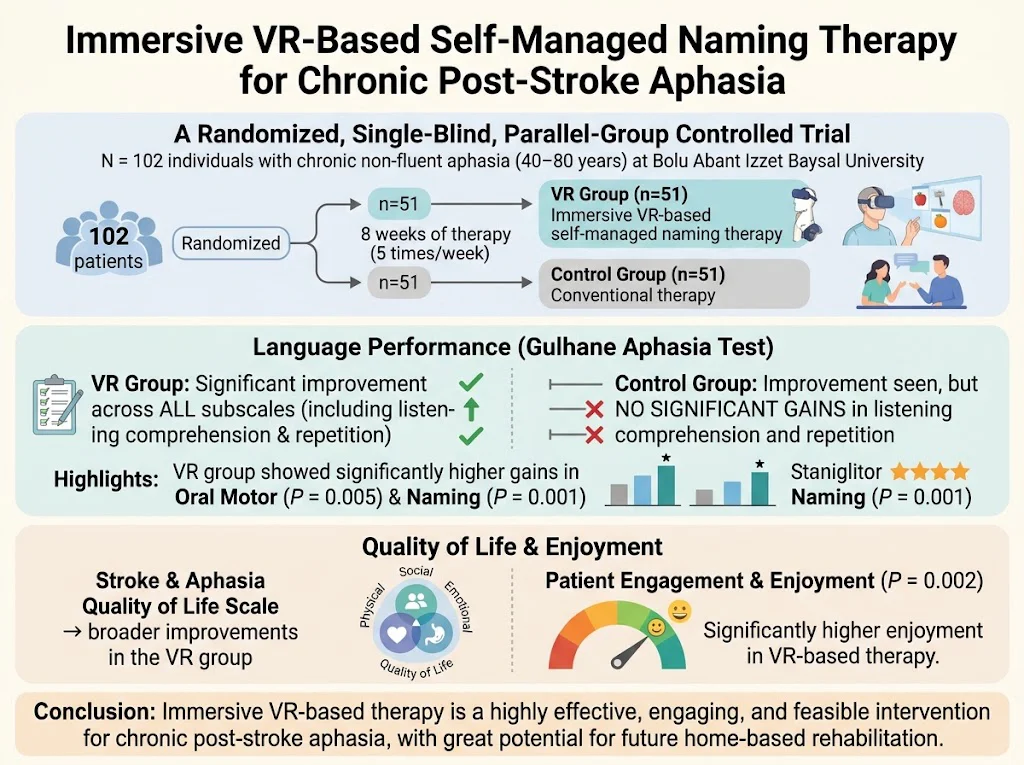
This was a randomized, single-blind, parallel-group, controlled trial conducted at Bolu Abant Izzet Baysal University Physical Medicine and Rehabilitation Hospital. A total of 102 patients aged 40 to 80 years with chronic non-fluent post-stroke aphasia were enrolled and randomly assigned to one of two groups (n=51 each). The VR group underwent immersive virtual reality-based self-managed naming therapy administered five times per week for eight weeks. The control group received conventional speech therapy following the same schedule.
The primary outcome measure was language performance assessed via the Gulhane Aphasia Test, covering multiple subdomains including oral motor skills, naming, listening comprehension, and repetition. Secondary outcomes included the Stroke and Aphasia Quality of Life Scale and patient-reported enjoyment of therapy sessions. Baseline demographics and clinical characteristics were similar between groups, ensuring comparability.
Key Findings
Both groups exhibited statistically significant improvements over baseline in overall Gulhane Aphasia Test scores and quality of life measures (p<0.05). However, the VR group demonstrated significant gains across all subscales of the Gulhane Aphasia Test, notably in oral motor function, naming, listening comprehension, and repetition, whereas the control group did not show significant improvements in listening comprehension and repetition domains.
Between-group comparisons revealed that the VR group achieved higher increases in oral motor scores (p=0.005) and naming ability (p=0.001). Notably, patient enjoyment was greater in the VR group (p=0.002), suggesting enhanced engagement and acceptance of the self-managed immersive therapy.
Quality of life improvements measured by the Stroke and Aphasia Quality of Life Scale were broader and more pronounced in the VR group, indicating meaningful functional benefits extending beyond language performance alone.
Expert Commentary
This randomized controlled trial provides compelling evidence supporting the efficacy of immersive VR-based naming therapy in enhancing language recovery in chronic post-stroke aphasia. The comprehensive improvements across multiple language domains may be attributed to VR’s multisensory, interactive environment that fosters active learning and neuroplastic reorganization. Increased patient enjoyment and engagement could translate into improved adherence and sustained functional gains.
However, the single-center design and lack of long-term follow-up necessitate cautious interpretation. Future multicenter studies with extended observation periods are warranted to confirm durability of effects and explore the feasibility of home-based VR rehabilitation platforms for broader access, particularly given the scalability of VR technologies.
Conclusion
Immersive VR-based self-managed naming therapy shows superior efficacy compared to conventional therapy for chronic non-fluent post-stroke aphasia, yielding significant improvements in language domains, patient quality of life, and enjoyment of therapy. These data indicate that VR is a promising adjunct or alternative in post-stroke aphasia rehabilitation, with the potential to overcome limitations of traditional therapy models. Further research should address long-term outcomes, cost-effectiveness, and implementation strategies for routine clinical practice and home use.
Funding and ClinicalTrials.gov
The study was conducted at Bolu Abant Izzet Baysal University Physical Medicine and Rehabilitation Hospital. Details regarding funding sources and clinical trial registration were not provided in the source material.
References
1. Kurul R, Benli ET, Ozkan T, Yaşar MF, Aydin Turkoğlu S. Efficacy of immersive virtual reality-based self-managed naming therapy for chronic post-stroke aphasia: A randomized controlled trial. Clinical Rehabilitation. 2026 Apr 21;40(11):1481-1493. PMID: 42012380.
2. Cherney LR, Halper AS, Holland AL, Cole R. Computerized Script Training for Aphasia: Preliminary Results. Am J Speech Lang Pathol. 2008;17(3):263-279.
3. Howard D. Neuroplasticity and aphasia therapy: progress and future prospects. Aphasiology. 2011;25(11):1325-1343.
4. Laver KE, George S, Thomas S, Deutsch JE, Crotty M. Virtual reality for stroke rehabilitation. Cochrane Database Syst Rev. 2017 Nov 20;11(11):CD008349.
5. Smania N, Picelli A, Gandolfi M, et al. Rehabilitation of aphasia: Evidence-based review of neuropsychological and speech therapy interventions. NeuroRehabilitation. 2010;27(3):201-213.