We use cookies

Our website uses essential cookies and, with your consent, additional cookies to measure performance and improve our services. Cookie Policy.

You can change your choice at any time.

MMedXYNews
HomeVideos
MedXY AI/MedXY News/Section: Internal Medicine

Bridging the Gap: Hospital Clinicians’ Challenges and Preparedness in Using Non-Stigmatizing Language in Clinical Documentation
MedXY Editorial Team•Oct 13, 2026•Internal Medicine
clinical documentationMedical EducationNội khoastigmatizing language

Highlight

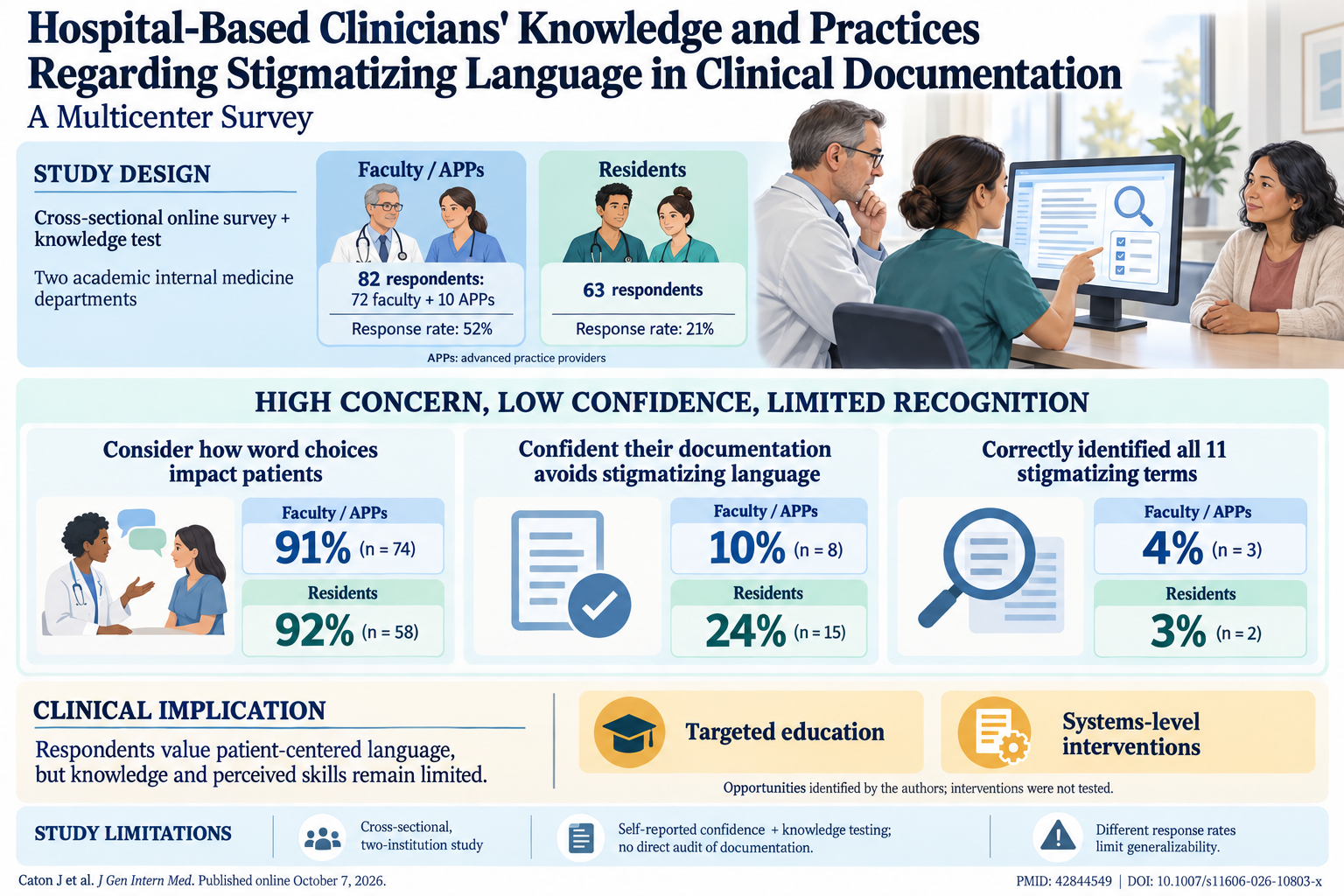
This multicenter survey studied internal medicine residents, faculty, and advanced practice providers’ (APPs) knowledge, attitudes, and practices regarding stigmatizing language in clinical documentation. Despite widespread recognition of the importance of thoughtful word choice, only a minority felt confident that their notes avoided stigmatizing language. Moreover, very few correctly identified all stigmatizing terms in a knowledge test, pointing to critical gaps in clinician preparedness. These findings underscore the urgent need for targeted educational interventions and system-level supports to promote patient-centered documentation and reduce implicit bias in clinical records.

Study Background

MedXY registered readers

Sign in free to continue reading

Create or use your MedXY account to unlock the complete article.

This article was created using several editorial tools, including AI, as part of the process. Human editors reviewed this content before publication.

Related articles

Open language-specific specialty feeds and department pages.

Enhancing Internal Medicine Resident Efficiency through Outpatient Documentation Standardization: Effects on Time, Note Quality, and BurnoutStandardizing outpatient documentation significantly reduces internal medicine resident time spent on EHR tasks and excessive note lengths, with modest improvements in burnout measures despite no broad well-being changes observed.Oct 17, 2026Bridging the Knowledge Gap: Enhancing Menopause Education for CliniciansDespite menopause being a universal experience, many physicians lack adequate training in menopause care, resulting in unmet patient needs and increased reliance on unregulated sources. Medical education reforms are essential to close this Oct 10, 2026Bridging Knowledge and Practice: Trauma-Informed Care Across Medical Training StagesThis study evaluates trauma-informed care (TIC) knowledge, attitudes, and practices among medical students and clinical instructors, revealing differences linked to training stages and lived adversity, highlighting opportunities for improveOct 1, 2026
Loading comments...
MedXY briefing

Get the free newsletter

Evidence-led clinical news, trends, and analysis—delivered to your inbox.

Ask MedXY AI

Most popular

Intimate Health
Five Benefits for Women Continuing Sexual Activity After Menopause
Intimate Health
Why Some Women Have a Strong Sex Drive—And Why Men Shouldn't Worry About It
Nursing & care
How often should a couple have sex?
Cardiology
Precision Medicine for Long QT Syndrome Type 2: Lumacaftor Corrects Trafficking Defects and Shortens QT Interval
General Surgery
Optimizing Postoperative Opioid Prescriptions After Intra-Abdominal Cancer Surgery: Comparing the 5x-Multiplier and 3-Tier Models
© 2026 MedXY
Contact usAbout usPrivacy PolicyMedXY story
When Well-Done Is Not the Same: Dissecting Communication Skill Assessment in Virtual versus In-Person OSCEs Among Medicine Residents
This study employs Item Response Theory to reveal that while overall communication scores in virtual and in-person OSCEs are similar, specific communication items like explaining jargon differ in proficiency thresholds across modalities, un
Sep 27, 2026
Evaluating ChatGPT-4o in Critical Care Board Review: High Accuracy but Risky Multimodal InterpretationsChatGPT-4o achieves high accuracy on critical care board questions but shows notable limitations in image interpretation and reasoning, posing potential clinical risks.Sep 27, 2026
Evolving Competence in Goals-of-Care Discussions Among Internal Medicine Physicians: Insights from a Qualitative Study Across Training LevelsThis qualitative study explores how internal medicine clinicians develop skills in discussing goals of care, revealing a progression from basic understanding to advanced, integrated communication approaches, and underscores the need for strSep 26, 2026