Highlight
A low-cost, blended digital parenting program (ParentApp) effectively reduces adolescent girls’ sexual violence victimisation in Tanzania.
ParentApp significantly decreases child maltreatment (physical, verbal abuse, neglect) as reported by both adolescents and caregivers.
The intervention also reduces exposure to high-risk situations for sexual violence in both boys and girls.
Demonstrates feasibility and scalability of integrating digital tools into community-based violence prevention in low-resource settings.
Study Background
Violence against children—including sexual, physical, and verbal abuse—is a pervasive global public health challenge. It is estimated that one billion children worldwide suffer from some form of violence annually, resulting in profound long-term physical, psychological, and social consequences. In sub-Saharan Africa, and specifically Tanzania, resource limitations, poor access to prevention programs, and cultural barriers exacerbate the problem. Evidence-based, scalable interventions that support families in creating safer environments for adolescents are urgently needed.
Parenting programmes represent a promising approach to mitigate risk factors for violence, nurturing protective family environments and enhancing caregiver-adolescent relationships. However, traditional delivery methods face challenges such as infrastructure gaps, cost, and engagement barriers. Digital innovations hold potential to overcome these constraints, yet rigorous evidence on efficacy and scalability remains limited. The ParentApp intervention uniquely integrates sexual violence prevention within the globally recognized WHO-UNICEF Parenting for Lifelong Health framework, employing a blended delivery involving both digital modules and interpersonal support to maximize impact.
Study Design
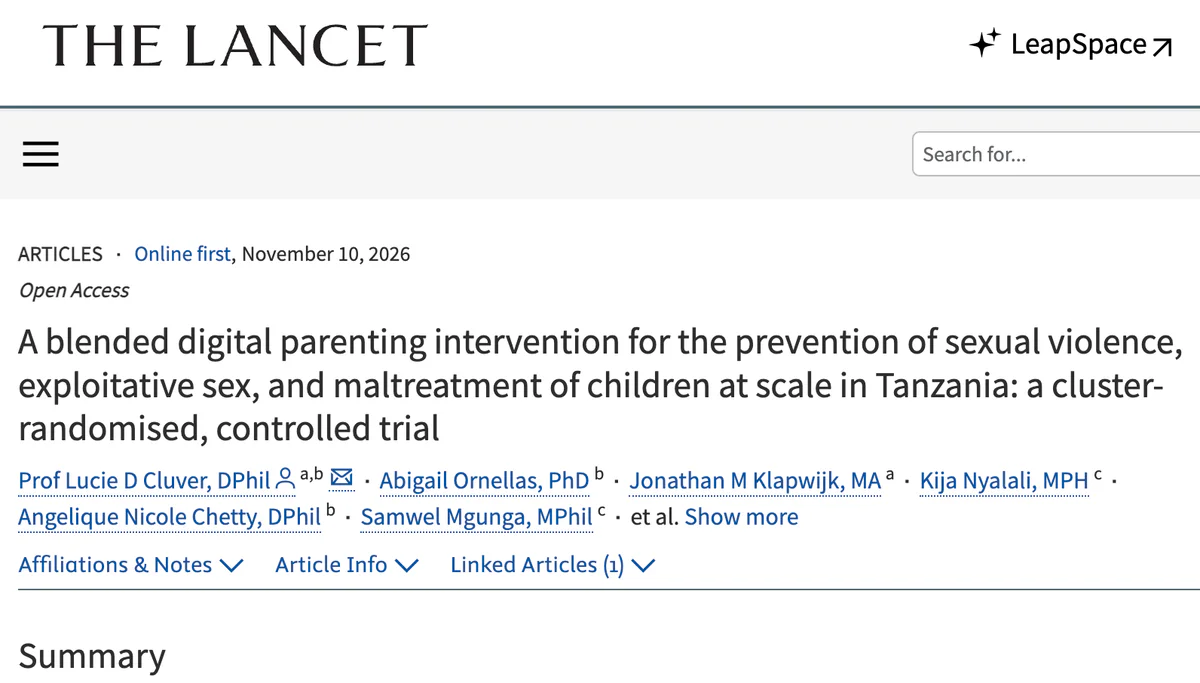
This cluster-randomized controlled trial was conducted across 80 sub-wards in Tanzania, encompassing both urban and rural settings. The study population comprised primary caregivers aged 18 years or older and their adolescent children aged 10–17 years. Each sub-ward (cluster) was randomly assigned in a 1:1 ratio to receive either the ParentApp intervention or a control intervention (WASHApp) focused on water, sanitation, and hygiene education.
The ParentApp intervention consisted of a 12-module offline-first Android application delivering sexual violence prevention content integrated within parenting education. Families received a low-cost Android smartphone preinstalled with ParentApp, one in-person orientation session, and ongoing remote support through WhatsApp group chats. The control arm similarly received an Android device with WASHApp and orientation but no content related to violence prevention. At scale, the ParentApp was projected to cost approximately US10 including smartphone provision).
The primary outcomes measured at 5 and 18 months post-baseline were (1) adolescent sexual violence victimisation, defined as recent experiences of sexual abuse or exploitative sex, (2) maltreatment including physical, verbal abuse and neglect, and (3) exposure to high-risk situations for sexual violence, as reported by adolescents and caregivers. Participants and researchers were aware of allocations due to the intervention nature; however, statisticians and data analysts remained masked to reduce bias. The trial was registered at OSF on March 14, 2023 (https://osf.io/t9fxz).
Key Findings
Out of 2,692 caregiver-adolescent dyads screened, 2,396 enrolled (50.8% female adolescents; 74.9% female caregivers) with retention rates of 89.5% for adolescents and 94.0% for caregivers at 18 months. Analysis revealed a robust and specific impact of ParentApp on reducing sexual violence against adolescent girls but not boys. Specifically, female adolescents in ParentApp clusters experienced a 57% reduction in past-month sexual violence victimisation compared to controls (incidence rate ratio [IRR] 0.43, 95% CI 0.21–0.86, p=0.018). No statistically significant effect was observed in boys (IRR 1.21, 95% CI 0.59–2.43, p=0.60).
Beyond sexual violence, the intervention significantly diminished maltreatment rates across adolescent and caregiver reports, with IRRs of 0.92 (adolescent) and 0.87 (caregiver), both at p<0.0001. This reflects substantial decreases in physical abuse, verbal abuse, and neglect. Moreover, exposure to high-risk contexts for sexual violence decreased markedly in ParentApp clusters for girls (IRR 0.87, p=0.012), boys (IRR 0.85, p<0.0001), and caregiver reports (IRR 0.81, p<0.0001), highlighting the program’s broader protective effect on environment safety.
Notably, no adverse events attributable to the intervention were reported, supporting the safety of the digital approach. These findings demonstrate the capacity of a low-cost, blended digital parenting intervention to effectively target multiple dimensions of violence prevention simultaneously.
Expert Commentary
This study represents a landmark in the field of violence prevention, demonstrating that digital parenting programs can be both feasible and effective at scale in low-resource settings. The significant reduction in sexual violence victimization specifically among girls aligns with epidemiologic patterns of gender vulnerability during adolescence. The intervention’s integrated approach, combining digital self-paced learning with interpersonal support, is likely a key factor enabling behavioral change and enhanced parent-adolescent communication.
Limitations include the inability to blind participants and researchers and potential reporting bias inherent in self-reported outcomes. Furthermore, the lack of effect on boys’ sexual violence victimization warrants further investigation to tailor interventions that address gender-specific risk pathways. Additional research is needed to assess long-term sustainability and potential integration into national child protection frameworks.
From mechanistic perspectives, ParentApp likely enhances protective caregiving behaviors and reduces risk factors such as poor mental health and dysfunctional family relationships, as suggested by improvements in these secondary outcomes reported in the full trial publication.
Conclusion
The ParentApp trial provides rigorous, real-world evidence that a blended digital parenting intervention can substantially reduce childhood sexual violence (in adolescent girls), maltreatment, and risk situations for sexual violence in resource-constrained countries such as Tanzania. Its low cost, scalability, and alignment with international WHO-UNICEF parenting frameworks render it a promising candidate for global dissemination and policy adoption. Future efforts should focus on optimizing engagement, adapting content for male adolescents, and embedding such tools within comprehensive multi-sectoral child protection strategies.
Funding and Trial Registration
This study was funded by the UK Research and Innovation Global Challenges Research Fund, The Oak Foundation, The LEGO Foundation, The European Research Council, and an anonymous donor. The trial protocol was registered with OSF (https://osf.io/t9fxz) on March 14, 2023.