Google DeepMind today announced the launch of AlphaGenome 2, a next-generation DNA sequence prediction model designed to decode how genetic variations alter gene regulation at the single-cell level. Trained on over 107 million individual cell profiles across 68 tissues, the conditional AI architecture moves beyond broad-tissue averages to pinpoint the exact cellular drivers of complex conditions, offering transformative potential for rare disease diagnostics and precision oncology.
Unlocking Cell-Specific Drivers in Rare Diseases and Oncology
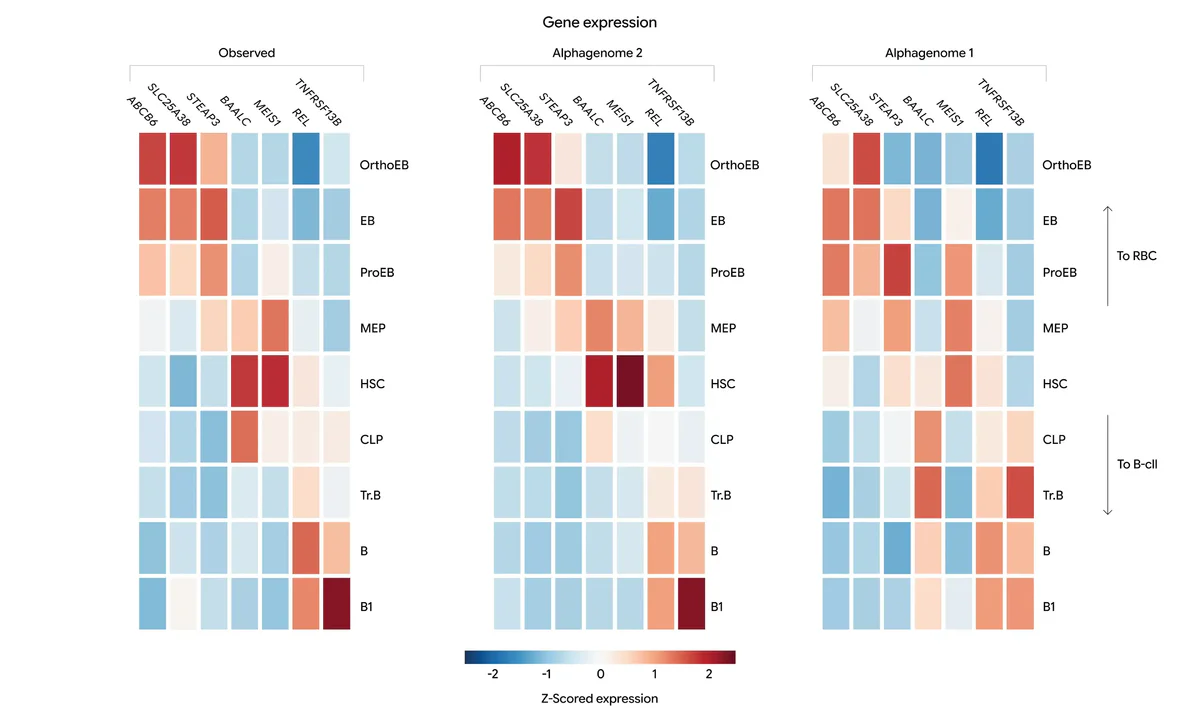
While the original AlphaGenome model and the AlphaGenome Atlas mapped all 9 billion possible single-letter mutations across broad tissues, subtle pathogenic variants often act only within highly specialized cell types or transient disease states. AlphaGenome 2 solves this bottleneck by taking both a 1-million-letter DNA sequence and a target biological condition—such as a specific cell lineage or a scientist's own single-cell RNA-seq snapshot—as simultaneous inputs.
Accelerating Rare Disease Diagnostics: Many rare genetic disorders stem from non-coding variants tucked inside distant regulatory switches (enhancers) whose target genes are invisible in bulk tissue samples. By mapping enhancer–gene wiring diagrams directly in primary human cell types—and identifying nearly twice as many causal variants (30% vs. 16%) as previous state-of-the-art tools—AlphaGenome 2 empowers clinicians and researchers to rapidly prioritize elusive, disease-causing mutations without requiring exhaustive lab-grown cell models.
Advancing Precision Oncology: Cancer thrives on cellular heterogeneity, aberrant epigenetic states, and dysfunctional immune microenvironments. AlphaGenome 2 not only predicts gene expression and chromatin accessibility, but introduces DNA methylation readouts and zero-shot generalization to unseen cellular states. By distinguishing how mutations disrupt gene activity in activated versus resting immune cells—or across continuous developmental lineages—the model can help oncology researchers trace tumor evolution, identify cell-specific oncogenic drivers, and uncover novel targets for targeted therapies and immunotherapies.
Industry Perspective: Agentic AI and Gene Editing Poised to Redefine Genetic Medicine
The release of AlphaGenome 2 arrives alongside plans to integrate its capabilities directly into Google's agentic scientific workflows, including upcoming AlphaGenome 2 Skills paired with Gemini 4 in Google Antigravity.
Industry observers note that embedding high-precision genomic reasoning directly into autonomous AI systems marks a pivotal inflection point for biomedicine. Rather than functioning solely as a standalone lookup tool, genomic prediction is rapidly becoming a core, internalized capability of frontier AI agents capable of formulating hypotheses, designing experiments, and interpreting multi-modal biological data end-to-end.
When paired with next-generation gene-editing technologies—such as base editing, prime editing, and epigenetic editors—this convergence could fundamentally compress the timeline from genetic discovery to clinical intervention. By using AI to pinpoint the exact causal nucleotide and vulnerable cell type with high confidence, and deploying programmable editors to rewrite or silence those pathogenic instructions in vivo, the biomedical field stands on the cusp of a rapid transformation in how inherited and somatic genetic diseases are diagnosed, modeled, and cured.
Availability
AlphaGenome 2 and interactive Colab expression-conditioning tutorials are available starting today for non-commercial research via the AlphaGenome API, and in private preview for commercial partners. (Note: AlphaGenome and AlphaGenome 2 are intended strictly for research use and have not been validated for clinical or diagnostic applications.)