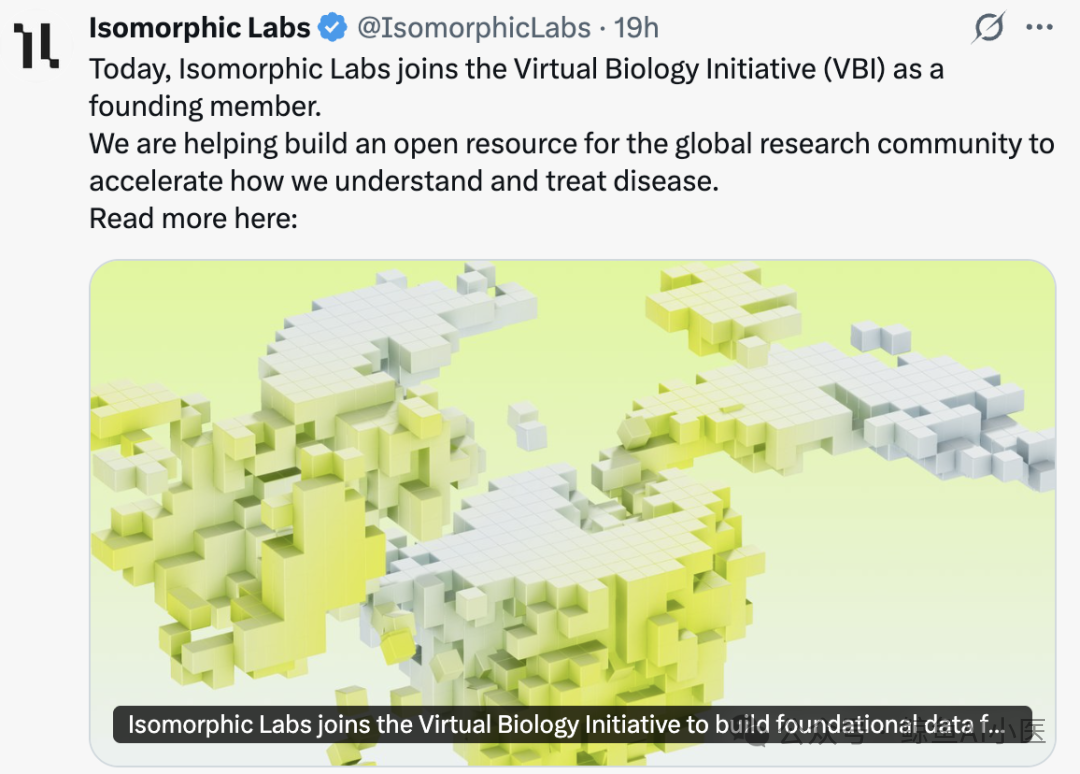
On October 7, the Chan Zuckerberg Biohub expanded its Virtual Biology Initiative; the DOE, NIH, Google DeepMind, Isomorphic Labs and Meta joined, bringing the combined figure to $1.8 billion, or roughly RMB 12 billion.
That figure pools new funding commitments with the assigned value of existing datasets, compute and laboratory assets. It is not a single cash transfer.
The stated rationale: protein structure prediction works, but cell-level efficacy, toxicity and drug-response prediction still fails, largely for lack of large, verified training data.
Commercial contributors receive roughly a one-year data embargo; government-funded data are to be released openly.
A first large dataset is targeted within a year; usable predictive models are a five-year goal. No patients, endpoints or clinical outcomes are involved.
What was actually announced
On October 7, the Chan Zuckerberg Biohub — the nonprofit research organization founded by Mark Zuckerberg and Priscilla Chan — announced an expansion of its Virtual Biology Initiative. The U.S. Department of Energy (DOE), the National Institutes of Health (NIH), Google DeepMind, Isomorphic Labs and Meta joined the effort, and the participants put the combined value of new investment, contributed data, compute and laboratory capability at $1.8 billion, roughly RMB 12 billion.
Precision matters here. This is not a clinical trial, a drug approval or a peer-reviewed result. There are no enrolled participants, no primary endpoint, and no efficacy or safety data. It is a research-infrastructure announcement: a plan to generate and share biological data at a scale intended to train predictive models of how cells behave and respond to perturbation.
The source material for this article is a Chinese-language industry commentary rather than a primary document, and it is explicit that the $1.8 billion is a pool — new funds plus the value assigned to existing data resources and compute assets — rather than a one-time cash injection. Read with that caveat, the announcement is still notable for who is participating and for what the participants say is missing from AI-driven drug discovery.
Where the $1.8 billion comes from
The breakdown described in the source coverage is as follows.
Participant | Contribution as described |
|---|---|
Chan Zuckerberg Biohub | $500 million committed in April, covering data generation, next-generation measurement technology, and cell observation and perturbation tools |
U.S. Department of Energy | More than $500 million over five years for data collection, AI analysis, measurement and imaging, and modelling compute; the DOE also brings exascale supercomputing, neutron scattering, cryo-electron microscopy and automated laboratory resources |
NIH | More than $500 million in existing datasets and knowledge bases to be coordinated and made AI-ready, drawing on holdings associated with the National Library of Medicine, NCBI, and consortium-built biological atlases |
DeepMind, Isomorphic Labs, Meta | $300 million combined, directed at the technology and multimodal datasets needed for predictive life-science models |
Ecosystem partners | The Allen Institute, Broad Institute, Human Cell Atlas and Human Protein Atlas contribute data; NVIDIA provides accelerated computing; the Renaissance Philanthropy foundation contributes additional funding |
161 days from $500 million to $1.8 billion
Biohub first announced the project on April 29, with a five-year, $500 million commitment: $100 million for a globally coordinated data-generation system and $400 million for large-scale data generation, next-generation measurement technology, and cell observation and perturbation tools. The expansion was announced 161 days later.
Whether adding in-kind data and compute to headline funding is the most informative way to describe the effort is a legitimate question. What is not in dispute is the shape of the coalition: government laboratories and supercomputers, decades of public biomedical databases, company-built models and engineering, and nonprofit convening capacity, assembled around one shared input.
Why the bottleneck has moved from models to data
The argument advanced by the participants is straightforward. Protein structure prediction has become remarkably capable, but when the same generation of models is asked about cell-level drug efficacy, toxicity or metabolic response, performance falls away — and the stated reason is the training data, which are neither large enough nor verified enough.
The source quotes Google DeepMind's vice president of AI, Pushmeet Kohli, saying that building a virtual cell is one of humanity's greatest scientific challenges and that it cannot be solved without large-scale open experimental data recording how living cells behave and respond to change. The wording is a re-translation from the source's Chinese text, so it should be read as paraphrase of meaning rather than a verbatim quotation.
The quantitative gap described is large. Existing cell datasets cover only hundreds of millions of cells, whereas high-accuracy predictive models would need billions to trillions of measurements spanning cell states, gene expression, protein changes and drug-response dynamics. No single company or agency can generate that volume alone, which is the stated logic for the alliance.
The loop Biohub wants to build
The intended workflow is a design-build-test-learn cycle: experiments generate data; the data train models; the models predict cell responses; cells are reprogrammed; experiments validate the predictions; and the results feed back into the models. Automated laboratories and standardized measurement technology are as central to that loop as the algorithms.
The timeline offered is deliberately conservative. The first large dataset is expected within about a year. Usable predictive models are a five-year goal. The long-term vision — a virtual cell accurate enough that experiments can be run in digital space, with only the most promising candidates sent to a physical bench — is framed as an aspiration, not a deliverable.
Open data with a one-year commercial head start
The governance mechanism may be the most consequential part of the announcement for industry readers. According to the source, all datasets are ultimately intended for public release as shared scientific assets. Commercial funders — DeepMind, Isomorphic Labs and Meta — receive an embargo of roughly one year, during which they can study the data before it opens to everyone. Data generated with government funding through the NIH and DOE is described as openly available without that restriction.
Alex Rives, a scientific lead at Biohub, is quoted saying that commercial participants need an incentive and that the embargo exists for that reason; again, this is a re-translation. The design trades a twelve-month information advantage for private capital that subsidizes public science. The source notes that Biohub plans further discussions with pharmaceutical companies and philanthropic foundations, and suggests that paying for early access to a defined data window may become a recurring commercial structure in AI drug discovery.
The same day, on several other fronts
The source places the announcement in a broader cluster of same-day or near-simultaneous moves, each aimed at data or experimental capacity rather than model architecture:
Rivercell announced $25 million in financing to build a data platform and AI models predicting human cell responses to therapy — a direct parallel to the virtual-cell thesis.
Isomorphic Labs was reported to be in talks to raise new funding at a valuation of at least $40 billion. That figure is unconfirmed and should be treated as reported, not established.
Anthropic established a wet laboratory, adding experimental biology capacity in-house.
The OpenAI Foundation launched a funding program of more than $125 million specifically for building biological and medical datasets needed for AI research.
The common thread the source identifies is that none of these moves primarily compete on model capability; they compete on data generation and experimental throughput.
Five implications the source draws for medical AI
The following points are the source author's industry analysis, not findings from a study or statements from the participating organizations.
Data assets become licensable. Where companies once licensed pipelines and molecules, they may increasingly negotiate priority access to curated datasets. Provenance, consent, quality auditing and compliance move from back-office functions to the deal table.
Wet labs and automation are the next moat. If model architectures converge, the differentiator becomes who can generate verified experimental data faster and more cheaply. Purely algorithmic companies need a credible answer on where their data come from.
Pharmaceutical companies face a window to secure data sources. If digital pre-screening followed by bench confirmation compresses development timelines, the benefit accrues to organizations with pipelines and clinical validation capacity — but only if they hold a seat at the data-generation table.
Contract research and laboratory automation gain a structural opening. A meaningful share of this spending flows to measurement technology, perturbation tools and data collection — creating demand for standardized, structured, model-ready experimental outputs rather than experiments alone.
Investors should separate real data moats from data narratives. Due diligence now needs to ask whether a dataset has a closed experimental validation loop, whether access is exclusive or time-limited, and whether annotation quality can support cell-level prediction.
What the announcement does not establish
Several boundaries deserve emphasis. The $1.8 billion is an aggregated commitment figure assembled by the participants, not independently audited cash. No data have yet been released, no model performance has been demonstrated, and no external benchmark supports the claim that the resulting datasets will enable accurate cell-level prediction. The five-year model target is a stated goal without a published milestone framework, and any slippage would not be visible from outside.
The embargo arrangement raises unresolved questions about how government-funded and commercially funded data streams will be separated in practice, how long the exclusivity window will survive commercial pressure, and whether academic groups without computing resources can use the data even once it is open.
Finally, nothing in this announcement speaks to clinical outcomes. A virtual cell that predicts toxicity or efficacy more accurately would change how candidates are prioritized before trials, but it would not replace human trials, and no regulatory pathway for model-guided candidate selection is described here. The consolidation of public data, government compute and private capital is a signal about where the field believes its constraint lies; it is not yet evidence that the constraint has been removed.