We use cookies

Our website uses essential cookies and, with your consent, additional cookies to measure performance and improve our services. Cookie Policy.

You can change your choice at any time.

MMedXYNews
HomeVideos
MedXY AI/MedXY News/Section: Diabetes & Endocrinology

Gardnerella Enrichment in the Vaginal Microbiome of Women with Gestational Diabetes Mellitus Is Associated with Lower Fetal Birthweight Percentiles
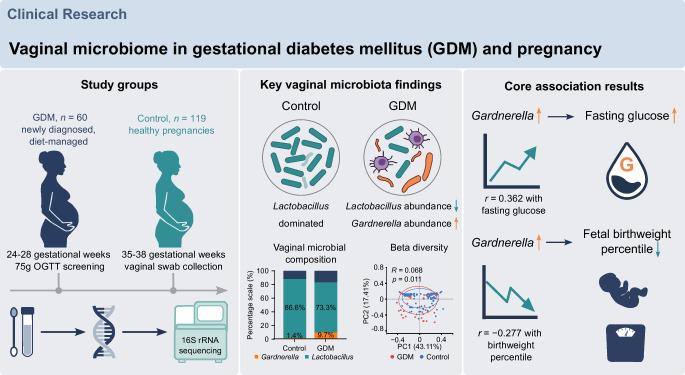
MedXY Editorial Team•Sep 8, 2026•Diabetes & Endocrinology
Gestational diabetes mellitusTăng trưởng thai nhiGardnerellaBirthweightVaginal Microbiome

graphic file with name 125_2026_6770_Figa_HTML.jpg

Introduction

Gestational diabetes mellitus (GDM) is a common pregnancy complication characterized by glucose intolerance with onset or first recognition during pregnancy. It is known to influence both maternal health and fetal development, posing risks such as macrosomia and increased cesarean delivery rates. Recent advances in microbiome research suggest that the vaginal microbiota, a critical component of maternal health, may also be altered in GDM, potentially affecting pregnancy outcomes. This article explores vaginal microbiome changes in late pregnancy among women with GDM and their correlations with maternal glycemic control and fetal growth metrics.

Study Objectives

MedXY registered readers

Sign in free to continue reading

Create or use your MedXY account to unlock the complete article.

This article was created using several editorial tools, including AI, as part of the process. Human editors reviewed this content before publication.

Related articles

Open language-specific specialty feeds and department pages.

Maternal Supine Sleep in Late Pregnancy: No Impact on Fetal Growth in Prospective Cohort StudyThis study finds no association between objectively measured maternal supine sleep during late pregnancy and customised birthweight centiles, suggesting mechanisms other than fetal growth underlie the risk of stillbirth with supine sleep poSep 5, 2026Antiseizure Medication Use During Pregnancy: Implications for Fetal Growth from the EURAP RegistryA comprehensive cohort study from the EURAP registry reveals that antiseizure medication, especially polytherapy and certain monotherapies, increases the risk of poor fetal growth, underscoring the need for optimized treatment strategies duSep 5, 2026Long-Term Cardiometabolic Risks of Gestational Diabetes Mellitus Subtypes: Insights from a 10-14 Year Prospective StudyThis study reveals that distinct gestational diabetes mellitus (GDM) subtypes confer increased risks of prediabetes, diabetes, metabolic syndrome, and cardiovascular disease 10-14 years postpartum, underscoring the need for tailored long-teAug 18, 2026
Loading comments...
MedXY briefing

Get the free newsletter

Evidence-led clinical news, trends, and analysis—delivered to your inbox.

Ask MedXY AI

Most popular

Intimate Health
Five Benefits for Women Continuing Sexual Activity After Menopause
Intimate Health
Why Some Women Have a Strong Sex Drive—And Why Men Shouldn't Worry About It
Nursing & care
How often should a couple have sex?
Intimate Health
Classic Intimacy Recommendations: How to Help Women Reach Orgasm and Enjoy Mutual Pleasure
Intimate Health
What Makes a Woman "Physiologically Addicted" Is Never Money, But These Two Relationship Qualities
© 2026 MedXY
Contact usAbout usPrivacy PolicyMedXY story
Bariatric Surgery, Gestational Diabetes, and Perinatal Outcomes: Insights from a Large Population-Based Study in New South Wales
This study examines how bariatric surgery and gestational diabetes mellitus independently and jointly impact maternal and neonatal outcomes, highlighting increased risks and the need for personalized antenatal care.
Aug 12, 2026
Lithium Use in Pregnancy: Balancing Risks of Spontaneous Preterm Birth, Cardiac Malformations, and Fetal GrowthA statewide Australian cohort study reveals lithium exposure during pregnancy doubles risk of spontaneous preterm birth and raises risks of cardiac malformations and large-for-gestational-age infants, informing clinical decision-making.Aug 18, 2026
Evaluating Selenium Supplementation in Gestational Diabetes Mellitus: Insights from a Systematic Review and Meta-AnalysisSelenium supplementation at 200 µg/d may reduce fasting plasma glucose and newborn hyperbilirubinemia risk in gestational diabetes without significantly altering lipid profiles, highlighting potential but limited benefits requiring further Oct 12, 2025