Functional Dissociation of Cervical VEMP and Posterior Canal vHIT: Implications for Vestibular Diagnostics in 1770 Unselected Ears
Introduction
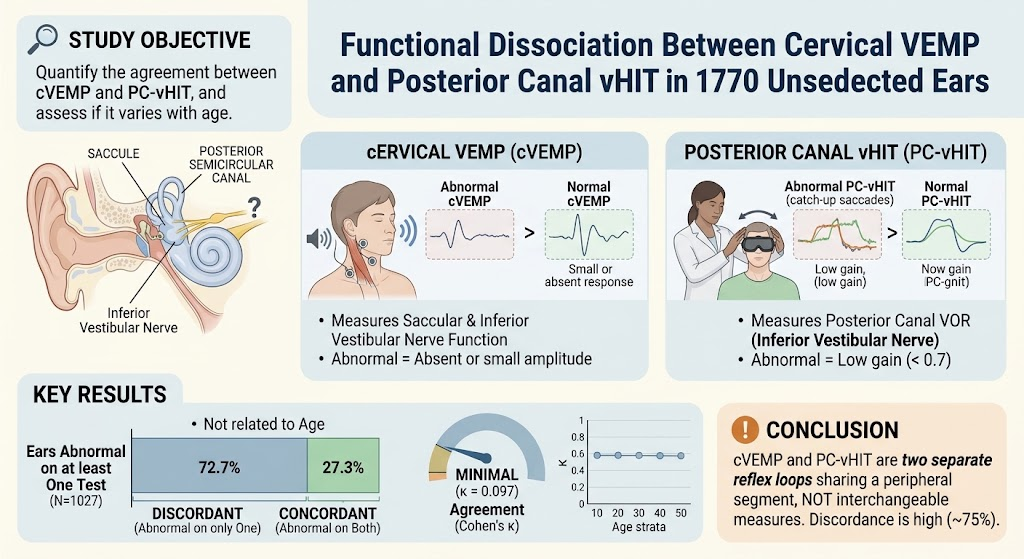
The vestibular system is critical for balance and spatial orientation, involving complex sensory inputs from semicircular canals and otolithic organs. The inferior vestibular nerve innervates the posterior semicircular canal and the saccule, which are routinely assessed clinically using posterior canal video head impulse testing (PC-vHIT) and cervical vestibular evoked myogenic potentials (cVEMP), respectively. Traditionally, these tests are considered complementary measures of a single inferior vestibular functional unit. However, the concordance of these tests, especially across a broad clinical population, remains uncertain.
This article reviews findings from a retrospective analysis of 1770 unselected ears, examining the agreement between cVEMP and PC-vHIT and interprets the clinical and physiological implications of their dissociation. We explore how these findings inform diagnostic approaches and understanding of vestibular reflex pathways.
Sign in free to continue reading
Create or use your MedXY account to unlock the complete article.
This article was created using several editorial tools, including AI, as part of the process. Human editors reviewed this content before publication.