Highlight
– Approximately 30% of infants with focal congenital hyperinsulinism (FoCHI) demonstrate early spontaneous glycemic improvement before surgery.
– Patients with less severe hypoglycemia and later diagnosis tended to achieve normoglycemia without surgical intervention.
– Surgical resection remains highly effective, but postoperative complications such as exocrine pancreatic insufficiency are primarily linked to pancreatic head resection.
– An exploratory predictive score was developed to identify candidates suitable for conservative management, potentially avoiding surgery.
Study Background
Congenital hyperinsulinism (CHI) represents the predominant genetic etiology underpinning persistent hypoglycemia in infancy, characterized by inappropriate insulin secretion leading to severe hypoglycemia. Early diagnosis and appropriate management are critical to prevent neurodevelopmental sequelae. Among the CHI subtypes, the focal form (FoCHI) features a localized pancreatic lesion amenable to targeted surgical resection. While surgery is curative in most cases, it carries significant risks, especially when involving the pancreatic head, including exocrine insufficiency and surgical morbidities. Exploring natural history and spontaneous glycemic trajectories preceding surgery could inform clinical decisions about treatment timing and the potential for conservative approaches.
Study Design
This retrospective cohort study analyzed medical records from a single referral center specializing in CHI management. The inclusion criterion was a confirmed diagnosis of FoCHI. Severity of hypoglycemia was stratified based on the requirement for continuous gastric tube feeding (TF) to maintain euglycemia before surgery, dividing the cohort into TF and no-tube feeding (NTF) groups. Data collected included age at diagnosis, initial hypoglycemia severity, treatment modalities, surgical outcomes, and long-term complications. An exploratory predictive score to assess early disease evolution was developed using clinical and biochemical parameters observed prior to surgery.
Key Findings
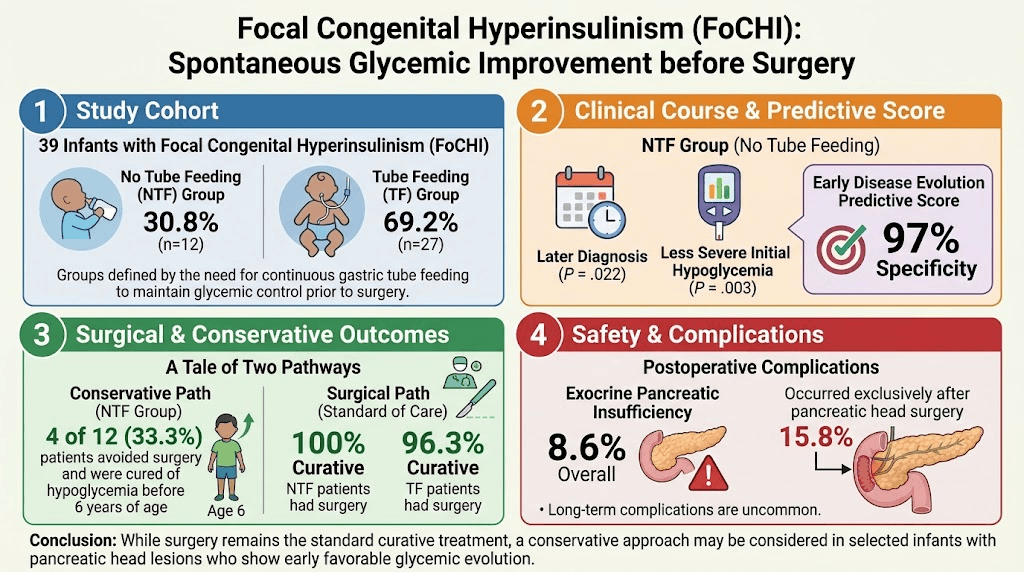
The cohort comprised 39 infants diagnosed with FoCHI: 12 (30.8%) were in the NTF group and 27 (69.2%) in the TF group. Key distinctions between groups included:
Age at diagnosis: The NTF group was diagnosed significantly later than the TF group (P = .022), suggesting a milder disease onset allowing for delayed clinical recognition.
Hypoglycemia severity: The NTF group exhibited less severe initial hypoglycemia (P = .003), correlating with a diminished need for aggressive nutritional support.
Spontaneous resolution: Remarkably, 4 of the 12 patients in the NTF group experienced spontaneous normalization of glycemia without surgical intervention, with resolution before 6 years of age.
Surgical outcomes: Surgery was curative in 96.3% of the TF group and 100% in those who underwent surgery in the NTF group, confirming surgical resection as a highly effective modality.
Long-term complications: Postoperative complications were infrequent (8.6% in TF group, 0% in NTF), limited to exocrine pancreatic insufficiency exclusively observed after pancreatic head resections (15.8%).
The authors proposed an exploratory predictive score incorporating clinical data to aid early identification of infants likely to improve spontaneously, achieving a high specificity of 97% for early favorable glycemic evolution.
Expert Commentary
This study challenges the conventional paradigm that immediate surgical intervention is always necessary for FoCHI. The observation that a meaningful subset of patients can improve spontaneously is clinically significant, especially in reducing surgical morbidity risks. The predominance of complications following pancreatic head surgery underscores the need to balance curative intent with preserving pancreatic function.
Limitations include the retrospective design and single-center context, which may limit generalizability. Prospective validation of the predictive score in diverse populations is essential before routine clinical application. Additionally, mechanistic explanations for spontaneous resolution remain to be elucidated but may involve regression or maturation changes in the focal lesion or compensatory metabolic adaptations.
Current guidelines prioritize surgical resection for FoCHI, but these findings encourage consideration of individualized, conservative strategies when early clinical indicators favor nonoperative management. Multidisciplinary discussion including endocrinologists, surgeons, and geneticists remains critical in managing these complex cases.
Conclusion
The data indicate that approximately 30% of infants with FoCHI can demonstrate early spontaneous normalization of glycemia, potentially obviating the need for surgery. Despite surgical resection remaining the gold standard for PHI cure, a selective conservative management approach may be feasible and safe for infants exhibiting favorable early glycemic trends, particularly with pancreatic head lesions. This underscores the importance of tailored clinical evaluation and cautious surgical decision-making to minimize long-term complications while ensuring metabolic control and neuroprotection.
Further research should aim to validate predictive models prospectively and clarify biological mechanisms underpinning spontaneous improvement. Meanwhile, clinicians should consider the possibility of natural disease regression and weigh surgical risks thoroughly in treatment planning.
Reference
Arnoux JB, Mayer C, Jhaouat I, Saint-Martin C, Bérat CM, Altenburger L, Brassier A, Bouchereau J, Querciagrossa S, Bustarret O, Jugie M, Barbet P, Aveline C, Montravers F, Capito C, de Lonlay P. Focal congenital hyperinsulinism: spontaneous glycemic improvement before surgery. J Clin Endocrinol Metab. 2026 Oct 16;111(11):3032-3041. doi: 10.1210/clinem/dgag227. PMID: 42274546.