Exploring the Link Between Mild Autonomous Cortisol Secretion and Psychiatric Disorders in Patients With Adrenal Tumors
Highlight
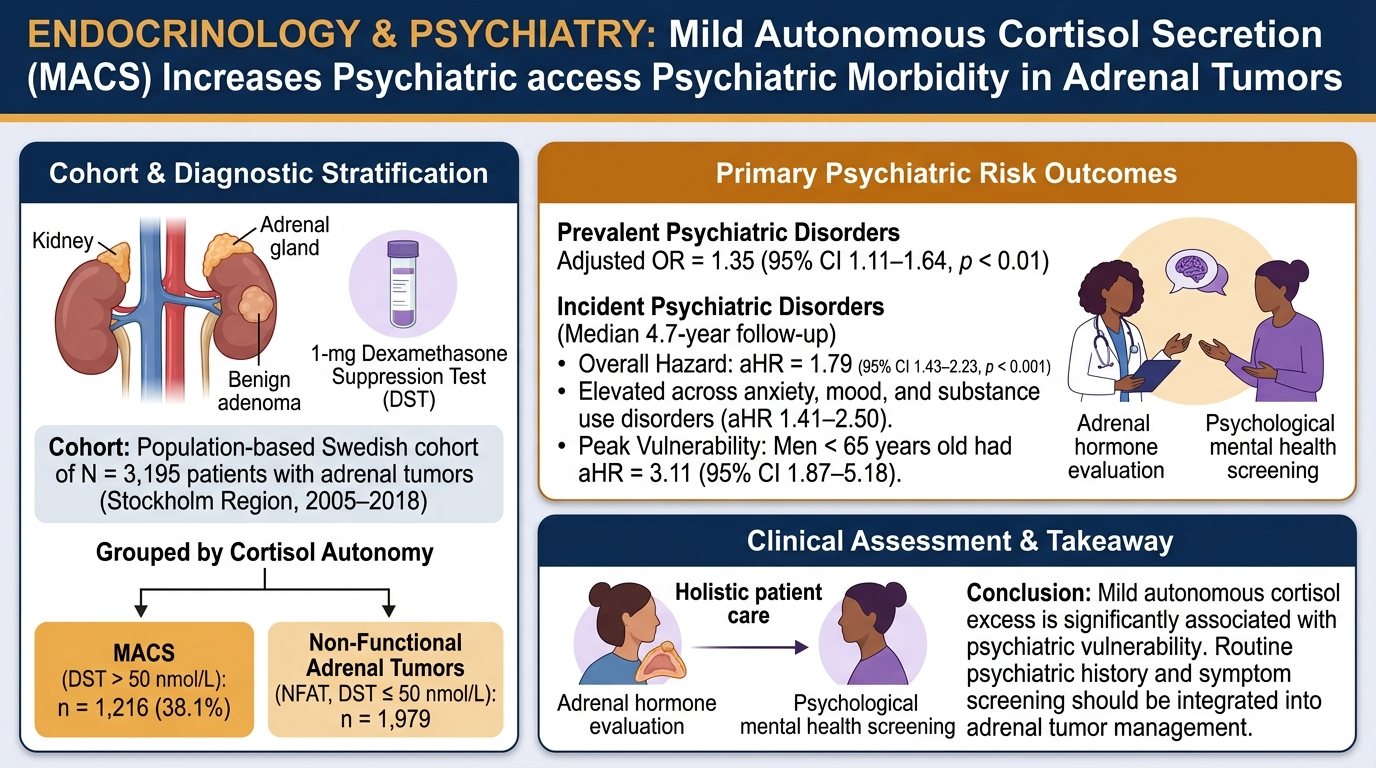
Mild autonomous cortisol secretion (MACS) in adrenal tumors correlates with a higher prevalence and incidence of psychiatric disorders.
Psychiatric morbidity includes anxiety, mood, and substance use disorders, with the strongest association among men under 65 years.
Findings suggest clinical evaluation for psychiatric symptoms should be integrated into management of patients with adrenal tumors exhibiting cortisol autonomy.
The study emphasizes the neuropsychiatric impacts of subtle cortisol excess beyond known cardiometabolic risks.
Study Background
Adrenal tumors (ATs) are increasingly detected incidentally during imaging for unrelated conditions. While many ATs are non-functional, some exhibit mild autonomous cortisol secretion (MACS) characterized by slight cortisol excess without overt features of Cushing syndrome. MACS is well-documented to increase cardiometabolic risk, including hypertension, diabetes, and cardiovascular events. However, its impact on psychiatric health remains poorly characterized despite cortisol’s well-known influence on brain function and mood regulation.
Cortisol dysregulation has been implicated in various psychiatric conditions such as depression, anxiety, and substance use disorders. Understanding whether MACS contributes to psychiatric morbidity is critical to informing holistic management strategies for patients with adrenal tumors exhibiting mild cortisol autonomy.
Study Design
This population-based retrospective cohort study included 3,195 patients with a first-time diagnosis of a benign adrenal tumor from 2005 to 2018 in the Stockholm Region, Sweden. All patients had undergone a 1-mg dexamethasone suppression test (DST), a standard diagnostic tool measuring cortisol suppression after dexamethasone administration. Patients were classified as having MACS if the post-DST cortisol level exceeded 50 nmol/L, indicating inadequate cortisol suppression; those with levels ≤50 nmol/L were classified as having non-functional adrenal tumors (NFAT).
Data were obtained via linkage of national registers and regional laboratory databases, capturing psychiatric diagnoses and dispensed psychotropic medications. Both prevalent (existing) and incident (newly diagnosed during follow-up) psychiatric outcomes were analyzed. Statistical methods included logistic regression for prevalent outcomes and Cox proportional hazards models for incidence, adjusting for confounding factors such as age, sex, and socioeconomic status.
Key Findings
Of the 3,195 patients, 1,216 (38%) met criteria for MACS, while 1,979 had NFAT.
Prevalent Psychiatric Disorders: At baseline, psychiatric diagnoses were more common in the MACS group than in NFAT, with an adjusted odds ratio (aOR) of 1.35 (95% CI, 1.11-1.64), indicating a 35% higher likelihood of psychiatric morbidity associated with cortisol autonomy.
Incident Psychiatric Disorders During Follow-up: With a median follow-up duration of 4.7 years, MACS was significantly associated with higher incidence of psychiatric disorders overall (adjusted hazard ratio [aHR] 1.79, 95% CI 1.43-2.23). This increased risk encompassed several diagnostic categories including anxiety disorders, mood disorders, and notably substance use disorders—with aHRs ranging from 1.41 to 2.50.
Subgroup analyses demonstrated that men under 65 years old with MACS had the highest risk for developing psychiatric disorders (aHR 3.11, 95% CI 1.87-5.18), suggesting age and sex may modify vulnerability.
After correction for multiple statistical comparisons, the associations remained statistically significant only for overall psychiatric disorders and substance use disorders, underscoring a particularly strong link between mild cortisol excess and propensity for substance misuse.
Analyses were robust across both categorical DST cutoff groups and continuous cortisol level measures, reinforcing the relationship between cortisol autonomy and psychiatric risk.
Expert Commentary
This comprehensive cohort study adds important evidence that even mild autonomous cortisol secretion, often considered subclinical, can adversely affect psychiatric health. Cortisol’s neurobiological effects include modulation of neurotransmitters, neuronal plasticity, and the hypothalamic-pituitary-adrenal axis, all implicated in mood and addictive behaviors.
Clinicians caring for patients with adrenal tumors should be aware of the elevated psychiatric risk associated with MACS, especially in younger men who seem particularly vulnerable. Psychiatric screening and close monitoring may facilitate earlier identification of mood and substance use disorders and improve overall outcomes.
Nevertheless, limitations of the study include its retrospective design and reliance on registry diagnoses, which may underreport psychiatric morbidity. The causal directionality between cortisol excess and psychiatric disease cannot be definitively proven but is biologically plausible given the known effects of glucocorticoids on the brain.
Conclusion
Mild autonomous cortisol secretion in patients with adrenal tumors is associated with an increased prevalence and incidence of psychiatric disorders, particularly substance use disorders. This underscores the need for integrated psychiatric assessment and management in this population. Future prospective studies are warranted to explore potential benefits of addressing cortisol autonomy on psychiatric outcomes and to elucidate underlying mechanisms.
Funding and Clinical Trials
No specific funding or clinical trial identifiers were reported for this study.
References
Mirzaei H, Lindh JD, Falhammar A, Schaafsma M, Mannheimer B, Falhammar H. Mild Autonomous Cortisol Secretion and Psychiatric Morbidity in Patients With Adrenal Tumors: A Cohort Study. J Clin Endocrinol Metab. 2026 Oct 12; PMID: 42861547. https://pubmed.ncbi.nlm.nih.gov/42861547/
Vreeburg SA, Hoogendijk WJ, van Dyck R, et al. Major depressive disorder and hypothalamic-pituitary-adrenal axis activity: results from a large cohort study. Arch Gen Psychiatry. 2009;66(6):617-626.
Stewart PM. Clinical review: The adrenal cortex. J Clin Endocrinol Metab. 2012;97(6):1846-1856.
Chrousos GP. Stress and disorders of the stress system. Nat Rev Endocrinol. 2009;5(7):374-381.
Tobin VA et al. Neuroendocrinology of stress and mental illness: translational research and clinical perspectives. Front Psychiatry. 2019;10:1-18.
This article was created using several editorial tools, including AI, as part of the process. Human editors reviewed this content before publication.