Exploring Janus Kinase Inhibition as a Novel Therapeutic Avenue in Idiopathic Subglottic Stenosis
Highlight
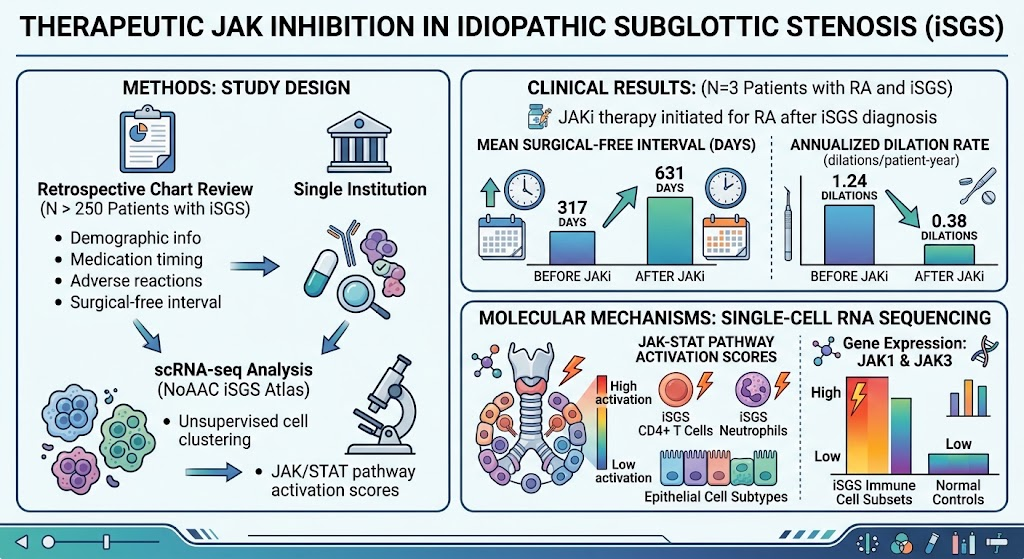
• JAK/STAT signaling pathway activation is pronounced in immune cells, primarily CD4+ T cells and neutrophils, in idiopathic subglottic stenosis (iSGS).
• Initiation of Janus kinase inhibitors (JAKi) in three patients with coexistent rheumatoid arthritis and iSGS doubled the surgical-free interval and reduced annual airway dilation rates.
• Single-cell RNA sequencing (scRNA-seq) reveals elevated JAK1 and JAK3 expression in immune subsets compared to normal controls, underscoring a pathological immune-mediated mechanism.
• These data suggest JAK inhibitors could fill a therapeutic gap in iSGS, currently lacking effective adjuvant medical therapies.
Study Background and Disease Burden
Idiopathic subglottic stenosis (iSGS) is a rare yet clinically significant fibroinflammatory disorder characterized by progressive narrowing of the subglottic airway, leading to obstructive respiratory symptoms and repeated procedural interventions. The etiology of iSGS remains unclear, but it is increasingly recognized as an immune-mediated fibroinflammatory disease predominantly affecting adult women. Current management hinges on surgical interventions such as endoscopic dilations or open airway resections. However, these approaches do not address underlying disease activity, leading to frequent recurrences and significant patient morbidity.
This unmet need for effective medical therapies has inspired investigation into targeted immunomodulatory agents. Janus kinase inhibitors (JAKi), which disrupt the JAK/STAT signaling involved in immune cell activation, have revolutionized treatment paradigms in autoimmune and fibroinflammatory diseases, notably rheumatoid arthritis (RA). Given the fibroinflammatory nature of iSGS and shared immunopathogenic pathways, repurposing JAKi presents a compelling rationale for therapeutic innovation.
Study Design
The study is a retrospective single-center chart review involving over 250 patients diagnosed with iSGS. Among them, three patients who concurrently developed RA initiated JAK inhibitor therapy. Key clinical parameters were analyzed before and after JAKi initiation, including surgical-free intervals and the frequency of airway dilations per patient-year. Demographic data and adverse events were recorded.
Complementing clinical data, the authors utilized the NoAAC iSGS single-cell RNA sequencing atlas to interrogate cellular-level JAK/STAT pathway activity. Unsupervised clustering of single-cell transcriptomes permitted identification of immune and epithelial cell subtypes, and calculation of JAK/STAT activation scores illuminating disease-relevant cellular targets.
Key Findings and Results
Clinical outcomes showed a substantial increase in mean surgical-free interval—from 317 days before JAKi initiation to 631 days after—and a decrease in annualized dilation rates from 1.24 to 0.38 per patient-year across the three patients treated with JAKi for RA. This suggests a clinically meaningful impact on disease recurrence and airway patency maintenance.
Single-cell transcriptomic analysis revealed elevation of JAK/STAT signaling specifically in immune cell populations implicated in iSGS pathogenesis. CD4+ T cells and neutrophils exhibited the highest activation scores, whereas epithelial cells showed minimal activation, indicating that immune-mediated inflammation rather than epithelial alteration drives disease progression. Gene expression of JAK1 and JAK3 was markedly increased in immune cells from iSGS samples compared to healthy controls, supporting a mechanistic basis for JAK inhibition targeting these kinases.
Adverse events related to JAKi therapy were not reported in detail but no significant safety concerns emerged in this small cohort, consistent with established safety profiles of JAK inhibitors when carefully monitored.
Expert Commentary
The study offers promising preliminary evidence that disrupting immune-driven fibroinflammation via JAK inhibition may alter the natural history of iSGS. The use of cutting-edge single-cell transcriptomics solidifies a mechanistic rationale by pinpointing the cellular compartments with active JAK/STAT signaling, aligning translational data with clinical observation.
However, limitations include the retrospective design, small sample size for JAKi-treated patients, and lack of a controlled comparator group. These factors caution against overgeneralization. Moreover, iSGS heterogeneity and disease rarity necessitate multicentric prospective clinical trials to validate efficacy and safety and optimize therapeutic regimens.
In the context of broader fibroinflammatory airway diseases, similar targeted approaches may be applicable, reflecting the expanding role of JAK inhibitors across disciplines beyond rheumatology.
Conclusion
This work highlights the potential of Janus kinase inhibitors as a novel therapeutic strategy in idiopathic subglottic stenosis, with preliminary clinical evidence indicating extension of surgical-free intervals and decreased requirement for airway dilations. The single-cell RNA sequencing data underscore the centrality of JAK/STAT signaling in immune cells driving disease pathology.
Future directions include well-designed prospective clinical trials assessing JAKi efficacy and safety specifically in iSGS patients, incorporation of biomarkers for patient stratification, and exploration of combination strategies with surgical interventions to optimize outcomes. Ultimately, targeted immunomodulation may transform management paradigms in this challenging disorder.
Funding and Clinical Trials
The source publication does not specify funding details or registered clinical trials. Prospective studies should be registered with appropriate clinical trial registries to enhance transparency.
References
1. Larkin RM, Lina I, Kostas J, Christmann C, Byram K, Gelbard A. Therapeutic JAK Inhibition in Idiopathic Subglottic Stenosis. The Laryngoscope. 2026 Aug 27. PMID: 42657509.
2. Schwartz DM, et al. JAK inhibition as a therapeutic strategy for immune and inflammatory diseases. Nat Rev Drug Discov. 2017 Dec;16(12):843-862.
3. Gelbard A, et al. Immunopathology of idiopathic subglottic stenosis. Laryngoscope Investig Otolaryngol. 2022;7(3):663-672.
4. Ouyang W, et al. Janus kinases are potential targets in fibroinflammatory diseases. Sci Transl Med. 2021;13(576):eabd2953.
This article was created using several editorial tools, including AI, as part of the process. Human editors reviewed this content before publication.