We use cookies

Our website uses essential cookies and, with your consent, additional cookies to measure performance and improve our services. Cookie Policy.

You can change your choice at any time.

MMedXYNews
HomeVideos
MedXY AI/MedXY News/Section: Hematology-Oncology

Evolving Landscape of Respiratory Viral Infections in Hematopoietic Cellular and CAR T-cell Therapy Recipients Post-COVID-19 Pandemic

MedXY Editorial Team•Sep 24, 2026•Hematology-Oncology
hematopoietic cell transplantCAR T-cell therapyrespiratory viral infectionsimmunocompromised hostSARS-CoV-2
Highlight

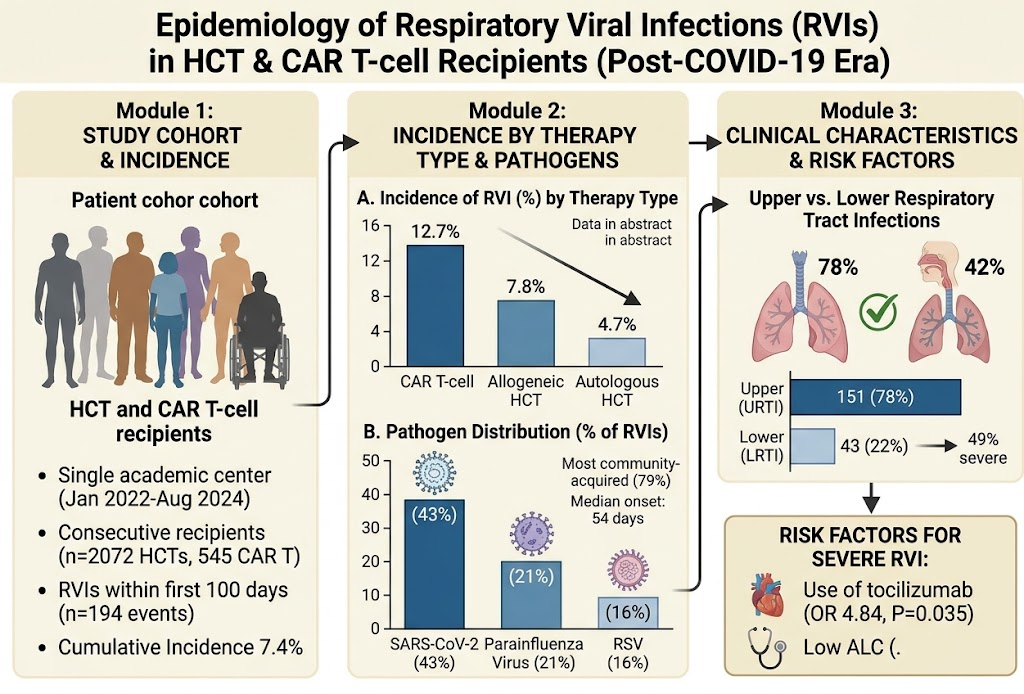
  • Respiratory viral infections (RVIs) remain a frequent complication within the first 100 days after hematopoietic cell transplantation (HCT) and CAR T-cell therapy, with an overall cumulative incidence of 7.4%.
  • SARS-CoV-2 is now the most common respiratory virus identified in this vulnerable population, accounting for 43% of RVIs, followed by parainfluenza virus and RSV.
  • CART-cell therapy recipients experience a higher incidence of RVI (12.7%) compared to allogeneic (7.8%) and autologous (4.7%) HCT recipients, with severe lower respiratory tract infections (LRTIs) occurring frequently in the setting of recent tocilizumab exposure and lymphopenia.

Study Background

MedXY registered readers

Sign in free to continue reading

Create or use your MedXY account to unlock the complete article.

This article was created using several editorial tools, including AI, as part of the process. Human editors reviewed this content before publication.

Related articles

Open language-specific specialty feeds and department pages.

Unraveling the Risks: T-Cell Lymphoma After CAR T-Cell Therapy—A Rare but Real ConcernT-cell lymphomas after CAR T-cell therapy are exceedingly rare but significant. This article reviews incidence, mechanisms, diagnostic challenges, and clinical implications to guide vigilance without overshadowing CAR T-cell therapy’sSep 22, 2026Five-Year Survival and Durable Remission with Lisocabtagene Maraleucel in Relapsed/Refractory Large B-Cell Lymphoma: Insights from the TRANSCEND NHL 001 StudyLisocabtagene maraleucel demonstrates durable five-year survival and potential cure in relapsed/refractory large B-cell lymphoma, with manageable long-term safety, based on data from the TRANSCEND NHL 001 trial and its long-term follow-up.Sep 18, 2026Optimizing Bridging Therapy Before BCMA-Directed CAR T-Cell Treatment in Relapsed/Refractory Multiple Myeloma: A Real-World Multicenter AnalysisBridging therapy before BCMA-directed CAR T-cell infusion in relapsed/refractory multiple myeloma impacts disease control and outcomes. This study analyzes regimen efficacy and safety in 399 patients, highlighting variable responses and safSep 13, 2026
Loading comments...
MedXY briefing

Get the free newsletter

Evidence-led clinical news, trends, and analysis—delivered to your inbox.

Ask MedXY AI

Most popular

Intimate Health
Five Benefits for Women Continuing Sexual Activity After Menopause
Intimate Health
Why Some Women Have a Strong Sex Drive—And Why Men Shouldn't Worry About It
Nursing & care
How often should a couple have sex?
General Surgery
Optimizing Postoperative Opioid Prescriptions After Intra-Abdominal Cancer Surgery: Comparing the 5x-Multiplier and 3-Tier Models
Intimate Health
Classic Intimacy Recommendations: How to Help Women Reach Orgasm and Enjoy Mutual Pleasure
© 2026 MedXY
Contact usAbout usPrivacy PolicyMedXY story
Arlocabtagene Autoleucel: Advancing Treatment Paradigms in Heavily Pretreated Relapsed/Refractory Multiple Myeloma
Arlocabtagene autoleucel (arlo-cel) is a novel GPRC5D-targeted CAR T-cell therapy showing promising efficacy and manageable safety in patients with relapsed/refractory multiple myeloma heavily pretreated with standard regimens, including pr
Sep 12, 2026
Bicistronic CD19/CD22 CAR T-Cell Therapy: A Breakthrough for Pediatric Relapsed/Refractory B-Cell Acute Lymphoblastic LeukemiaA phase 2 trial shows bicistronic CD19/CD22 CAR T-cell therapy yields high remission rates with durable event-free survival in pediatric relapsed/refractory B-ALL, reducing antigen-negative relapse risks and improving outcomes.Sep 6, 2026
Targeting the CA19-9 Glycan: A Promising CAR T Cell Therapy for Pancreatic and Gastrointestinal CancersCAR T cells targeting the CA19-9 glycan show potent, specific anti-tumor activity in pancreatic and various gastrointestinal cancers, providing new avenues for immunotherapy of hard-to-treat solid tumors.Aug 29, 2026