We use cookies

Our website uses essential cookies and, with your consent, additional cookies to measure performance and improve our services. Cookie Policy.

You can change your choice at any time.

MMedXYNews
HomeVideos
MedXY AI/MedXY News/Section: news

Evaluating Voice Disorder Risks in Peri- and Post-Menopausal Women Using Hormone Replacement Therapy: Insights from a Large TriNetX Cohort
MedXY Editorial Team•Sep 7, 2026•news
MenopausedysphoniaVoice Disordershormone replacement therapy

Highlight

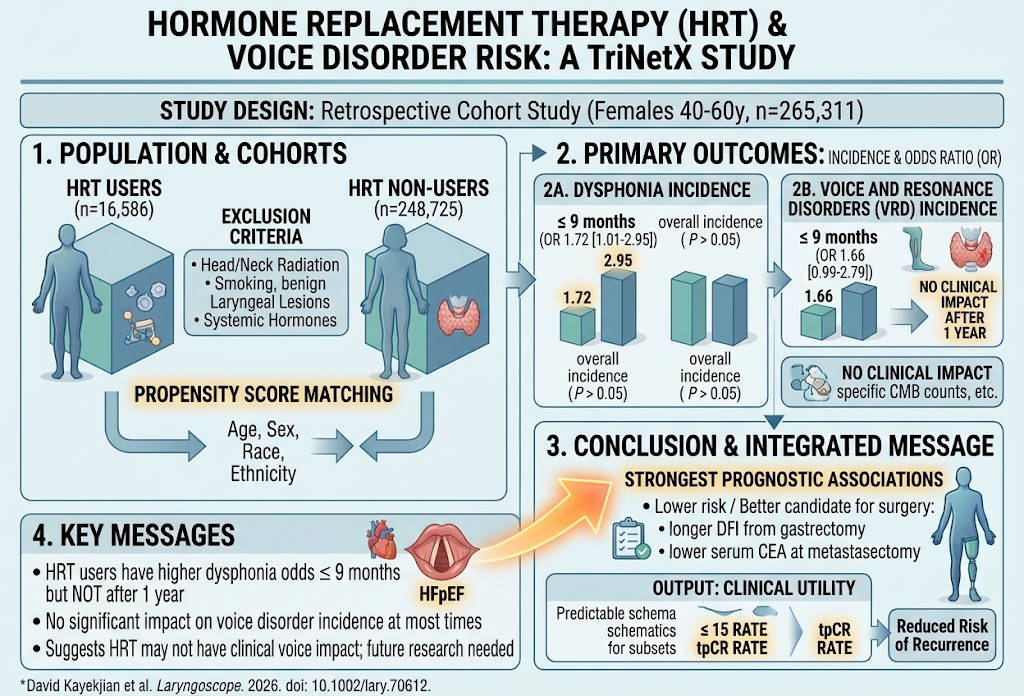
This large retrospective cohort study utilizing the TriNetX database evaluated peri- and post-menopausal women aged 40–60 years and found that hormone replacement therapy (HRT) users exhibited a transient increase in dysphonia risk during the first 9 months of treatment. No significant long-term increased risk for voice and resonance disorders (VRD) was observed within one year. The study contributes to the sparse and conflicting literature on HRT’s impact on voice health, emphasizing the need for further prospective research.

Study Background

MedXY registered readers

Sign in free to continue reading

Create or use your MedXY account to unlock the complete article.

This article was created using several editorial tools, including AI, as part of the process. Human editors reviewed this content before publication.

Related articles

Open language-specific specialty feeds and department pages.

Variable Effects of Vagus Nerve Stimulator Cycling on Vocal Fold Motion: A Videographic Case SeriesThis case series examines eight patients experiencing dysphonia after vagus nerve stimulator placement, highlighting variable and transient vocal fold motion changes during device cycling.Aug 31, 2026Menopausal Transition and Thyroid Function: Deciphering the Impact Beyond Aging in Midlife WomenA comprehensive longitudinal study reveals that menopausal transition does not significantly alter thyroid function beyond normal aging effects in healthy women, clarifying the interplay between menopause and thyroid health.Aug 21, 2026Menopause Management in Patients with Cancer: A Symptom‑Based, Risk‑Stratified FrameworkPractical, symptom‑focused recommendations for managing menopause in people with cancer—balancing symptom relief with oncologic safety using nonhormonal first-line strategies, selective use of local estrogen, and shared decision making forAug 12, 2026Integrative Medicine Approaches for Menopause: Evidence-Based Nonhormonal Strategies for Symptom Management
Loading comments...
MedXY briefing

Get the free newsletter

Evidence-led clinical news, trends, and analysis—delivered to your inbox.

Ask MedXY AI

Most popular

Intimate Health
Five Benefits for Women Continuing Sexual Activity After Menopause
Intimate Health
Why Some Women Have a Strong Sex Drive—And Why Men Shouldn't Worry About It
Nursing & care
How often should a couple have sex?
Intimate Health
Classic Intimacy Recommendations: How to Help Women Reach Orgasm and Enjoy Mutual Pleasure
Intimate Health
What Makes a Woman "Physiologically Addicted" Is Never Money, But These Two Relationship Qualities
© 2026 MedXY
Contact usAbout usPrivacy PolicyMedXY story
This article reviews evidence-based integrative medicine approaches for menopause, including lifestyle, mind-body therapies, nutrition, botanicals, and acupuncture, emphasizing nonhormonal options for symptom relief and health optimization.
Aug 18, 2026
Can Postmenopausal Women Still Have a Sex Life? Stop Worrying About Weekly Frequency—Comfort, Safety, and Mutual Desire Matter MostMenopause isn't a "stop button" for intimacy, nor is there any medical rule dictating that you must retire your sex life at a certain age. What trulyAug 7, 2026
Disparities and Persistence in Systemic Hormone Therapy Among Menopausal Women: Insights from a Large Real-World AnalysisA comprehensive study reveals initiation rates, duration, and racial disparities in systemic hormone therapy use among menopausal women, emphasizing critical care gaps and the need for equitable interventions.Aug 18, 2026