We use cookies

Our website uses essential cookies and, with your consent, additional cookies to measure performance and improve our services. Cookie Policy.

You can change your choice at any time.

MMedXYNews
HomeVideos
MedXY AI/MedXY News/Section: news

Evaluating the Safety of Standardized Tranexamic Acid Dosage in Facelift Surgery: Insights from a Large Retrospective Cohort
MedXY Editorial Team•Oct 14, 2026•news
facelift surgerylocal anesthesiarhytidectomySafety ProfileTranexamic Acid

Highlight

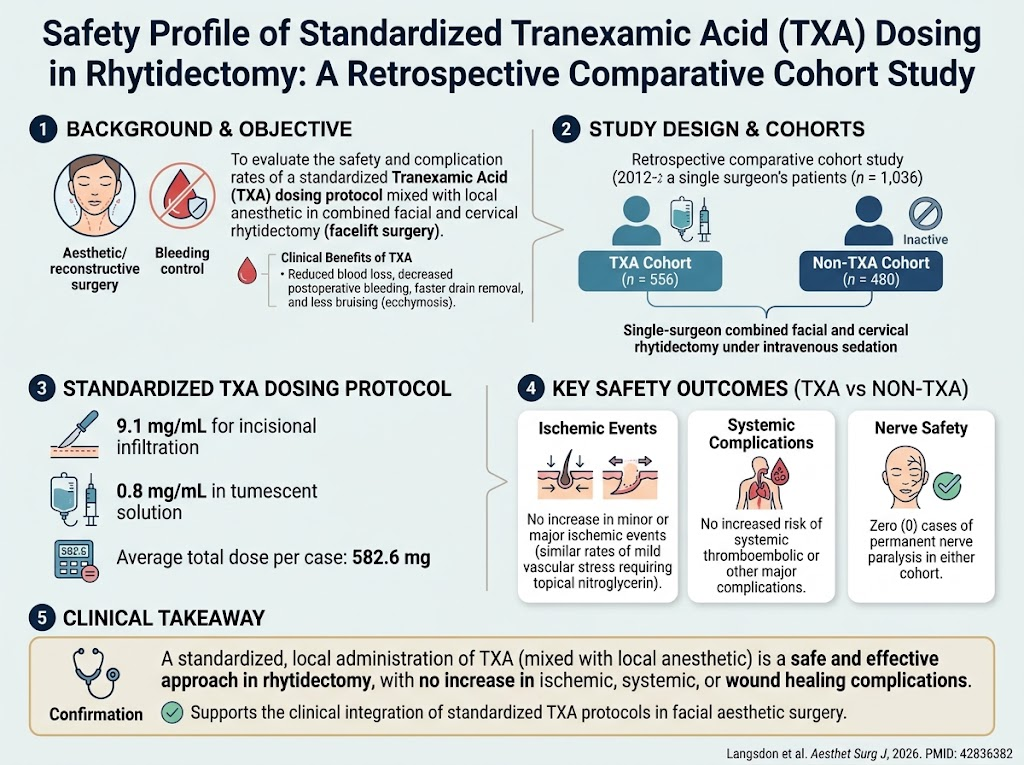
  • Standardized tranexamic acid (TXA) dosing mixed with local anesthetic was evaluated in over 1,000 facelift patients under intravenous sedation.
  • No increase in ischemic, vascular, or systemic complications was identified with TXA use compared to controls.
  • TXA showed a comparable rate of distal flap vascular compromise, managed effectively without permanent sequelae.
  • The study supports TXA’s safety in rhytidectomy with controlled dosing protocols.

Study Background

MedXY registered readers

Sign in free to continue reading

Create or use your MedXY account to unlock the complete article.

This article was created using several editorial tools, including AI, as part of the process. Human editors reviewed this content before publication.

Related articles

Open language-specific specialty feeds and department pages.

Evaluating Tranexamic Acid’s Safety and Efficacy in Head and Neck Free Flap Reconstruction: Insights from a Retrospective Cohort StudyThis retrospective study assesses the safety and impact of tranexamic acid on bleeding, transfusions, and complications in head and neck free flap surgery, finding no significant difference in outcomes and supporting its safe use.Oct 8, 2026Assessing Age-Related Risks in Facelift Surgery: Is Chronological Age a Barrier?A decade-long single-surgeon study finds facelift surgery safe across all age groups, including patients older than 75, with no significant increase in major or minor complications attributable to age alone.Sep 2, 2026What Lies Beneath: Navigating Carotid Artery Depth for Safe Hemostatic Net Use in Facelift SurgeryThis article examines the anatomical depth of carotid arteries in the neck to guide safe hemostatic net placement during facelift surgery, minimizing risk of vascular injury.Jul 21, 2026Clinical Care Guideline Implementation of Nebulized Tranexamic Acid in Post-Tonsillectomy Hemorrhage
Loading comments...
MedXY briefing

Get the free newsletter

Evidence-led clinical news, trends, and analysis—delivered to your inbox.

Ask MedXY AI

Most popular

Intimate Health
Five Benefits for Women Continuing Sexual Activity After Menopause
Intimate Health
Why Some Women Have a Strong Sex Drive—And Why Men Shouldn't Worry About It
Nursing & care
How often should a couple have sex?
Cardiology
Precision Medicine for Long QT Syndrome Type 2: Lumacaftor Corrects Trafficking Defects and Shortens QT Interval
General Surgery
Optimizing Postoperative Opioid Prescriptions After Intra-Abdominal Cancer Surgery: Comparing the 5x-Multiplier and 3-Tier Models
© 2026 MedXY
Contact usAbout usPrivacy PolicyMedXY story
A clinical care guideline improved emergency use of nebulized tranexamic acid for post-tonsillectomy bleeding and was associated with fewer returns to the operating room.
Jun 1, 2026
A Post-Tonsillectomy Hemorrhage Guideline Using Nebulized Tranexamic Acid Was Associated With Fewer Returns to the Operating RoomA quality-improvement clinical care guideline for nebulized tranexamic acid in post-tonsillectomy hemorrhage achieved high protocol adherence and was associated with a marked reduction in operative intervention.Jun 1, 2026
Clinical Care Guideline Implementation of Nebulized Tranexamic Acid in Post-Tonsillectomy HemorrhageA clinical care guideline for nebulized tranexamic acid in post-tonsillectomy hemorrhage was rapidly adopted in the Emergency Department and was associated with fewer returns to the operating room.Jun 1, 2026