Evaluating the Risk of Anterior Ischemic Optic Neuropathy with GLP-1 Receptor Agonists in Type 2 Diabetes: Insights from a Swedish Nationwide Cohort Study
Highlight
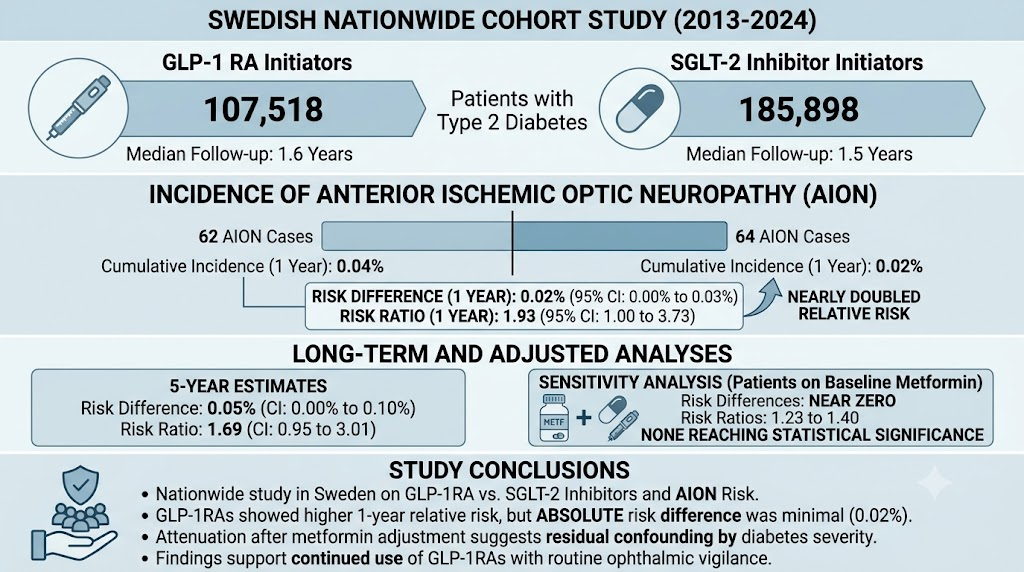
This nationwide, register-based cohort study from Sweden evaluated the association between glucagon-like peptide-1 receptor agonist (GLP-1RA) therapy and risk of anterior ischemic optic neuropathy (AION) in patients with type 2 diabetes. Compared with sodium-glucose cotransporter-2 (SGLT-2) inhibitor initiators, GLP-1RA users showed a nearly doubled relative risk of AION over one year, but absolute event rates were very low. After adjusting for confounding by restricting to patients on baseline metformin, risk differences and ratios were attenuated, suggesting residual confounding related to diabetes severity.
Key findings:
1. Absolute risk of AION at 1 year was 0.04% in GLP-1RA users versus 0.02% in SGLT-2 inhibitor users.
2. Risk ratio for AION was 1.93 (95% CI, 1.00 to 3.73) favoring SGLT-2 inhibitors over GLP-1RAs.
3. Restricting analyses to patients receiving metformin at baseline substantially reduced risk differences and ratios, indicating confounding.
4. Event numbers were low, and generalizability to non-diabetic GLP-1RA users is limited.
Study Background
GLP-1 receptor agonists are widely used in managing type 2 diabetes, offering glycemic control benefits and cardiovascular risk reduction. However, safety concerns regarding rare ocular adverse events have emerged, including reports suggesting an association between GLP-1RA use and anterior ischemic optic neuropathy (AION), a cause of sudden, painless vision loss due to ischemia of the optic nerve head. AION primarily comprises the nonarteritic form (NAION), linked to vascular risk factors common in diabetes. Understanding whether GLP-1RA therapy contributes to increased risk of AION has important implications for clinical decision-making and patient counseling.
Study Design
This was a nationwide, register-based cohort study conducted in Sweden, spanning from 2013 to 2024. The study population included adult patients with type 2 diabetes who initiated either GLP-1RA therapy or SGLT-2 inhibitors during the study period. Using national patient and prescription registers, researchers identified new users of these medications and tracked incident cases of anterior ischemic optic neuropathy, as recorded in the national patient register.
The comparator group of SGLT-2 inhibitor initiators was selected due to a similar clinical indication profile, aiming to mitigate confounding by indication. Adjusted risk differences (RDs) and risk ratios (RRs) were estimated using propensity score weighting to balance baseline characteristics. Additional sensitivity analyses restricted to patients receiving metformin at baseline were performed to better account for confounding by diabetes severity, given metformin’s role as first-line therapy.
Key Findings
The study followed 107,518 patients initiating GLP-1RAs and 185,898 initiating SGLT-2 inhibitors, with median follow-up times of 1.6 years and 1.5 years, respectively. Over this period, 62 GLP-1RA users and 64 SGLT-2 inhibitor users experienced anterior ischemic optic neuropathy.
At 1 year, the cumulative incidence of AION was 0.04% for GLP-1RA users and 0.02% for SGLT-2 inhibitor users. This translated to a risk difference of 0.02% (95% confidence interval [CI], 0.00% to 0.03%) and a risk ratio of 1.93 (95% CI, 1.00 to 3.73), indicating a nearly doubled relative risk associated with GLP-1RA use compared to SGLT-2 inhibitors.
Five-year estimates showed risk differences of 0.05% (CI, 0.00% to 0.10%) and a risk ratio of 1.69 (CI, 0.95 to 3.01). Sensitivity analyses restricting to patients on metformin at baseline markedly attenuated the differences, with risk differences near zero and risk ratios ranging from 1.23 to 1.40, none reaching statistical significance.
These findings suggest that while GLP-1RA therapy might be associated with a higher relative risk of AION, the absolute risk increase is minimal. Furthermore, accounting for diabetes severity and treatment context minimizes these associations, implying that residual confounding may explain observed differences.
Expert Commentary
This rigorous nationwide study provides valuable epidemiologic evidence addressing a rare but clinically significant potential adverse effect of GLP-1RAs. The use of an active comparator, large sample size, and propensity score methods strengthen the methodological rigor. Nonetheless, several limitations warrant caution in interpreting causal inference.
First, the number of AION events was low, limiting precision and robustness of risk estimates. Second, residual confounding remains a concern despite attempts to adjust for diabetes severity, as unmeasured factors such as microvascular disease burden or systemic vascular health could influence susceptibility to optic nerve ischemia.
Biologically, GLP-1RAs exert their effects through incretin pathways with established cardiovascular benefits, but direct mechanistic links to optic nerve ischemia are not well established. It is possible that differences in patient baseline vascular risk profiles rather than drug effects per se explain the observed association.
Clinicians should weigh these findings in conjunction with the proven cardiovascular and metabolic benefits of GLP-1RAs. The small absolute risk and attenuation after adjustment mean that GLP-1RA therapy remains a safe and effective option for most patients with type 2 diabetes.
Future research should include replication studies in diverse populations, exploration of mechanistic pathways, and post-marketing surveillance to refine risk characterization.
Conclusion
The Swedish nationwide cohort study identified a modestly increased relative risk of anterior ischemic optic neuropathy associated with GLP-1 receptor agonist use compared to SGLT-2 inhibitors in type 2 diabetes. Absolute risks were very low, and adjustment for diabetes treatment with metformin significantly reduced risk differences, suggesting residual confounding drives the observed association rather than a direct causal relationship. These findings support continued use of GLP-1RAs with routine ophthalmologic vigilance but highlight the need for further research into rare ocular adverse events in diabetes therapies.
Funding and Clinical Trials
This study was funded by Karolinska Institutet, the Swedish Society of Medicine, the Swedish Research Council, and Region Stockholm. The study was a retrospective analysis of nationwide register data; hence, no clinical trial registration is applicable.
References
1. Ueda P, Svanström H, Söderling J, et al. Glucagon-like Peptide-1 Receptor Agonists and Risk for Anterior Ischemic Optic Neuropathy: A Nationwide Cohort Study. Ann Intern Med. 2026 Jul 14. doi:10.7326/M25-1234.
2. Sharma P, et al. Pathophysiology of nonarteritic anterior ischemic optic neuropathy. Surv Ophthalmol. 2020;65(2):195-208. doi:10.1016/j.survophthal.2019.10.008.
3. Marso SP, et al. Cardiovascular outcomes with GLP-1 receptor agonists in type 2 diabetes. N Engl J Med. 2016;375:311-322.
4. Zinman B, et al. Empagliflozin, cardiovascular outcomes, and mortality in type 2 diabetes. N Engl J Med. 2015;373:2117-2128.
This article was created using several editorial tools, including AI, as part of the process. Human editors reviewed this content before publication.