We use cookies

Our website uses essential cookies and, with your consent, additional cookies to measure performance and improve our services. Cookie Policy.

You can change your choice at any time.

MMedXYNews
HomeVideos
MedXY AI/MedXY News/Section: news

Evaluating the Impact of Multicancer Early-Detection Blood Tests on Late-Stage Cancer Diagnosis: Insights from a Large Randomized Trial
MedXY Editorial Team•Oct 13, 2026•news
cancer screeningclinical triallate-stage cancermulticancer early-detection

Highlight

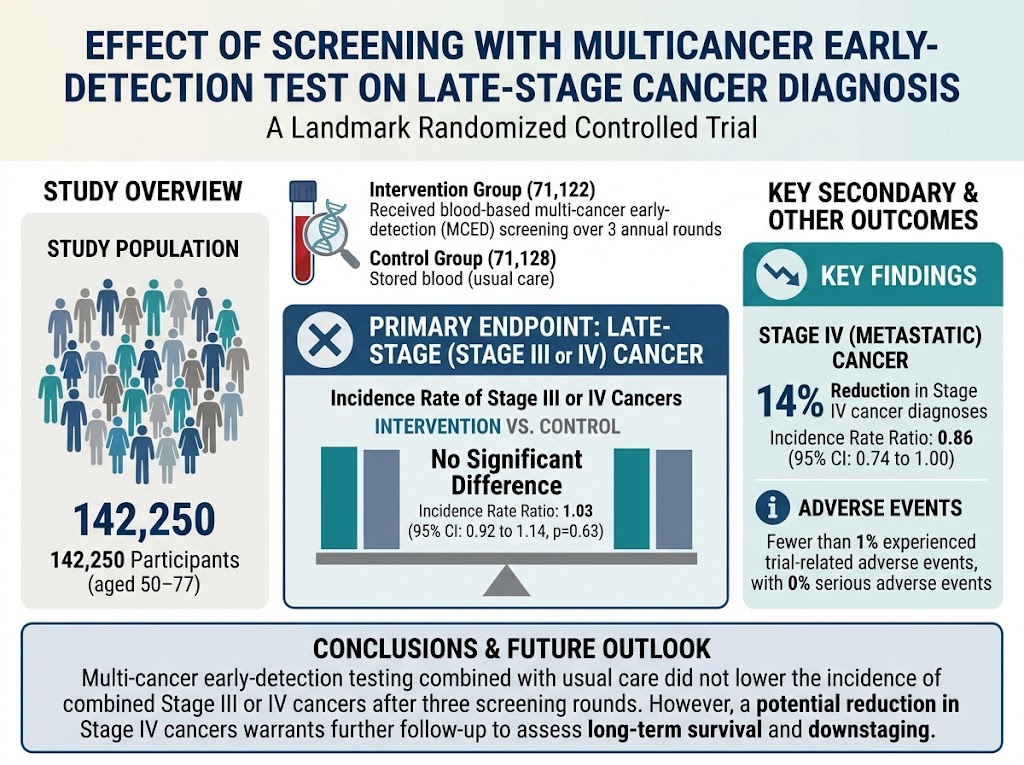
• Large-scale randomized trial evaluated the effect of blood-based multicancer early-detection testing on late-stage cancer diagnosis in adults aged 50 to 77.
• Primary endpoint showed no statistically significant reduction in stage III or IV cancers after three screening rounds.
• A key secondary endpoint suggested a potential reduction in stage IV cancer incidence with an incidence rate ratio of 0.86, approaching statistical significance.
• Multi-round testing was well-tolerated with less than 1% adverse events and no serious trial-related harms.

Study Background

MedXY registered readers

Sign in free to continue reading

Create or use your MedXY account to unlock the complete article.

This article was created using several editorial tools, including AI, as part of the process. Human editors reviewed this content before publication.

Related articles

Open language-specific specialty feeds and department pages.

Pulse versus Nonpulse Corticosteroid Therapy in Acute Exacerbation of Idiopathic Pulmonary Fibrosis: Evidence Synthesis and Clinical Implications from the SAFER TrialThis review synthesizes current evidence on pulse versus nonpulse corticosteroid therapy in AE-IPF, contextualizing the SAFER trial findings within prior studies and clinical guidelines to guide management and future research.Oct 18, 2026Evaluating the Impact of a Digital Companion App in Periodontal Therapy: Insights from a Multi-Center Randomised Controlled TrialA multi-center RCT assessing the adjunctive use of the Paro-ComPas app in periodontal care found no significant overall benefit, though moderate app engagement showed potential for improved plaque control.Oct 16, 2026Sonelokimab: A Promising Dual IL-17A/F Nanobody for Moderate-to-Severe Hidradenitis SuppurativaThe phase 2 MIRA trial shows sonelokimab, an IL-17A/F-inhibiting nanobody, significantly improves outcomes in moderate-to-severe hidradenitis suppurativa with good tolerability compared to placebo.Oct 16, 2026
Loading comments...
MedXY briefing

Get the free newsletter

Evidence-led clinical news, trends, and analysis—delivered to your inbox.

Ask MedXY AI

Most popular

Intimate Health
Five Benefits for Women Continuing Sexual Activity After Menopause
Intimate Health
Why Some Women Have a Strong Sex Drive—And Why Men Shouldn't Worry About It
Nursing & care
How often should a couple have sex?
Cardiology
Precision Medicine for Long QT Syndrome Type 2: Lumacaftor Corrects Trafficking Defects and Shortens QT Interval
General Surgery
Optimizing Postoperative Opioid Prescriptions After Intra-Abdominal Cancer Surgery: Comparing the 5x-Multiplier and 3-Tier Models
© 2026 MedXY
Contact usAbout usPrivacy PolicyMedXY story
Transforming Outcomes in Severe Tricuspid Regurgitation: Insights from the TRIC-I-HF Trial
Transcatheter tricuspid-valve repair plus medical therapy significantly improves survival, reduces heart failure hospitalizations, and enhances quality of life in patients with severe tricuspid regurgitation compared to medical therapy alon
Oct 15, 2026
Evaluating SAR443820, a RIPK1 Inhibitor, in Amyotrophic Lateral Sclerosis: Insights from the Phase 2 HIMALAYA TrialThis phase 2 trial assessed SAR443820, a RIPK1 inhibitor, in ALS patients; it showed no clinical efficacy and increased hepatic side effects, indicating limited therapeutic potential in ALS.Oct 5, 2026
Dapirolizumab Pegol Improves Disease Activity in Systemic Lupus Erythematosus: Evidence from Phase 3 PHOENYCS GO Trial and Prior StudiesDapirolizumab pegol, a CD40 ligand inhibitor, significantly improves disease activity in moderate-to-severe SLE over 48 weeks when added to standard care, supported by robust phase 3 trial data and pharmacokinetic findings.Sep 22, 2026