Evaluating HOTV Versus Tumbling E Vision Tests for Effective Pediatric Screening
Highlight
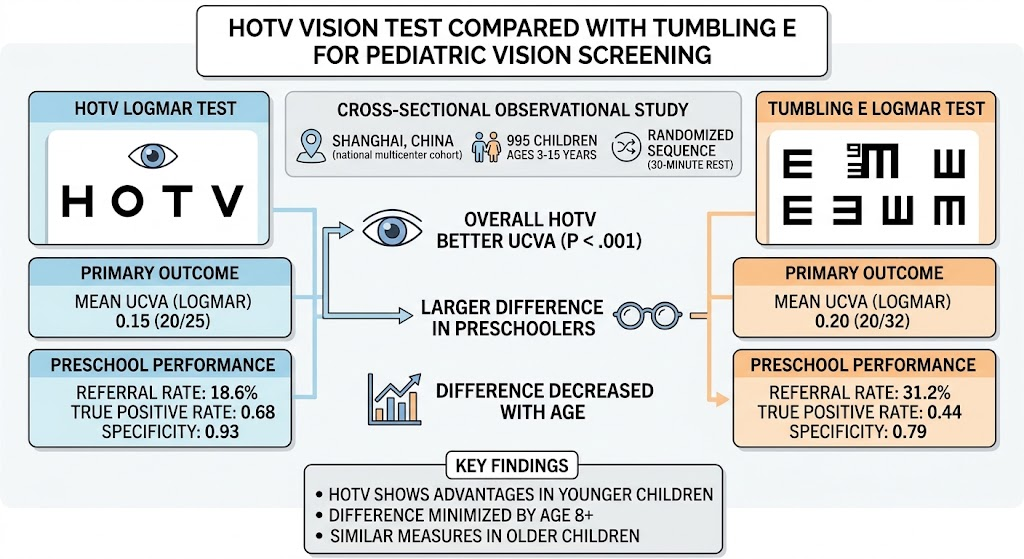
This study provides a direct comparison between HOTV and tumbling E vision tests for uncorrected visual acuity in children aged 3 to 15 years. Results show that HOTV testing yields better accuracy and lower referral rates, particularly for children younger than 8 years. This supports HOTV as a preferred tool for early pediatric vision screening, with implications for streamlined amblyopia and refractive error detection.
Study Background
Uncorrected visual acuity (UCVA) assessment is a cornerstone of pediatric vision screening to detect amblyopia, myopia, and other refractive errors that can impair vision development if not identified early. The HOTV letter-matching test has been recommended widely for young children due to its simplicity and cognitive ease, helping optimize screening efficiency. However, the tumbling E test remains commonly used globally, despite posing greater cognitive and orientation demands on children, potentially affecting testability and the accuracy of UCVA measurements. Until now, comparative data on the effectiveness and outcomes of these two tests across different pediatric age groups have been limited, creating uncertainty regarding their optimal application in clinical practice.
Study Design
This cross-sectional observational study was conducted in Shanghai as part of a national multicenter cohort in China. It included 995 children aged 3 to 15 years who underwent comprehensive ophthalmic examinations, including cycloplegic refraction, and UCVA testing using both HOTV and tumbling E logMAR charts. The order of testing was randomized with a 30-minute rest between tests to reduce fatigue. The primary outcome measure was mean UCVA expressed as logMAR. Secondary outcomes included referral rates for reduced UCVA, diagnostic screening performance for amblyopia and refractive errors, testability, and the time required to complete each vision test. Data collection spanned January 2025 to June 2026.
Key Findings
The study found a statistically significant difference in UCVA outcomes between the two tests. Overall, mean UCVA was better with the HOTV test (0.15 logMAR, equivalent to 20/25) compared with the tumbling E test (0.20 logMAR, equivalent to 20/32) (95% CI, -0.07 to -0.02; P < .001). This difference was most prominent in younger children, decreasing with age. Children between 3 and under 4 years demonstrated a difference of approximately one logMAR line, equating to more than three letters, while those aged 8 years or older showed negligible differences of one or fewer letters between the two tests.
Among 183 preschool children, the HOTV test significantly lowered referral rates for reduced UCVA compared to tumbling E (18.6% vs 31.2%; mean difference -12.6%; 95% CI, -19.2% to -5.9%; P < .001). Additionally, the HOTV test had a higher true positive rate for detecting amblyopia and refractive errors (0.68 vs 0.44; P < .001) and superior specificity (0.93 vs 0.79; P < .001). In older children, screening performances were similar between tests.
The study also noted that the tumbling E test requires more cognitive effort, which may reduce testability and increase fatigue in younger children, thereby contributing to less reliable UCVA assessments. As a screening tool, HOTV’s higher specificity and true positive rate could reduce false-positive referrals, alleviating burden on healthcare services and families.
Expert Commentary
This comprehensive study reinforces current recommendations favoring HOTV testing for younger children in vision screening programs. Clinicians should consider the cognitive demands inherent in vision tests when selecting screening modalities, especially in preschool populations. The demonstrable lower referral rate with HOTV testing decreases unnecessary clinical follow-ups and anxiety for families.
Study limitations include its single geographic setting in China, which may influence generalizability to other populations. However, the large sample size and randomized testing order strengthen the robustness of the findings. Future studies could expand on longitudinal outcomes and the impact of vision screening modality choice on treatment success for amblyopia and refractive errors.
Conclusion
The HOTV vision test is preferable for UCVA assessment in children younger than 8 years due to better accuracy, fewer false-positive referrals, and greater specificity compared with the tumbling E test. Adoption of the HOTV test in pediatric screening programs can optimize early detection of vision problems such as amblyopia and myopia. This is particularly critical as global initiatives emphasize early screening to prevent permanent visual impairment in children.
Healthcare providers and policymakers should align pediatric vision screening protocols to incorporate the HOTV test for younger children, while remaining cognizant of testability factors and local resource availability. This evidence-based strategy promises to improve pediatric eye care outcomes and reduce healthcare resource strain.
Funding and Clinical Trials Registration
This research was part of a national multicenter cohort study in China. The trial is registered on ClinicalTrials.gov with the identifier NCT05770661.
References
Wu H, Wang Y, Ni Z, Liu Y, Liu Z, Chen J, Zou H, Morgan IG, Xu X, Rose KA, He X. HOTV Vision Test Compared With Tumbling E for Pediatric Vision Screening. JAMA Ophthalmol. 2026 Aug 27. PMID: 42658504. https://pubmed.ncbi.nlm.nih.gov/42658504/
This article was created using several editorial tools, including AI, as part of the process. Human editors reviewed this content before publication.