Highlight
Patients with ST-segment elevation myocardial infarction (STEMI) at high bleeding risk (HBR) have significantly elevated rates of ischemic and bleeding events after primary percutaneous coronary intervention (PCI).
The PREMIUM trial post hoc analysis assessed whether upfront aspirin omission modifies outcomes in HBR patients receiving primary PCI for STEMI.
While HBR status identifies patients with worse overall prognosis, it did not significantly alter the relative benefit of aspirin omission versus standard dual antiplatelet therapy (DAPT) with aspirin and prasugrel.
These results suggest caution in using HBR status alone to guide aspirin omission after primary PCI in STEMI, especially in the context of low-dose prasugrel regimens.
Study Background
ST-segment elevation myocardial infarction (STEMI) is a critical cardiovascular emergency requiring rapid reperfusion, primarily achieved via primary percutaneous coronary intervention (PCI). Post-PCI antiplatelet therapy typically involves dual antiplatelet therapy (DAPT) with aspirin plus a P2Y12 inhibitor to reduce thrombotic complications. However, balancing ischemic protection against bleeding risk remains challenging, especially in patients classified at high bleeding risk (HBR).
Patients classified as HBR present a clinical quandary: they are simultaneously at increased risk for ischemic events and bleeding complications. Optimizing antiplatelet therapy in this subgroup to minimize bleeding without compromising ischemic protection is an unmet need. Aspirin omission, continuing with P2Y12 inhibitor monotherapy, has emerged as a potential strategy to mitigate bleeding. Yet, evidence for such an approach specifically in HBR STEMI patients at the time of primary PCI is sparse.
The PREMIUM (Prasugrel Monotherapy Following Primary Percutaneous Coronary Intervention for ST-Elevation Myocardial Infarction) trial evaluated prasugrel monotherapy versus DAPT post-primary PCI in STEMI patients. This post hoc analysis aimed to determine whether HBR status modifies the effect of aspirin omission on ischemic and bleeding outcomes.
Study Design
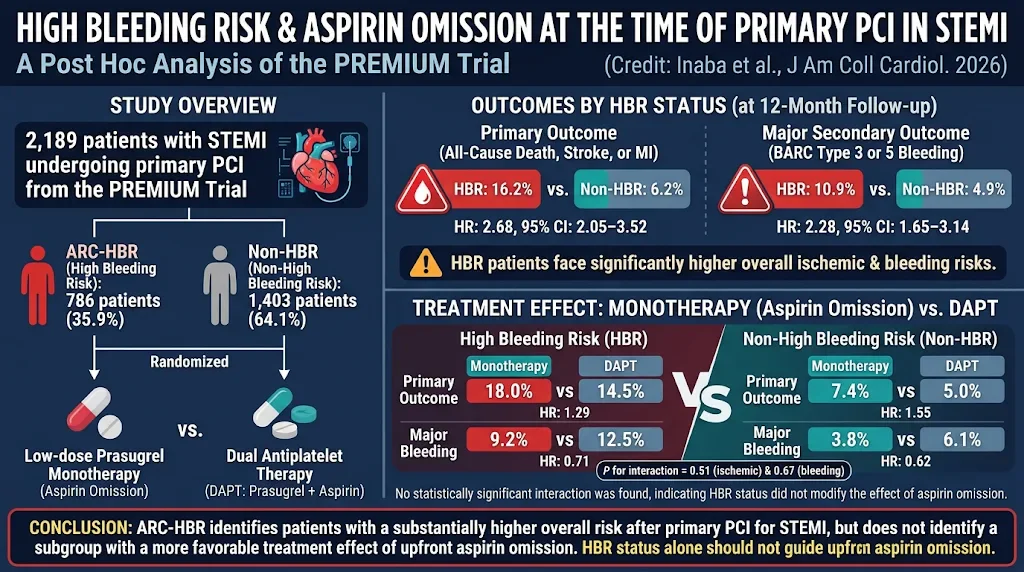
The PREMIUM trial was a randomized controlled study including 2,189 STEMI patients undergoing primary PCI. Participants were randomized to receive either low-dose prasugrel monotherapy or standard DAPT with aspirin plus prasugrel.
Key aspects included:
– HBR classification was determined according to the Academic Research Consortium (ARC) criteria.
– In the DAPT arm, patients meeting ARC-HBR criteria were allowed to discontinue aspirin after 3 months, whereas non-HBR patients remained on DAPT for 12 months.
– The primary endpoint assessed over 12 months was a composite of all-cause death, stroke, or myocardial infarction.
– Major secondary outcomes included bleeding events defined as Bleeding Academic Research Consortium (BARC) type 3 or 5 bleeding.
This post hoc subgroup analysis evaluated outcome differences between prasugrel monotherapy and DAPT according to HBR status.
Key Findings
Of the 2,189 patients, 786 (35.9%) met ARC-HBR criteria. Several important findings emerged:
1. Elevated Risk in HBR Patients:
– The HBR subgroup experienced significantly higher primary composite event rates at 16.2% versus 6.2% in non-HBR patients (Hazard Ratio [HR]: 2.68; 95% Confidence Interval [CI]: 2.05-3.52).
– Major bleeding rates (BARC 3 or 5) were also elevated at 10.9% in HBR versus 4.9% in non-HBR patients (HR: 2.28; 95% CI: 1.65-3.14).
2. Effect of Aspirin Omission in HBR Patients:
– The primary outcome occurred in 18.0% of HBR patients on prasugrel monotherapy compared with 14.5% on DAPT (HR: 1.29; 95% CI: 0.91-1.82).
– Among non-HBR patients, these rates were 7.4% vs 5.0% respectively (HR: 1.55; 95% CI: 1.01-2.37).
– Statistical interaction testing revealed no significant difference in treatment effect modification based on HBR status (P for interaction=0.51).
3. Bleeding Outcomes with Aspirin Omission:
– In HBR patients, bleeding occurred less with prasugrel monotherapy (9.2%) versus DAPT (12.5%), but this difference did not reach statistical significance (HR: 0.71; 95% CI: 0.46-1.11).
– Non-HBR patients had similar trends, with bleeding rates of 3.8% versus 6.1% favoring monotherapy (HR: 0.62; 95% CI: 0.38-1.00).
– Again, interaction testing showed no significant differential effect by HBR status (P=0.67).
4. Interpretation:
The observed hazard ratios suggest possible trends toward increased ischemic events with aspirin omission and reduced bleeding events, but these did not differ meaningfully between HBR and non-HBR groups. The confidence intervals reflect limited precision, preventing definitive conclusions about treatment-effect modification.
Expert Commentary
This analysis provides important, hypothesis-generating insights into antiplatelet management in complex STEMI populations. The findings reaffirm that HBR patients face a substantially heightened risk of both ischemic and bleeding complications post-primary PCI. Nonetheless, upfront aspirin omission, at least in the context of low-dose prasugrel used in Japan, does not clearly confer a favorable balance of risks and benefits uniquely in HBR patients.
Current guidelines increasingly acknowledge personalized antiplatelet regimens, including shorter DAPT or P2Y12 inhibitor monotherapy, particularly in patients prone to bleeding. However, these post hoc data suggest that HBR status alone may be insufficient to guide upfront aspirin omission decisions safely after STEMI.
Limitations include the post hoc nature, potential confounding, and regional specificity of prasugrel dosing, which may limit generalizability outside Japan. Moreover, the trial’s sample size constrains statistical power for subgroup interaction analyses.
Future well-powered prospective studies are essential to clarify optimal antiplatelet strategies in STEMI patients at HBR, incorporating bleeding risk stratification with other clinical factors and novel agents.
Conclusion
The PREMIUM trial post hoc analysis confirms that patients with ARC-defined high bleeding risk undergoing primary PCI for STEMI have significantly worse ischemic and bleeding outcomes. However, HBR status did not identify a subgroup with a clearly improved risk-benefit profile for aspirin omission at the time of PCI using low-dose prasugrel monotherapy.
Clinicians should therefore exercise caution in omitting aspirin upfront solely based on bleeding risk classification until further data are available. These findings underscore the ongoing complexity of tailoring antiplatelet therapy in high-risk STEMI populations and the need for individualized clinical judgment supported by robust evidence.
Funding and Trial Registration
The PREMIUM trial (NCT05709626) was conducted with support from Japanese cardiovascular research foundations and adhered to ethical standards appropriate for interventional cardiology trials.
References
1. Inaba S, Ogita M, Suwa S, et al. High Bleeding Risk and Aspirin Omission at the Time of Primary PCI in STEMI: A Post Hoc Analysis of the PREMIUM Trial. J Am Coll Cardiol. 2026 Oct 31. PMID: 42998063.
2. Urban P, Mehran R, Colleran R, et al. Defining High Bleeding Risk in Patients Undergoing Percutaneous Coronary Intervention. Circulation. 2019;140(3):240-261.
3. Valgimigli M, Bueno H, Byrne RA, et al. 2017 ESC Focused Update on Dual Antiplatelet Therapy. Eur Heart J. 2018;39(3):213-260.
4. Costa F, van Klaveren D, James S, et al. Derivation and Validation of the PRECISE-DAPT Score. Lancet. 2017;389(10073):1025-1034.