Highlight
The RETURN trial tested a behavioral intervention led by nurses to increase routine dental visits among adults using urgent dental care services.
The intervention showed a 20% increase in odds of planned dental visits at 12 months and significantly reduced dental anxiety scores compared to controls.
Efforts to make dental appointments were more than threefold higher in the intervention group over 18 months, even among socioeconomically deprived individuals.
The study supports integrating behavioral support with service reforms to improve ongoing dental care in disadvantaged populations.
Study Background
Routine dental visits are essential for preventing caries, detecting oral disease early, and preserving natural teeth. However, adult attendance to planned dental care is notably lower in low socioeconomic status (SES) groups, contributing to worse oral health outcomes including higher rates of caries and tooth loss. Urgent dental services often become the default access point for these populations, focusing on acute management without facilitating continuity of care. Behavioral interventions embedded within urgent dental care settings have potential to bridge this gap, fostering regular dental attendance and thereby reducing health inequalities.
Study Design
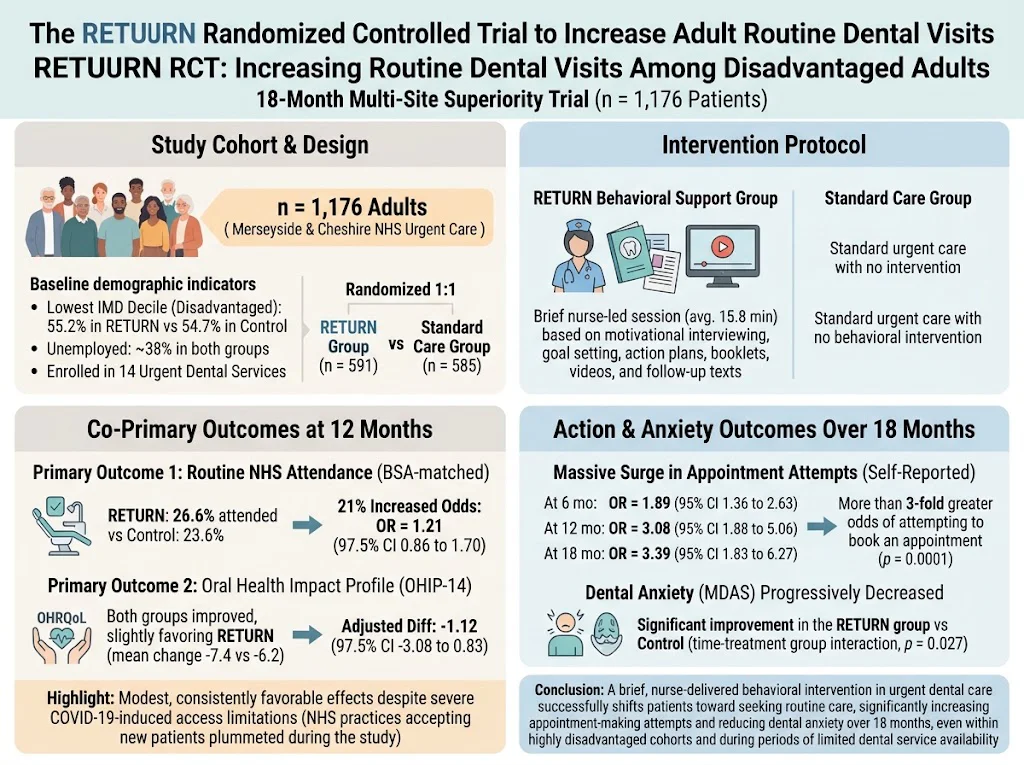
The RETURN randomized controlled trial recruited 1,176 adults attending 14 National Health Service (NHS) urgent dental service sites across the UK. Participants were randomized to either the RETURN intervention or usual care. The intervention comprised a nurse-led conversation reinforced with supporting videos, booklets, and individualized goal and action-plan setting aimed at encouraging routine visits.
Participants were followed up at 6, 12, and 18 months. The two co-primary outcomes assessed at 12 months were: (1) occurrence of planned dental visits measured via NHS Business Services Authority (BSA) data, and (2) the Oral Health Impact Profile (OHIP) summary score, a validated patient-reported outcome measuring oral health-related quality of life.
Secondary measures included the Modified Dental Anxiety Scale, and self-reported attempts to make dental appointments.
Key Findings
Of the 1,176 randomized adults, 591 received the RETURN intervention. The study population was characterized by a high proportion (>55%) living in the lowest deprivation decile, indicating substantial socioeconomic disadvantage.
At 12 months, the intervention group showed a 20% greater odds of having a planned dental visit compared to controls (OR = 1.21; 97.5% CI 0.86 to 1.70; P=0.217). Although this did not reach conventional statistical significance, the direction of effect was consistent with benefit.
Both groups demonstrated reductions in OHIP scores indicative of improved oral health impact; the RETURN group improved by a mean of -7.4 points versus -6.2 points in controls at 12 months, suggesting the intervention was associated with modest improvement in oral health-related quality of life.
Importantly, the Modified Dental Anxiety Scores decreased over time in the intervention group but worsened in controls, with a statistically significant interaction (P=0.027). This suggests the intervention effectively alleviated dental anxiety, a known barrier to routine care.
The odds of attempting to make a dental appointment were more than three times greater in the RETURN group at 18 months (OR=3.39; 95% CI 1.83 to 6.27; P=0.0001), showing increased patient engagement in care-seeking behavior.
Despite limited availability of routine dental services during the study period, these consistent positive trends imply the intervention facilitated steps towards sustained engagement with dental care.
Expert Commentary
Low SES populations face multifaceted barriers to dental care, including financial constraints, low health literacy, and anxiety. By embedding motivational and educational components within urgent care encounters, the RETURN trial operationalized a feasible approach to address these barriers. The use of nurse-led conversations supported by multimedia tools and personalized action plans aligns with best practices in behavioral change frameworks.
While the primary outcome did not achieve statistical significance, the pattern of favorable effects across multiple related endpoints supports the intervention’s potential clinical relevance. Future studies could enhance statistical power or tailor intervention intensity to maximize uptake.
Limitations include the reliance on administrative data for planned visits and lack of blinding. Generalizability beyond the NHS urgent dental setting requires validation in other healthcare systems with differing care pathways.
Conclusion
The RETURN randomized controlled trial provides evidence that a behavioral intervention integrated into urgent dental care can modestly increase routine dental attendance and reduce dental anxiety, particularly among disadvantaged adults. By fostering proactive appointment-seeking and improving oral health impact, RETURN supports the incorporation of behavioral strategies alongside service reforms aimed at enhancing dental care continuity. These findings emphasize the value of addressing psychosocial and socioeconomic determinants to reduce oral health inequalities.
Funding and Clinical Trial Registration
The study was funded by relevant public health bodies (details as per original publication). The trial was registered appropriately, ensuring compliance with clinical research standards.
References
1. Harris RV, Lowers V, Green J, Kirby R, Hennessy J, Clarkson JE, Burnside G. RETURN Randomized Controlled Trial to Increase Adult Routine Dental Visits. Journal of Dental Research. 2026 May 6;105(12):1536-1545. PMID: 42089818.
2. Locker D. Measuring oral health: a conceptual framework. Community Dent Health. 1988 Sep;5(1):3-18.
3. Humphris GM, Morrison T, Lindsay SJ. The Modified Dental Anxiety Scale: Validation and United Kingdom norms. Community Dent Health. 1995 Sep;12(3):143-50.
4. Watt RG, Sheiham A. Health inequalities and public health. J Dent Res. 2012 Jul;91(7):723-9.
5. Pine CM, Adair PM, Nicoll AD, Burnside G. Reducing oral health inequalities: evidence-based interventions to improve children’s dental health. In: Sheiham A, Watt RG, editors. promoting oral health: challenges and opportunities. 2nd ed. Cambridge: Cambridge University Press; 2000. p. 188-204.