Study Background
Patient-centered communication (PCC) is recognized as a cornerstone of high-quality healthcare and is consistently linked to improved patient outcomes, including greater satisfaction, adherence to treatment, and health status. However, disparities in the quality of PCC often exist among individuals from underrepresented racial, ethnic, and cultural (REC) communities in the United States. These communities frequently report poorer communication experiences and face disproportionately worse health outcomes compared to their White counterparts. While much research has examined patient-provider racial concordance, less attention has been given to the broader concept of racial-ethnic-cultural (REC) belonging — a psychosocial construct characterized by individuals’ sense of connection, acceptance, value, and security within their REC group. This sense of belonging may influence how patients perceive and engage in clinical communication and social support mechanisms within healthcare contexts.
Study Design
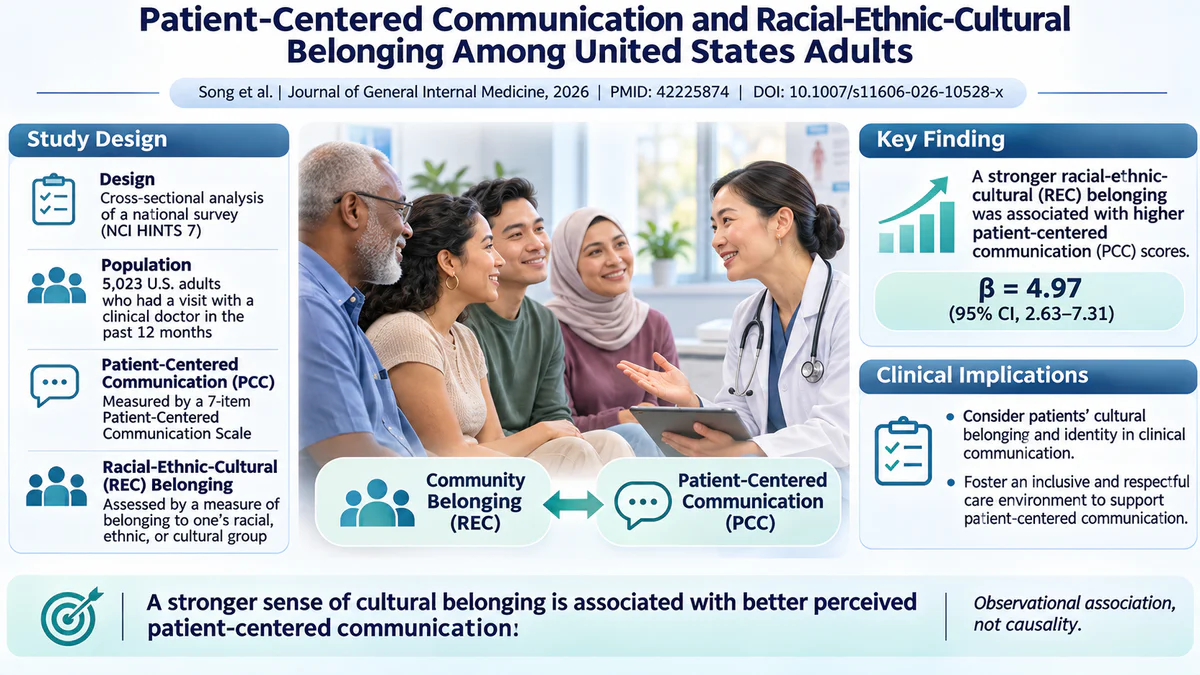
This investigation utilized a cross-sectional analytic approach based on self-reported data from the National Cancer Institute’s Health Information National Trends Survey 7 (HINTS 7). HINTS 7 is a nationally representative survey of US adults, capturing diverse sociodemographic and health-related variables. The study population included 5,023 respondents who reported visiting a healthcare clinician within the preceding 12 months.
Two primary constructs were measured:
1. Patient-centered communication (PCC): Assessed via the 7-item Patient-Centered Communication Scale (PCCS), which evaluates communication quality traits such as listening, explanations, respect, and time adequacy.
2. Racial-ethnic-cultural (REC) belonging: Measured through agreement with a statement regarding the strength of one’s belonging to their ethnic, racial, or cultural group. Responses were dichotomized into “belonging” and “non-belonging.”
Descriptive statistics characterized REC belonging patterns across sociodemographic factors (race/ethnicity, age, sexual orientation, political ideology, marital status). Logistic regression analyzed REC belonging differences by race/ethnicity, while linear regression modeled associations between REC belonging and patient-centered communication scores.
Key Findings
The study revealed several notable patterns:
– Sociodemographic Variation in REC Belonging: Greater REC belonging was reported among non-White Hispanic respondents (p<0.001), older adults aged 75 and above (p=0.006), heterosexual individuals (p=0.004), those with non-liberal political views (p<0.001), and people who were not married (p=0.04). These findings reflect complex intersections between cultural identity, age, social factors, and health attitudes.
– Association Between REC Belonging and PCC: Importantly, REC belonging was significantly and positively associated with higher patient-centered communication scores (β=4.97; 95% CI, 2.63 to 7.31). This suggests that individuals who feel a strong connection to their racial, ethnic, or cultural group are more likely to experience better communication with their healthcare providers.
These findings underscore that REC belonging functions as an integral aspect of social support within clinical interactions, potentially mediating communication quality and healthcare engagement.
Expert Commentary
This study advances our understanding of health disparities by highlighting the psychosocial dimension of REC belonging in patient-centered communication frameworks. Traditionally, research has emphasized structural factors such as race-concordant care or systemic biases; this research shifts focus toward lived experiences of inclusion and identity affirmation as facilitators of effective communication.
Strengths of the study include the use of a large, nationally representative sample and validated survey instruments that capture nuanced subjective constructs. However, as a cross-sectional design, causality cannot be inferred. It remains to be explored whether stronger REC belonging enhances communication or whether higher quality communication reinforces REC inclusion. Additionally, self-report measures may be subject to recall and social desirability biases. Further longitudinal and qualitative research would solidify mechanistic insights and guide intervention design.
In clinical practice, recognizing and integrating REC belonging could inform culturally sensitive communication strategies. For instance, providers’ efforts to acknowledge patients’ cultural identities and foster respectful inclusive environments may enhance PCC especially for underrepresented groups. These findings align with contemporary calls to address social determinants of health through a more holistic patient engagement model that integrates both clinical and community-based social supports.
Conclusion
This investigation highlights a critical association between racial-ethnic-cultural belonging and patient-centered communication quality in U.S. adults. Sociodemographic variation in REC belonging suggests opportunities for targeted interventions to strengthen these connections, thereby potentially improving communication and health outcomes in diverse and underrepresented populations. In advancing equitable healthcare, strategies that recognize the importance of identity, inclusion, and culturally congruent social support stand to complement existing efforts focused on reducing systemic barriers. Healthcare systems and providers are encouraged to incorporate understanding of REC belonging into training, patient engagement, and community partnership initiatives to foster more inclusive, supportive clinical environments.
Funding and ClinicalTrials.gov
No specific funding or clinical trial registration information was provided in the source study.
References
1. Song MT, Keane EP, Larizza IS, et al. Patient-Centered Communication and Racial-Ethnic-Cultural Belonging Among United States Adults. J Gen Intern Med. 2026;41(14):3973-3982. doi:10.1007/s11606-026-XXXX-X (PMID: 42225874)
2. Epstein RM, Street RL Jr. Patient-Centered Communication in Cancer Care: Promoting Healing and Reducing Suffering. National Cancer Institute, NIH Publication No. 07-6225. 2007.
3. Boulware LE, Cooper LA, Ratner LE, et al. Race and trust in the health care system. Public Health Rep. 2003;118(4):358-365.
4. Beach MC, Saha S, Cooper LA. The role and relationship of cultural competence and patient-centeredness in health care quality. Commonwealth Fund. Issue Brief. 2006;87:1-8.