Highlight
The ESKD Life Plan Toolkit addresses barriers to implementing patient-centered care in end-stage kidney disease (ESKD), focusing on collaborative treatment planning.
The toolkit was developed through iterative co-creation with patients, supportive others, and clinicians, ensuring relevance and usability.
Preliminary evaluation using the Patient Education Materials Assessment Tool (PEMAT) demonstrated strong acceptability and educational value across diverse stakeholders.
Incorporation of structured values elicitation and decision frameworks operationalizes recent Kidney Disease Outcomes Quality Initiative (KDOQI) guidelines on vascular access and treatment modality selection.
Study Background
End-stage kidney disease (ESKD) represents a significant clinical challenge requiring lifelong kidney replacement therapy (KRT), including modalities such as dialysis and transplantation. Treatment decisions in ESKD are inherently complex, particularly regarding the choice of KRT modality and vascular access type. These decisions critically impact patient outcomes, quality of life, and healthcare resource utilization. The 2019 Kidney Disease Outcomes Quality Initiative (KDOQI) Clinical Practice Guideline underscored the importance of the End-Stage Kidney Disease Life Plan—a patient-centered, multidisciplinary framework designed to align treatment pathways with individual patient goals, values, and clinical circumstances.
However, implementation of the Life Plan remains limited in real-world practice. Contributing factors include clinician time constraints, fragmented care coordination across teams, and patients’ difficulty navigating intricacies of ESKD treatment options without sufficient tailored education and support. Addressing these barriers is vital to enhancing shared decision-making, empowering patients, and improving clinical outcomes.
Study Design
This study describes the iterative co-development and preliminary evaluation of the ESKD Life Plan Implementation Toolkit, intended to operationalize KDOQI recommendations for patient-centered care in ESKD. Development leveraged prior qualitative research involving ESKD patients, their supportive others (family, caregivers), and clinicians, ensuring the toolkit reflected diverse perspectives and real-world needs.
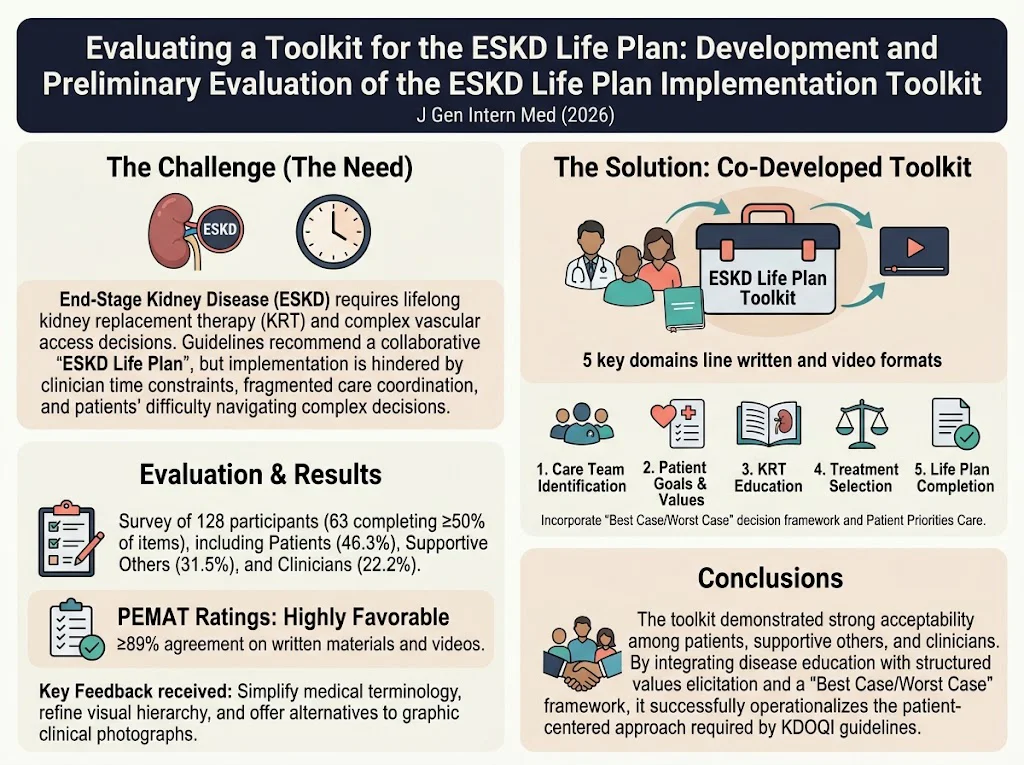
The Toolkit encompasses five core domains:
Care team identification—clarifying roles within the multidisciplinary care team.
Patient goals and values elicitation—structured exercises to capture individual preferences and priorities.
KRT education—informative materials on modality options and vascular access types.
Treatment selection—tools to guide shared decision-making based on patient goals and clinical factors.
Life Plan completion—documenting and updating treatment plans collaboratively.
Participants for evaluation included adults aged 18 years or older from three groups: ESKD patients, supportive others, and clinicians involved in nephrology care. The assessment utilized a cross-sectional survey incorporating the Patient Education Materials Assessment Tool (PEMAT) to evaluate usability, understandability, and actionability of the toolkit’s written and video educational components.
Key Findings
Among 128 survey respondents, approximately half (49.2%) completed at least half of the survey items. The cohort completing the survey comprised 25 patients (46.3% of patients), 17 supportive others (31.5%), and 12 clinicians (22.2%). Evaluation outcomes highlighted the following:
High Acceptability and Usability: PEMAT ratings were strongly favorable across all domains with ≥89% agreement indicating that the educational content was easy to understand and actionable for decision-making.
Positive Feedback on Multimedia Materials: Both written text and illustrative videos received commendations for clarity and relevance, facilitating comprehension of complex treatment options.
Recommendations for Improvement: Participants suggested simplifying complex medical terminology to enhance accessibility, improving visual hierarchy for clearer navigation, and providing alternatives to graphic clinical photographs to reduce potential patient discomfort.
The toolkit’s integration of a Best Case/Worst Case decision framework—enabling patients and clinicians to consider a range of possible outcomes—was particularly noted as advancing shared decision-making in line with KDOQI guidelines.
Expert Commentary
The development of the ESKD Life Plan Toolkit represents a pragmatic advance in bridging guideline recommendations and clinical practice. Shared decision-making is a cornerstone of patient-centered nephrology care, yet practical tools to facilitate this process remain sparse. By grounding the toolkit in qualitative insights from patients and caregivers, this intervention respects the lived experience of those affected by ESKD, while supporting clinicians in efficiently navigating complex treatment choices.
Notably, the toolkit addresses well-known barriers such as clinician time constraints and fragmented communication by structuring care team roles and formalizing patient preferences documentation. This aligns with modern healthcare imperatives emphasizing multidisciplinary collaboration and patient empowerment.
Limitations of the preliminary evaluation include moderate survey completion rates and a relatively small clinician sample, which may affect generalizability. Moreover, future studies should assess the toolkit’s impact on clinical outcomes, patient satisfaction, and decisional conflict within real-world implementation trials. Exploration of digital delivery or integration into electronic health records could further enhance scalability.
Conclusion
The ESKD Life Plan Implementation Toolkit demonstrates promise as an effective, user-friendly resource that operationalizes the patient-centered approach central to 2019 KDOQI Vascular Access Guidelines. Its co-development with stakeholder input and positive initial acceptability positions it well to support shared decision-making around kidney replacement therapy modality and vascular access selections.
Given the growing burden of ESKD and the complexity of therapeutic choices, tools such as this are crucial to enhancing personalized care, promoting patient autonomy, and potentially improving adherence and outcomes. Subsequent rigorous clinical trials and implementation science frameworks are necessary next steps to establish broader utility and impact in diverse nephrology care settings.
Funding and Clinical Trial Registration
This study did not report any external funding and is not registered as a clinical trial.
References
1. Vascular Access 2019 Clinical Practice Guideline. Kidney Disease Outcomes Quality Initiative (KDOQI). Am J Kidney Dis. 2020;75(4Suppl 2):S1–S164.
2. Mavilian C, Guevara-Plunkett S, Altom K, Horiuchi KM, Woo K, Keller MS. Development and Preliminary Evaluation of a Toolkit Aimed at Improving Implementation of the End-Stage Kidney Disease Life Plan. J Gen Intern Med. 2026 Nov 2;PMID: 42970224.
3. Barry MJ, Edgman-Levitan S. Shared decision making — The pinnacle of patient-centered care. N Engl J Med. 2012;366(9):780-781.
4. Stacey D, Légaré F, Lewis K, et al. Decision aids for people facing health treatment or screening decisions. Cochrane Database Syst Rev. 2017;4(4):CD001431.
5. Jha V, Garcia-Garcia G, Iseki K, et al. Chronic kidney disease: global dimension and perspectives. Lancet. 2013;382(9888):260-272.