Highlight
rhBMP-2 loaded volume-stable collagen matrix (VCMX) significantly increased new bone volume compared to guided bone regeneration (GBR) and controls in a canine model.
Histometric analysis showed greater new bone thickness at crestal, middle, and apical levels in the rhBMP-2 group versus GBR and VCMX alone.
Coronal contour gains with rhBMP-2/VCMX matched those of GBR, indicating comparable augmentation efficacy.
These findings suggest rhBMP-2 delivery via VCMX as a promising alternative to conventional GBR for horizontal alveolar ridge augmentation.
Study Background
Horizontal alveolar ridge defects pose a significant clinical challenge in dental implantology, often requiring augmentation procedures to restore sufficient bone volume for stable implant placement. Traditional approaches such as guided bone regeneration (GBR), which commonly use deproteinised bovine bone mineral and collagen membranes, have well-established efficacy but may involve longer healing times and increased procedural complexity. Bone morphogenetic proteins (BMPs), particularly recombinant human BMP-2 (rhBMP-2), are potent osteoinductive agents known to enhance bone regeneration by stimulating differentiation of mesenchymal stem cells into osteoblasts. Incorporating rhBMP-2 into a volume-stable collagen matrix (VCMX) could leverage not only the osteoinductive potential of rhBMP-2 but also the scaffold stability of the collagen matrix to improve horizontal ridge augmentation outcomes. This approach may offer a streamlined alternative to GBR with potentially greater and faster bone regeneration.
Study Design
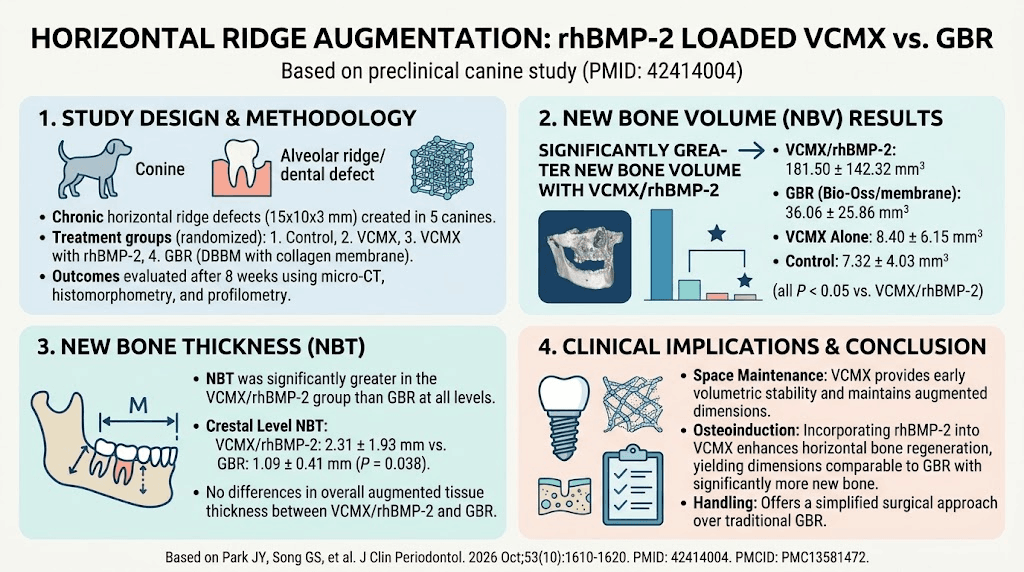
This preclinical in vivo study employed a chronic horizontal ridge defect model in five healthy canines. Four treatment groups were compared within randomized defect sites: (1) control with no augmentation, (2) volume-stable collagen matrix alone (VCMX), (3) VCMX loaded with rhBMP-2, and (4) guided bone regeneration (GBR) using deproteinised bovine bone mineral with a collagen membrane. Following an 8-week healing period, the augmented sites underwent three complementary evaluations: profilometry to assess external contour changes, micro-computed tomography (micro-CT) for quantitative bone volume measurement, and histomorphometry to analyze new bone thickness at crestal, middle, and apical levels of the alveolar ridge.
Key Findings
The primary outcome revealed that VCMX combined with rhBMP-2 yielded significantly greater new bone volume (mean 181.50 ± 142.32 mm³) than GBR (36.06 ± 25.86 mm³), VCMX alone (8.40 ± 6.15 mm³), and control sites (7.32 ± 4.03 mm³), with all comparisons reaching statistical significance (p < 0.05). The remarkably enhanced bone volume in the rhBMP-2/VCMX group underscores the powerful osteoinductive capacity of rhBMP-2 when effectively delivered.
Histometric assessment demonstrated that new bone thickness was significantly greater in the rhBMP-2/VCMX group than in the GBR group at all evaluated levels: crestal (2.31 ± 1.93 mm vs. 1.09 ± 0.41 mm, p = 0.038), middle, and apical sites, further indicating more robust bone regeneration overall. In contour profile analyses, the rhBMP-2/VCMX yielded higher coronal contour gain than VCMX alone (p = 0.007), approximating the gains observed with GBR (p = 0.654, no significant difference). Notably, all augmentation groups showed significantly greater bone thickness at middle and apical levels compared to controls (p ≤ 0.011), reinforcing the advantage of intervention.
No adverse effects or complications related to rhBMP-2 application or matrix implantation were reported in the animals studied, emphasizing the safety profile of the approach within the controlled preclinical setting.
Expert Commentary
The utilization of rhBMP-2 via a volume-stable collagen matrix represents an innovative step beyond traditional GBR, offering the dual benefits of osteoinduction through a potent biologic agent and structural support from a biodegradable scaffold. This strategy may reduce reliance on autogenous bone grafts or xenografts, minimizing donor site morbidity and potential immune responses. However, the relatively wide standard deviation in bone volume with rhBMP-2 suggests individual variability or technical factors may influence outcomes and warrants further investigation.
While the canine model provides relevant translational insights, differences in bone healing dynamics between animals and humans must be considered before extrapolating results directly to clinical practice. Additionally, long-term stability and integration of the augmented bone require further evaluation to assess implant success rates post-augmentation.
Current clinical guidelines acknowledge rhBMP-2 as a valuable tool in alveolar ridge augmentation but recommend cautious use given cost considerations and regulatory restrictions. This study contributes compelling preclinical data supporting expanded applications, potentially informing future evidence-based protocols.
Conclusion
The delivery of rhBMP-2 via a volume-stable collagen matrix significantly enhances horizontal alveolar ridge augmentation in a canine model compared to guided bone regeneration and collagen matrix alone. It achieves superior new bone volume and thickness with augmentation dimensions comparable to conventional GBR, highlighting its potential as an efficacious alternative in dental reconstructive surgery. Future clinical trials are essential to confirm safety, optimize dosing, and validate long-term outcomes in human patients. The integration of biologically active molecules like rhBMP-2 with scaffold technologies heralds a promising evolution in regenerative dental medicine.
Funding and ClinicalTrials.gov
No funding or registration information was provided in the original study abstract. Further inquiries into funding sources should be made directly from the original publication or corresponding authors.
References
1. Park JY, Song GS, Park SH, Tavelli L, Wu DT, Thoma DS, Jung RE, Jung UW, Cha JK. Horizontal Ridge Augmentation Using an rhBMP-2 Loaded Volume-Stable Collagen Matrix Compared to Guided Bone Regeneration: A Preclinical In Vivo Study. J Clin Periodontol. 2026 Jul;53(10):1610-1620. doi: 10.1111/jcpe.13420. PMID: 42414004.
2. Boyne PJ, Lilly LC, Marx RE. Recombinant human bone morphogenetic protein-2 for the reconstruction of alveolar clefts: clinical results in 9 patients. J Oral Maxillofac Surg. 2005 Mar;63(3):362-77.
3. Carranza FA Jr. Carranza’s Clinical Periodontology. 13th Edition. Elsevier; 2019.
4. Fabrication and Evaluation of Volume-Stable Collagen Matrices in Bone Regeneration. Tissue Eng Part B Rev. 2021;27(1):19-34.
5. Eweida AE, Taha RM. Bone morphogenetic protein-2 in cleft alveolar bone grafting: A narrative review. J Oral Maxillofac Surg Med Pathol. 2020;32(6):619-625.