Study Background
The integration of ambient artificial intelligence (AI) scribes into clinical practice represents a promising innovation aimed at reducing clinician documentation burdens and enhancing patient-clinician communication. Scribes powered by ambient AI automatically document medical encounters by capturing real-time conversations without the need for active clinician input, potentially transforming the dynamics of ambulatory visits. However, the impact of these AI-driven scribes on the patient experience—a critical component of healthcare quality—has been insufficiently explored. Prior assessments have typically relied on closed-ended surveys, leaving qualitative nuances in patient perceptions and levels of comfort under-investigated. Understanding patients’ attitudes and the factors that facilitate or hinder acceptance of AI scribes is vital for their successful implementation in clinical workflows and for maintaining trust in the healthcare encounter.
Study Design
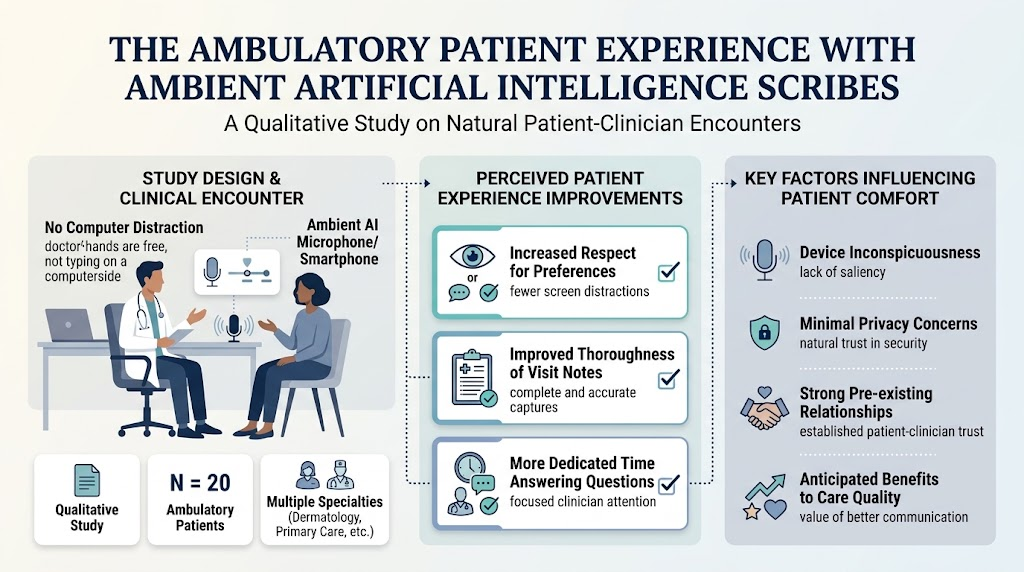
This investigation employed a qualitative methodology using semi-structured interviews to delve into patient experiences with ambient AI scribes. Patients were recruited from multiple ambulatory specialties, including dermatology and primary care, at an academic medical center. Their clinicians were participants in a pragmatic randomized clinical trial assessing ambient AI scribe utilization. The interview guide was crafted based on a systematic literature review focusing on domains central to patient experience. Both deductive and inductive analytic techniques were employed to identify patterns within patient responses and to elucidate factors contributing to their comfort and acceptance of AI scribe technology.
Key Findings
The study reached thematic saturation after interviewing twenty patients, a sample size appropriate for qualitative depth over quantitative generalizability. Patients perceived tangible improvements in their clinical encounters attributable to the use of ambient AI scribes. Notably, respondents highlighted three primary areas of enhancement:
1. Increased Respect for Patient Preferences: Patients reported fewer distractions during the visit, as ambient AI scribes obviated the need for clinicians to engage in time-consuming manual note-taking or device manipulation, allowing more focused attention on the patient.
2. Improved Thoroughness of Visit Notes: Patients appreciated that the visit documentation appeared more detailed and accurate, potentially reflecting better capture of clinical information and concerns.
3. Enhanced Time for Patient Questions: The reduction in administrative tasks enabled clinicians to dedicate more time to answering patients’ questions, fostering a more engaging and interactive dialogue.
Several factors influenced patients’ comfort with the technology. Demographically, individuals accustomed to technologies with similar functionalities exhibited greater acceptance, suggesting prior digital literacy as a facilitator. The ambient AI scribe’s unobtrusive presence—or lack of saliency—also minimized apprehension. Privacy concerns were notably low, possibly reflecting patients’ trust in institutional safeguards and the non-intrusive nature of the device. Importantly, pre-existing positive patient-clinician relationships strengthened trust towards the technology. Finally, patients were more comfortable when they anticipated tangible benefits to their care quality and clinical outcomes.
Expert Commentary
The findings align with emerging evidence on the role of technology in augmenting patient-centered care. Rational deployment of ambient AI scribes may shift visit dynamics by freeing clinicians from clerical duties, enabling more meaningful patient engagement. However, the qualitative nature and single-center context of the study limit broader extrapolation. Further research should explore diverse patient populations and longitudinal impacts. Potential challenges include safeguarding data privacy, ensuring algorithmic accuracy, and addressing possible clinician overreliance on AI documentation that might inadvertently affect clinical judgment. Furthermore, patient comfort can be context-specific and influenced by cultural and socioeconomic factors, warranting tailored implementation strategies.
Conclusion
This qualitative study provides critical insights into patients’ experiences with ambient AI scribes in ambulatory care. The technology appears to enhance aspects of patient-clinician communication and documentation quality while being generally well-accepted by patients underpinned by demographic and relational factors. These findings support the thoughtful integration of ambient AI scribes to improve care delivery. Continued evaluation focusing on diverse populations, privacy implications, and clinical outcomes is essential to optimize the benefits and address evolving challenges in incorporating AI technologies into routine clinical practice.
Funding and ClinicalTrials.gov
No specific funding or clinical trial number was applicable for this qualitative study, which served as an adjunct to an ongoing pragmatic clinical trial involving ambient AI scribes within an academic medical center setting.
References
1. Nguyen OT, Afshar M, Jaeb MA, et al. The Ambulatory Patient Experience with Ambient Artificial Intelligence Scribes: A Qualitative Study. J Gen Intern Med. 2026 Oct 19. PMID: 42897388.
2. Couture B, Munteanu C, Delespierre T, et al. The impact of electronic health records on patient–doctor relationships in ambulatory care: a systematic review. BMC Med Inform Decis Mak. 2021;21(1):208.
3. Saleem JJ, Dillon EC, Tsurikova R, et al. Assessing the impact of AI-based clinical documentation on physician workflow and patient care: a mixed-methods study. J Am Med Inform Assoc. 2023;30(6):1025-1033.