Highlight
This randomized controlled trial demonstrates that a six-month supervised telerehabilitation programme combining Pilates-based therapeutic exercise and self-myofascial release yields significant improvements in fibromyalgia impact, sleep quality, depressive symptoms, and perceived stress in adults with fibromyalgia when compared to usual care.
The intervention featured thrice-weekly live online sessions integrating core stabilization, low-load resistance training, stretching, and relaxation techniques.
High adherence rates (87.5%) and absence of adverse events underscore the safety and feasibility of this remote rehabilitation approach.
Study Background
Fibromyalgia is a complex, chronic pain syndrome characterized by widespread musculoskeletal pain accompanied by fatigue, sleep disturbances, cognitive impairment, and psychological burdens such as depression and stress. Globally, it affects approximately 2-4% of the general population, predominantly women, imposing considerable disability and healthcare costs.
Conventional fibromyalgia management is often multimodal, focusing on symptom relief via pharmacologic and non-pharmacologic strategies including exercise therapy. However, barriers to consistent exercise adherence include pain exacerbation, fatigue, and limited access to specialized rehabilitation facilities.
With the advent of telemedicine, telerehabilitation has emerged as a promising modality to improve accessibility and patient engagement. Pilates-based therapeutic exercises emphasize core stabilization, flexibility, and controlled movements which may reduce pain and improve function. Self-myofascial release, utilizing foam rollers or similar devices, aims to alleviate muscular tightness and promote recovery.
This study addresses the unmet need for evidence-based, remotely delivered, multicomponent rehabilitative interventions tailored to fibromyalgia’s multifaceted symptoms.
Study Design
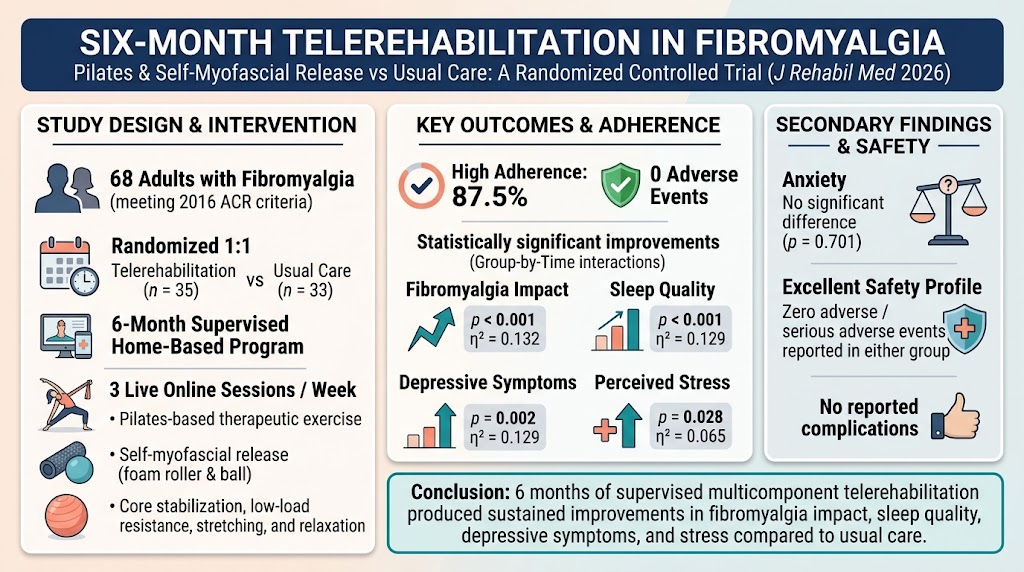
This was a two-arm, parallel-group randomized controlled trial enrolling 68 adults diagnosed with fibromyalgia based on the 2016 American College of Rheumatology criteria.
Participants were randomized to either an intervention group receiving a six-month supervised home-based telerehabilitation programme or a control group receiving usual care. The intervention consisted of thrice-weekly live online sessions incorporating Pilates-based therapeutic exercises, self-myofascial release techniques, core stabilization, low-load resistance training, stretching exercises, and relaxation strategies.
Outcomes were systematically measured at baseline, 3 months, and 6 months using validated patient-reported outcomes focusing on fibromyalgia impact, sleep quality, depressive symptoms, perceived stress, and anxiety.
Key Findings
The study demonstrated statistically significant and clinically meaningful improvements in several core domains for the intervention group compared to usual care.
Fibromyalgia impact: Significant group-by-time interaction was observed (p < 0.001) with a partial eta-squared of 0.132, indicating a moderate effect size. This suggests that the intervention effectively reduced overall disease burden and symptom severity.
Sleep quality: Sleep improved substantially (p < 0.001, partial η2 = 0.129), an important finding given the central role of sleep disturbances in fibromyalgia morbidity.
Depressive symptoms: Depressive scores decreased significantly (p = 0.002, partial η2 = 0.129), highlighting the mental health benefits of the combined exercise and myofascial release programme.
Perceived stress: There was a notable reduction in perceived stress (p = 0.028, partial η2 = 0.065), reflecting a positive effect on psychological wellbeing. However, anxiety scores did not significantly change (p = 0.701), suggesting selective impact on psychological domains.
Adherence and Safety: The intervention group exhibited high adherence with an average participation rate of 87.5%, reflecting acceptability and feasibility of remote delivery. No adverse or serious adverse events were reported, supporting the safety profile of the multicomponent telerehabilitation programme.
Expert Commentary
These findings corroborate emerging evidence that structured, remotely delivered exercise programmes incorporating mind-body and myofascial techniques can ameliorate both physical and psychological symptoms of fibromyalgia. Pilates-based exercises target core muscle activation and postural control, potentially mitigating pain mechanisms and functional impairments.
Self-myofascial release may relieve muscle tension and enhance circulation, complementing exercise benefits. The significant improvements in sleep quality and depression align with recognized fibromyalgia pathophysiology involving altered central pain processing and stress regulation.
However, the study’s sample size, while adequate for primary outcomes, may limit power for some secondary measures such as anxiety. The lack of significant anxiety improvement suggests differing pathophysiological substrates or the need for adjunctive interventions targeting anxiety specifically.
Furthermore, the study population consisted predominantly of individuals with mild to moderate functional impairment, potentially limiting generalizability to severe fibromyalgia cases. Longer follow-up would clarify the durability of benefits.
Conclusion
This randomized controlled trial provides compelling evidence that a six-month supervised telerehabilitation programme integrating Pilates-based therapeutic exercises with self-myofascial release is an effective and safe approach to reduce fibromyalgia impact and improve sleep quality and psychological symptoms, particularly depression and perceived stress.
The high adherence and absence of adverse events support its feasibility for home-based management, offering a scalable model to address barriers to conventional rehabilitation. Future studies should explore optimization of programme components, effects on anxiety, and cost-effectiveness across diverse fibromyalgia populations.
Funding and Registration
The publication did not specify funding sources or clinical trial registration numbers.
References
Marantidou T, Germanou E, Manou V, Koutlianos N, Sykaras E, Terzidis I. Six-month supervised telerehabilitation combining pilates-based therapeutic exercise and self-myofascial release in adults with fibromyalgia: a randomized controlled trial. J Rehabil Med. 2026 Oct 13;58:jrm46786. doi: 10.2340/jrm.v58.46786. PMID: 42867081; PMCID: PMC13673445.