Electronic Patient-Reported Outcome Monitoring With Alert-Based Interventions in Metastatic Breast Cancer: A Review of Evidence and Clinical Implications
Highlights
- Digital patient-reported outcome (PRO) monitoring with alert-based clinical responses significantly reduces fatigue in patients with metastatic breast cancer (mBC).
- Weekly electronic PRO assessments enable timely identification and intervention on symptom deterioration, leading to improved physical functioning.
- Use of standardized item banks and computerized adaptive testing optimizes PRO measurement precision and clinical actionability.
- This approach supports integration of patient-centered symptom monitoring into routine oncology care to enhance quality of life and functional status.
Background
Metastatic breast cancer is a chronic, incurable condition where symptom management and quality of life optimization are critical treatment goals. Fatigue is one of the most prevalent, distressing, and functionally impairing symptoms faced by patients with mBC. Despite systemic advances improving survival, fatigue remains under-addressed and negatively impacts physical functioning and overall well-being. Traditional clinical monitoring often lacks the granularity or frequency to capture dynamic symptom fluctuations or to facilitate timely interventions. Electronic patient-reported outcome (PRO) monitoring offers a scalable, patient-centered approach to symptom surveillance, enabling frequent assessments and alert-based clinical responses. While this strategy has demonstrated benefits in advanced solid tumors broadly, evidence specifically in mBC populations was limited until recently.
Key Content
Evolution of Electronic PRO Monitoring in Oncology
Early work in electronic PRO (ePRO) monitoring in oncology focused on symptom tracking in advanced cancers such as lung cancer, demonstrating reduced emergency visits and improved survival (Basch et al., JAMA 2017). Subsequent randomized controlled trials and meta-analyses confirmed that high-frequency symptom monitoring with clinician alerts improves quality of life (QoL) and may detect complications earlier. However, these studies tended to aggregate heterogeneous tumor types, limiting disease-specific insights.
Randomized Clinical Trial Evidence in Metastatic Breast Cancer
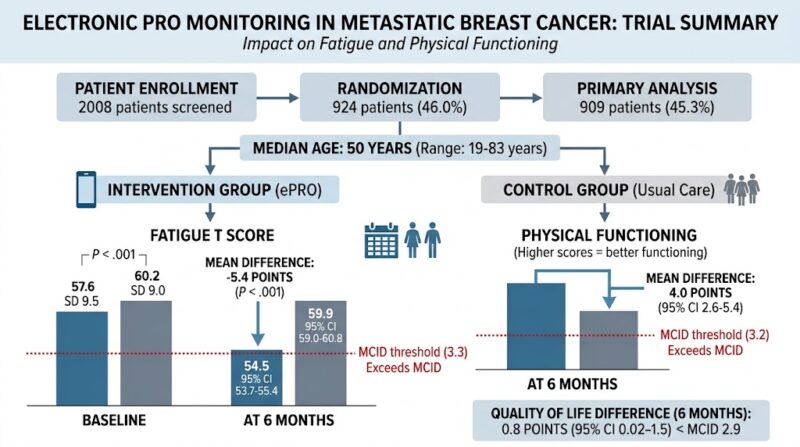
The 2026 multicenter RCT by Karsten et al. represents the largest and most rigorous effort to date focusing explicitly on mBC (n=924 randomized; 909 analyzed). Conducted across 52 breast cancer centers in Germany, the trial employed weekly digital PRO questionnaires utilizing validated short forms from the European Organization for Research and Treatment of Cancer (EORTC) computerized adaptive testing item bank. Automated alerts triggered by clinically significant PRO deterioration emailed trained nurses or physicians, who conducted follow-up telephone interventions within 48 hours. The control group received usual care with quarterly PRO assessments without alerts.
At six months, the intervention group demonstrated significantly reduced fatigue (adjusted mean fatigue T score 54.5 vs. 59.9; mean difference -5.4 points, p<0.001), surpassing the minimal clinically important difference (MCID) threshold of 3.3 points. Physical functioning also improved meaningfully (mean difference 4.0 points, exceeding MCID of 3.2). Although quality of life differences at 6 months were statistically significant (0.8 points), they did not reach MCID (2.9), suggesting more nuanced or longer-term benefits may require further study.
Mechanistic and Translational Insights
Frequent PRO querying likely enhances symptom awareness and self-management while enabling rapid clinical responses to emerging issues before irreversible functional decline occurs. The alert-based intervention was delivered by trained personnel, emphasizing multidisciplinary care and reinforcing patient-provider communication. The computerized adaptive testing methodology improved measurement efficiency and reliability, reducing patient burden while capturing relevant symptom changes sensitively.
Comparison to Broader Evidence and Guidelines
Findings align with prior research supporting ePRO interventions that reduce symptom burden and improve clinical outcomes in advanced cancer populations. NCCN and ASCO guidelines increasingly recommend integrating PRO monitoring into routine oncology for symptom management, yet specific recommendations for mBC have been less robust due to scarce targeted evidence. This trial provides important validation supporting guideline incorporation for mBC-specific PRO monitoring focusing on fatigue and physical function.
Expert Commentary
The Karsten et al. trial addresses a critical gap by demonstrating that electronic PRO systems paired with timely alert-based interventions can produce clinically meaningful symptom improvement in mBC, notably in fatigue which profoundly affects patient quality of life and daily function. The pragmatic design—including diverse clinical sites and a broad age range—supports generalizability. However, the study’s restriction to patients with smartphone access and German reading ability may limit applicability in other populations. Furthermore, the modest effect on QoL highlights that multifaceted supportive care beyond fatigue monitoring is needed.
The real-time nurse or physician telephone contact protocol exemplifies an effective model for clinical actionability of digital symptom data, but scalability and resource requirements warrant further research. Future studies might explore integration with electronic health records, automation of triage, incorporation of behavioral or pharmacological fatigue interventions, and cost-effectiveness.
Biologically, fatigue in mBC is multifactorial involving disease burden, treatment toxicity, inflammation, and psychosocial stressors. PRO monitoring can serve both as an early detection tool and a patient engagement mechanism, potentially mitigating symptom cascades. Translational research integrating biomarkers of fatigue with PRO data could elucidate underlying mechanisms and personalize interventions.
Conclusion
Electronic patient-reported outcome monitoring with alert-based clinical interventions represents a significant advancement in supportive care for metastatic breast cancer. This large randomized trial robustly demonstrates that such digital health strategies can substantially reduce fatigue and improve physical functioning, key determinants of patient quality of life. The evidence justifies broader implementation and further refinement of alert-based ePRO systems tailored to mBC patients. Moving forward, integrating these tools within multidisciplinary oncology care pathways and exploring synergistic interventions will be critical for maximizing patient benefit and transforming symptom management paradigms.
References
- Karsten MM et al. Electronic Patient-Reported Outcome Monitoring With Alert-Based Interventions in Metastatic Breast Cancer: A Randomized Clinical Trial. JAMA Oncol. 2026 Aug 6; PMID: 42560727.
- Basch E et al. Symptom monitoring with patient-reported outcomes during routine cancer treatment: a randomized controlled trial. JAMA. 2017; 318(2):197-198.
- Basch E et al. Overall survival results of a trial assessing patient-reported outcomes for symptom monitoring during routine cancer treatment. JAMA. 2017; 318(2):197–198.
- European Organisation for Research and Treatment of Cancer (EORTC) computerized adaptive testing core item bank. EORTC Quality of Life Group.
- National Comprehensive Cancer Network (NCCN) Guidelines. Survivorship and symptom management sections. 2024.
- American Society of Clinical Oncology (ASCO) Guideline on patient-reported outcomes and symptom management. 2023.
This article was created using several editorial tools, including AI, as part of the process. Human editors reviewed this content before publication.
