Highlights
Divarasib demonstrates significantly improved progression-free and overall survival compared to first-generation KRAS G12C inhibitors sotorasib and adagrasib in previously treated advanced NSCLC.
Real-world evidence confirms clinical efficacy and tolerability of sotorasib but highlights challenges related to dosing and patient frailty.
Matching-adjusted indirect comparisons indicate comparable efficacy between sotorasib and adagrasib, with sotorasib exhibiting a more favorable safety profile, especially in patients with brain metastases.
Circulating tumor DNA (ctDNA) dynamics serve as predictive biomarkers for treatment response and resistance across therapies, underscoring the importance of molecular monitoring.
Background
KRAS G12C mutations occur in approximately 10-13% of non-small-cell lung cancer (NSCLC) cases and represent a critical oncogenic driver with historically limited targeted treatment options. The recent development of covalent KRAS G12C inhibitors has revolutionized therapeutic approaches, shifting from chemotherapy toward precision medicine. Sotorasib and adagrasib—first-generation oral inhibitors—have demonstrated clinical efficacy but with modest progression-free survival (PFS) and overall survival (OS) benefits and challenges related to safety and CNS penetration. Divarasib, a next-generation KRAS G12C inhibitor, is designed to enhance potency, selectivity, and tolerability, potentially improving clinical outcomes in this difficult-to-treat population.
Key Content
Chronological Development and Comparative Clinical Efficacy
Initial phase 1 trial results (Skoulidis et al., 2023, NEJM PMID 37611121) showed promising antitumor activity of divarasib (GDC-6036) across KRAS G12C-mutated solid tumors, including NSCLC, with a confirmed objective response rate (ORR) of 53.4% and median PFS of over 13 months at the 400 mg dose. Treatment was generally well tolerated, with grade 3 or higher adverse events (AEs) in approximately 12% of patients.
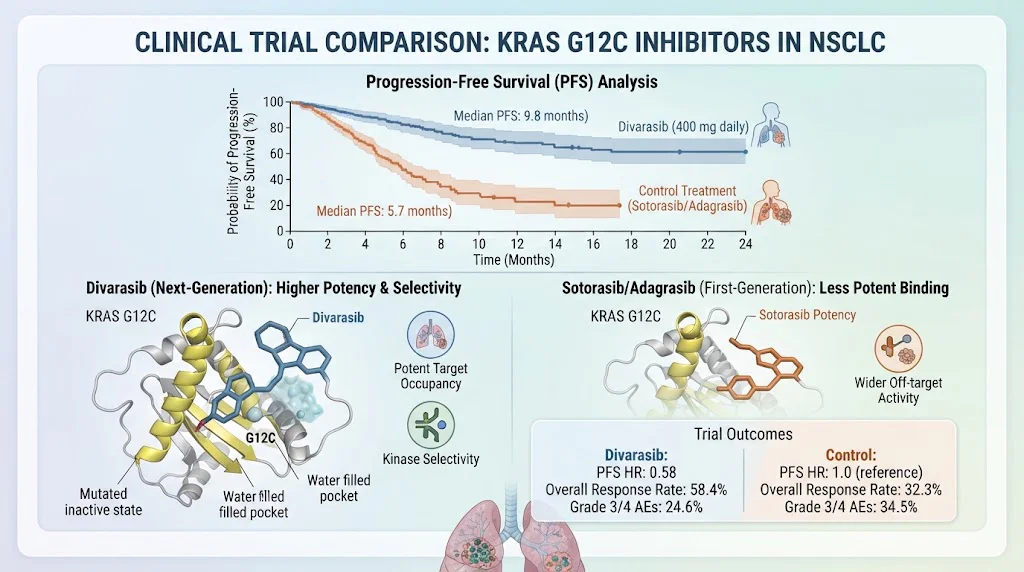
Building on these early data, the pivotal phase 3 Krascendo 1 trial (Skoulidis et al., 2026, NEJM PMID 42929675) directly compared divarasib (400 mg once daily) with control first-generation KRAS G12C inhibitors—sotorasib (960 mg once daily) or adagrasib (600 mg twice daily)—in 338 patients with previously treated advanced or metastatic KRAS G12C-mutated NSCLC. The study demonstrated a median PFS of 9.8 months with divarasib versus 5.7 months with control (HR 0.58, P < 0.001), and median OS of 17.7 months versus 12.0 months (HR 0.56, P < 0.001). ORR was significantly higher in the divarasib group (58.4% vs. 32.3%), alongside a longer median duration of response (11.9 vs. 6.9 months). Importantly, grade 3 or 4 treatment-related adverse events were less frequent with divarasib (24.6%) compared to controls (34.5%), highlighting an improved safety profile.
Sotorasib was first evaluated in the phase 3 CodeBreaK 200 trial, demonstrating improved PFS versus docetaxel but without a significant OS benefit (Reck et al., 2023). Real-world evidence from the UK and France (PMID 42771901, 39970524) has confirmed sotorasib’s clinical effectiveness and tolerability, though with variability related to patient frailty and CNS involvement. Dose optimization studies and meta-analyses (PMID 42224643, 39029295) suggest lower doses (240 mg) may retain efficacy with reduced toxicity, informing personalized dosing strategies.
Sotorasib also exhibits intracranial activity, as demonstrated in a subgroup analysis from CodeBreaK 200 showing prolonged CNS PFS and greater CNS tumor shrinkage compared to docetaxel, an important consideration given high CNS metastasis rates in KRAS G12C NSCLC (PMID 40774040).
Adagrasib demonstrated superiority over docetaxel in the phase 3 KRYSTAL-12 trial, improving PFS (5.5 vs. 3.8 months; HR 0.58, P < 0.0001) with manageable toxicity (Mirati Therapeutics/BMS) (PMID 40783289). Additional data from the KRYSTAL-1 trial confirmed adagrasib’s intracranial activity, with an intracranial ORR of 42% and disease control rate of 90% in patients with untreated CNS metastases (PMID 37327468).
A matching-adjusted indirect comparison (MAIC) of sotorasib versus adagrasib (PMID 40542959) found comparable systemic efficacy in previously treated NSCLC but favored sotorasib for safety and CNS PFS, suggesting clinical nuances to inform therapeutic choice.
Biomarker and Translational Insights
Patterns of circulating tumor DNA (ctDNA) dynamics have emerged as valuable predictive biomarkers for treatment response and disease progression:
In divarasib-treated patients, rapid decline in KRAS G12C ctDNA levels early in treatment correlated with tumor response and prolonged PFS, suggesting its use as an early pharmacodynamic marker (PMID 38995268).
In sotorasib-treated patients, clearance of KRAS G12C-mutant ctDNA was strongly associated with improved ORR, PFS, and OS (PMID 40445863, 38615940). Conversely, increases in ctDNA levels anticipated radiologic progression, enabling early intervention planning.
These findings advocate integrating liquid biopsy monitoring into clinical management to optimize outcomes and detect emerging resistance mechanisms.
Dosing Optimization and Safety Considerations
Recent systematic reviews show the standard 960 mg sotorasib dose does not significantly improve efficacy compared to lower doses (e.g., 240 mg), but entails increased toxicity burden (PMID 42224643). Dose reductions and interruptions are common, underscoring the need for optimized regimens aligned with patient tolerance. Divarasib’s favorable safety profile offers a promising alternative for patients experiencing first-generation inhibitor toxicity.
Cost-Effectiveness and Real-World Utility
Economic evaluations (PMID 41488979) indicate sotorasib is more cost-effective than adagrasib in the US healthcare context, driven by lower drug and adverse event management costs, reinforcing the importance of balancing clinical benefits with systemic resource allocation.
Real-world studies corroborate trial evidence for sotorasib but also reveal challenges in older and frail patient populations, highlighting the gap between clinical trial and routine practice settings that may impact outcomes and tolerability profiles (PMID 42771901, 39970524).
Expert Commentary
The emergence of divarasib as a next-generation oral KRAS G12C inhibitor marks a significant advance in targeted therapy for NSCLC with this oncogenic mutation. Its superior efficacy in prolonging PFS and OS compared to first-generation agents sotorasib and adagrasib, alongside a more tolerable safety profile, potentially redefines the therapeutic standard for previously treated patients.
Mechanistically, divarasib’s enhanced potency and selectivity leverage improved target engagement, possibly mitigating off-target toxicities observed with earlier inhibitors. CNS activity remains a critical factor, with sotorasib and adagrasib demonstrating intracranial efficacy and divarasib’s CNS penetration data pending but anticipated from structural and pharmacokinetic profiles.
Despite these advances, challenges persist including acquired resistance mediated by KRAS amplification or other pathway alterations. Molecular monitoring through ctDNA is pivotal for early detection and could guide timely therapeutic adjustments.
Clinical guidelines will need updating to incorporate divarasib’s role based on these robust phase 3 data. Real-world evidence and dose optimization studies are essential to translate efficacy into sustained patient benefit broadly, particularly in heterogeneous patient populations with diverse comorbidities and CNS involvement.
Limitations of current studies include relatively short median follow-ups and limited direct head-to-head comparisons beyond the Krascendo 1 trial. Moreover, real-world treatment patterns and access disparities may affect outcomes. Future research should address mechanisms of resistance, combination strategies to enhance durability of response, and biomarker-driven patient selection.
Conclusion
The landscape of KRAS G12C-mutated NSCLC treatment is rapidly evolving. Divarasib offers substantial clinical benefits over first-generation inhibitors, reshaping expectations for PFS and OS and enhancing patient tolerability. Continued translational efforts, ctDNA-guided monitoring, and integrated real-world data analyses are critical to optimal clinical implementation. Comparative pharmacoeconomic analyses will support health system decisions amid increasing therapeutic options.
Future directions include CNS activity confirmation of divarasib, exploration in combination regimens (e.g., with EGFR inhibitors), and expanded indications across KRAS-driven malignancies.
References
Skoulidis F et al. Divarasib as Compared with Sotorasib or Adagrasib in KRAS G12C-Mutated NSCLC. N Engl J Med. 2026; 42929675.
Skoulidis F et al. Single-Agent Divarasib (GDC-6036) in Solid Tumors with a G12C Mutation. N Engl J Med. 2023; 37611121.
Reck M et al. Sotorasib vs Docetaxel for KRAS G12C-Mutated NSCLC: CodeBreaK 200. Lancet Respir Med. 2023.
Langen K-J et al. Intracranial Activity of Sotorasib in KRAS G12C-Mutated NSCLC with Brain Metastases. Lung Cancer. 2025; 40774040.
Zhao Y et al. Matching-Adjusted Indirect Comparison of Sotorasib vs Adagrasib in KRAS G12C NSCLC. Adv Ther. 2025; 40542959.
Ahn MJ et al. Adagrasib versus Docetaxel in KRAS G12C Mutated NSCLC: KRYSTAL-12 Phase 3 Trial. Lancet. 2025; 40783289.
Gadgeel S et al. Real-World Experience with Sotorasib in KRAS G12C-Mutated NSCLC: UK Data. Clin Oncol. 2026; 42771901.
Skoulidis F et al. Long-Term Follow-Up of Single-Agent Divarasib: Phase 1 Study. J Clin Oncol. 2025; 40632992.
Li MSC et al. Circulating Tumor DNA Dynamics Predict Sotorasib Efficacy in KRASp.G12C NSCLC. Cancer. 2025; 40445863.
Yang J et al. Cost-Effectiveness of Sotorasib vs Adagrasib in KRAS G12C NSCLC. J Med Econ. 2025; 41488979.