We use cookies

Our website uses essential cookies and, with your consent, additional cookies to measure performance and improve our services. Cookie Policy.

You can change your choice at any time.

MMedXYNews
HomeVideos
MedXY AI/MedXY News/Section: Infectious Diseases

Distinct Clinical Profiles and Outcomes of Culture-Positive Endogenous Endophthalmitis by Pathogen: Insights from a 12-Year Multicenter Study
MedXY Editorial Team•Oct 1, 2026•Infectious Diseases
endogenous endophthalmitismicrobial pathogensocular infectionVisual Outcomesvitrectomy

Highlight

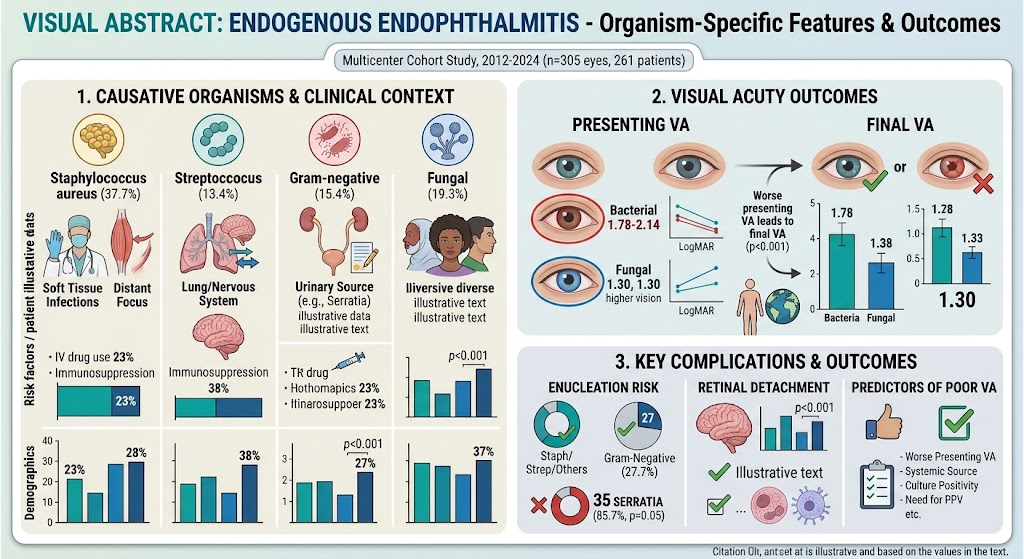
• Endogenous endophthalmitis presents with distinct clinical features and outcomes depending on the causative microbial pathogen.
• Gram-negative infections, especially Serratia, carry a significantly higher risk of enucleation and poor visual prognosis.
• Fungal infections are more common in immunosuppressed patients and intravenous drug users, with relatively better presenting and final visual acuities.
• Low intraocular culture yields and imperfect concordance with blood cultures complicate pathogen-directed treatment decisions.

Study Background

MedXY registered readers

Sign in free to continue reading

Create or use your MedXY account to unlock the complete article.

This article was created using several editorial tools, including AI, as part of the process. Human editors reviewed this content before publication.

Related articles

Open language-specific specialty feeds and department pages.

Early Optic Nerve Head Swelling Rate Predicts Visual Outcome Deterioration in Nonarteritic Anterior Ischemic Optic Neuropathy: An Evidence-Based ReviewEarly rapid optic nerve head swelling in NAION correlates with worse visual outcomes, with OCT measures of pONHV and mGCIPL thinning providing prognostic insights within days of symptom onset.Oct 7, 2026Early Optic Nerve Head Swelling Rate Correlates with Visual Decline in Nonarteritic Anterior Ischemic Optic Neuropathy: An Evidence-Based ReviewThis review synthesizes longitudinal OCT findings and clinical outcomes in NAION, highlighting the prognostic value of early optic nerve head swelling rates for visual impairment progression, and discusses mechanistic and translational implOct 6, 2026Cystoid Macular Edema Following Cultured Human Corneal Endothelial Cell Injection: Incidence, Risk Factors, and Visual PrognosisThis review synthesizes current evidence on the frequency and risk factors of cystoid macular edema (CME) after cultured human corneal endothelial cell (cHCEC) injection, highlighting prostaglandin analog use as a key associated factor andSep 19, 2026
Loading comments...
MedXY briefing

Get the free newsletter

Evidence-led clinical news, trends, and analysis—delivered to your inbox.

Ask MedXY AI

Most popular

Intimate Health
Five Benefits for Women Continuing Sexual Activity After Menopause
Intimate Health
Why Some Women Have a Strong Sex Drive—And Why Men Shouldn't Worry About It
Nursing & care
How often should a couple have sex?
Cardiology
Precision Medicine for Long QT Syndrome Type 2: Lumacaftor Corrects Trafficking Defects and Shortens QT Interval
General Surgery
Optimizing Postoperative Opioid Prescriptions After Intra-Abdominal Cancer Surgery: Comparing the 5x-Multiplier and 3-Tier Models
© 2026 MedXY
Contact usAbout usPrivacy PolicyMedXY story
Immune-Mediated Disorders and Central Serous Chorioretinopathy: Clinical Insights from the MICRoN Report 21This study reveals that central serous chorioretinopathy (CSCR) in patients with immune-mediated disorders exhibits distinct clinical and imaging features, with immune-mediated status linked to poorer visual outcomes and higher recurrence,Aug 26, 2026
Persistent Challenges in Managing Monocular Deprivation Amblyopia: A Three-Decade Trend Analysis of Infant Unilateral Cataract OutcomesThis review evaluates 30 years of clinical outcomes for monocular congenital cataracts, revealing stagnant visual acuity results, high surgical burdens, and significant rates of secondary glaucoma and nystagmus despite surgical advances.May 13, 2026