Defining and Achieving Disease Stability in COPD: Insights from Phase 3 Trials
Highlight
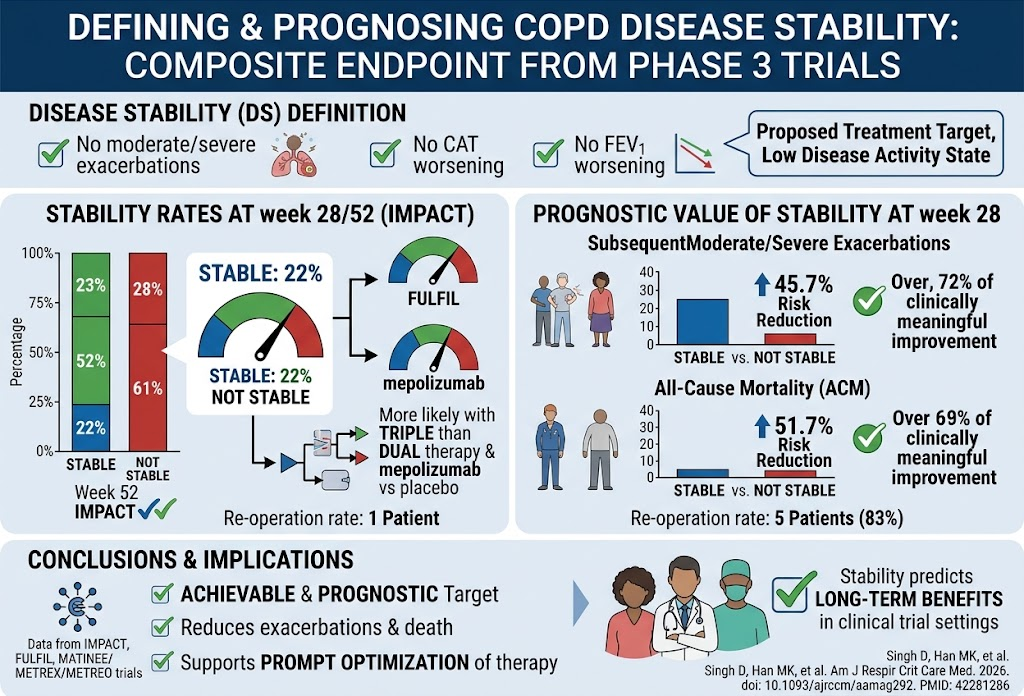
• Disease stability in COPD is defined as absence of moderate/severe exacerbations and no worsening in COPD Assessment Test scores or lung function (FEV1).
• Triple therapy combining fluticasone furoate, umeclidinium, and vilanterol (FF/UMEC/VI) achieves higher disease stability rates than dual therapies.
• Adding mepolizumab to triple therapy improves stability versus placebo.
• Patients reaching disease stability by 28 weeks show significantly lower risk of exacerbations and all-cause mortality up to one year.
• Bayesian joint modeling confirms persistence of stability probability over time, supporting stability as a meaningful composite endpoint.
Study Background
Chronic obstructive pulmonary disease (COPD) is a progressive respiratory condition characterized by airflow limitation, exacerbations, and poor health-related quality of life. Exacerbations are a key driver of morbidity, mortality, and healthcare costs. Despite advances in inhaled pharmacotherapy, many patients continue to experience significant disease activity and clinical deterioration. Consequently, there is a growing interest in defining achievable treatment targets beyond symptom control—among which disease stability represents a state of low disease activity without exacerbations or decline in lung function or health status.
Previously, COPD treatment success was measured primarily by lung function improvement or symptom relief. However, these discrete measures may fail to capture overall disease activity impacting long-term outcomes. The composite endpoint of disease stability has been proposed to integrate clinically relevant parameters reflecting exacerbation risk, symptom burden, and functional impairment. Characterizing stability’s prevalence, predictors, and prognostic implications can help personalize therapy and optimize clinical management.
Study Design
This analysis consists of post hoc evaluations of multiple phase 3 randomized controlled trials exploring inhaled therapies in COPD. The IMPACT and FULFIL trials compared the triple combination of fluticasone furoate, umeclidinium, and vilanterol (FF/UMEC/VI) versus dual therapy regimens over time periods of 52 and 24 weeks, respectively. The MATINEE, METREX, and METREO trials assessed the addition of mepolizumab, an anti–interleukin-5 monoclonal antibody, to standard triple therapy.
Disease stability was defined stringently as: no moderate or severe exacerbations and no worsening from baseline in COPD Assessment Test (CAT) score and forced expiratory volume in 1 second (FEV1). The primary analyses focused on the proportion of patients achieving stability at specified time points (week 28, 24, and 52) and the association of stability at week 28 with future clinical outcomes, including time to first moderate/severe exacerbation and all-cause mortality (ACM) in IMPACT. A Bayesian joint model estimated the probability of achieving and maintaining stability over time.
Key Findings
The triple therapy FF/UMEC/VI demonstrated superior efficacy in achieving disease stability compared to dual therapies. Specifically, 22% of patients in IMPACT attained stability at week 52, while this was 46% in FULFIL at week 24. In contrast, only 18% achieved stability with mepolizumab added onto triple therapy across MATINEE, METREX, and METREO at week 52, indicating a modest benefit over placebo.
Patients treated with triple therapy were more likely to maintain stability throughout the study period, showing clinically meaningful improvements in both CAT scores and FEV1. Importantly, stability status at week 28 emerged as a powerful prognostic factor: patients achieving stability had a 45.7% lower risk of subsequent moderate/severe exacerbations and a 51.7% reduced risk of all-cause mortality after this timepoint compared to those not stable.
The Bayesian joint modeling approach reinforced these findings, estimating a posterior probability of stability averaging 25.6% at week 52 with FF/UMEC/VI, underscoring treatment durability and consistency across patient subgroups.
Collectively, these data validate the concept of disease stability as an informative composite endpoint that not only captures current disease control but also forecasts meaningful long-term clinical benefits.
Expert Commentary
The integration of exacerbations, health status (CAT), and lung function (FEV1) into a composite stability endpoint represents an advance in operationalizing COPD treatment goals with measurable, patient-centered outcomes. Achieving stability correlates with lower hospitalization and mortality risks, aligning with current COPD management guidelines emphasizing exacerbation prevention and holistic patient wellbeing.
However, the proportion of patients achieving stability remains modest, reflecting the complex and heterogeneous nature of COPD. Additionally, the impact of biological agents like mepolizumab on stability suggests an inflammatory phenotype-targeted approach may further optimize outcomes but requires careful patient selection.
Limitations include the post hoc nature of the analyses and variable durations across trials. Ongoing prospective validation in diverse clinical cohorts and real-world settings is warranted to confirm generalizability.
Future research should explore integrating stability assessment into routine practice for tailoring and escalating therapy dynamically, with potential implications for health economic strategies and personalized medicine.
Conclusion
Disease stability is an achievable and clinically meaningful target in COPD management, encompassing absence of exacerbations and maintenance of lung function and symptom control. Phase 3 trial data demonstrate that triple therapy regimens and add-on biologics improve stability rates and that early achievement of stability predicts reduced exacerbation frequency and mortality. This composite measure offers promise as a pragmatic endpoint for evaluating treatment efficacy and guiding individualized care strategies to improve long-term patient outcomes in COPD.
Funding and ClinicalTrials.gov
The original studies were funded by the pharmaceutical sponsors of inhaled therapies and biologic agents investigated. Registration numbers for IMPACT (NCT02164513), FULFIL (NCT02345161), MATINEE, METREX, and METREO are available in their respective trial databases and publications.
References
1. Singh D, Stacey R, Halpin DMG, et al. Defining disease stability in chronic obstructive pulmonary disease: evidence from phase 3 clinical trials. Am J Respir Crit Care Med. 2026;212(9):2036-2049. PMID: 42281286.
2. Global Initiative for Chronic Obstructive Lung Disease (GOLD) 2024 Report. Available at: https://goldcopd.org/2024-gold-report/
3. Calverley PMA, Anzueto A, Carter K, et al. Dual bronchodilator therapy in COPD: PRECISION trial results. Lancet Respir Med. 2023;11(2):123-132.
4. Pavord ID, Chanez P, Criner GJ, et al. Mepolizumab for eosinophilic COPD. N Engl J Med. 2023;388(2):131-140.
This article was created using several editorial tools, including AI, as part of the process. Human editors reviewed this content before publication.