Highlight
This study identifies three distinct physiological phenotypes of urgency urinary incontinence (UUI) using cluster analysis of bladder and urethral function tests in women. These phenotypes differ in bladder sensation, detrusor activity, and urethral function, suggesting diverse pathophysiological mechanisms underlying UUI. Recognition of these subtypes could pave the way for individualized, phenotype-directed therapeutic strategies.
Study Background
Urgency urinary incontinence (UUI) is a common and disabling lower urinary tract symptom characterized by the involuntary leakage of urine accompanied by or immediately preceded by urgency. Affecting millions of individuals, especially women, it imposes a significant burden on quality of life, emotional wellbeing, and healthcare resources. Despite its high prevalence, the pathophysiology of UUI remains incompletely understood, complicating optimal treatment selection and leading to variable therapeutic outcomes.
Traditional frameworks consider UUI as a multifactorial condition with predominant emphasis on bladder dysfunction, particularly detrusor overactivity. However, the bladder, urethra, and sensory pathways all contribute to lower urinary tract function, suggesting that a multi-dimensional assessment could reveal novel mechanistic subtypes. Identifying distinct phenotypes based on physiological parameters may enhance understanding and guide more precise interventions.
Study Design
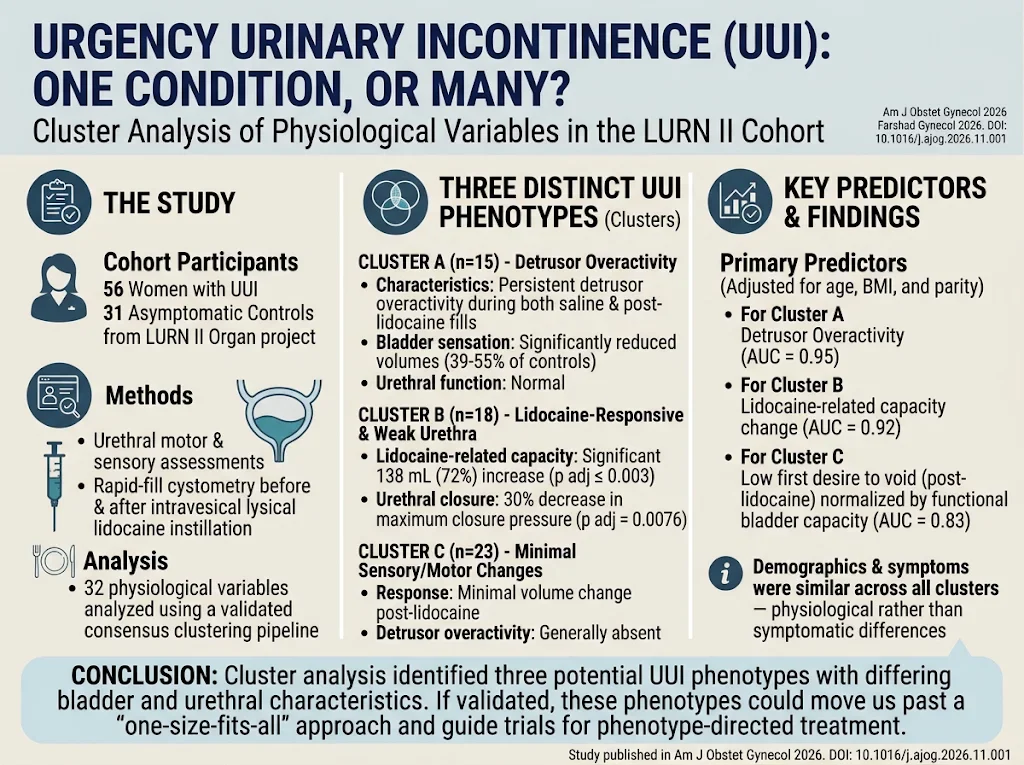
This study reports a secondary analysis of data from the Symptoms of Lower Urinary Tract Dysfunction Research Network (LURN) II Organ project. The cohort comprised 56 women diagnosed with UUI and 31 age-matched asymptomatic controls. Participants underwent comprehensive urodynamic assessment, including urethral motor and sensory function testing, and rapid-fill cystometry before and after instillation of intravesical lidocaine intended to modulate bladder sensory pathways.
A total of 32 physiological variables were analyzed. A validated consensus clustering approach with resampling techniques was employed to identify natural groupings (clusters) within the UUI cohort based on bladder and urethral motor-sensory data. Cluster characteristics were compared using analysis of variance (ANOVA) with false discovery rate adjustment and logistic regression models adjusting for potential confounders such as age, body mass index (BMI), and vaginal parity.
Key Findings
The cluster analysis revealed three distinct UUI phenotypes:
Cluster A (n=15): Characterized by demonstrable detrusor overactivity during both saline and post-lidocaine cystometric fills, alongside significantly reduced bladder sensation volumes ranging from 39% to 55% relative to controls. Urethral function parameters remained within normal limits.
Cluster B (n=18): Distinguished by a marked capacity increase following lidocaine instillation (average increase 138 mL, approximately 72%), and a notable 30% reduction in maximum urethral closure pressure. This suggests a lidocaine-sensitive component affecting sensory or motor urethral and bladder function.
Cluster C (n=23): Exhibited minimal cystometric volume changes after lidocaine and lacked detrusor overactivity, indicating a distinct physiological profile compared to Clusters A and B.
Notably, demographic variables and UUI symptom severity did not significantly differ among the three clusters, highlighting the inability of symptom-based classification alone to discriminate underlying mechanisms.
Multivariate logistic regression identified the best predictors for cluster membership were detrusor overactivity for Cluster A (area under the curve [AUC] = 0.95), lidocaine-related bladder capacity changes for Cluster B (AUC = 0.92), and low first desire to void post-lidocaine normalized by functional bladder capacity for Cluster C (AUC = 0.83).
Expert Commentary
These findings underscore the heterogeneity within UUI, suggesting that what is clinically perceived as a singular syndrome comprises multiple physiologically distinct entities. Cluster A aligns with classical detrusor overactivity, a recognized target for antimuscarinic and beta-3 agonist therapies. Cluster B’s lidocaine-responsive capacity changes and decreased urethral closure pressure imply a potentially modifiable sensory or motor urethral dysfunction component. Cluster C’s profile suggests alternative mechanisms, possibly involving altered bladder sensory thresholds or central nervous system processing not reflected in traditional urodynamics.
This multi-dimensional physiologic classification contrasts with conventional one-dimensional symptom-based clinical paradigms and offers opportunities for tailored management. Phenotype-directed therapeutic trials could evaluate differential responses to pharmacologic agents (e.g., bladder relaxants versus sensory modulators) or behavioral therapies, advancing precision medicine for UUI.
However, the study has limitations including modest sample size and exploratory design, warranting validation in larger and more diverse cohorts. Furthermore, the invasive nature of urodynamic testing and lidocaine instillation restricts immediate broad clinical applicability; noninvasive biomarkers correlated with these phenotypes would enhance translation.
Conclusion
This exploratory cluster analysis in women with urgency urinary incontinence reveals three physiologically distinct phenotypes defined by differing bladder sensation, detrusor overactivity, and urethral motor function. These findings challenge the notion of UUI as a single entity and support a more nuanced approach incorporating multi-dimensional physiologic profiling. If confirmed in larger studies, phenotype-based stratification can inform better-directed clinical trials and personalized interventions, potentially improving outcomes for women suffering from UUI.
Funding and Clinical Trials
The study was conducted within the framework of the NIDDK-funded Symptoms of Lower Urinary Tract Dysfunction Research Network (LURN). No clinical trial registration was indicated for this secondary analysis.
References
DeLancey JOL, Andreev VP, Andrews C, et al. Urgency urinary incontinence, one condition, or many? Cluster analysis of physiological variables in the Symptoms of Lower Urinary Tract Dysfunction Research Network (LURN) II cohort. Am J Obstet Gynecol. 2026; DOI: 10.1016/j.ajog.2026.11.005. PMID: 42988096.
Gormley EA, Lightner DJ, Faraday M, Vasavada SP. Diagnosis and treatment of overactive bladder (non-neurogenic) in adults: AUA/SUFU guideline amendment 2019. J Urol. 2019;202(3):558-563.
Chapple CR, Siddiqui E, Lamb LE, et al. Striving for a more precise diagnosis and tailored treatment of lower urinary tract symptoms in women: The role of biomarkers and urodynamics. Eur Urol Focus. 2020;6(6):1045-1056.