Comparative Evaluation of Topical versus Systemic Pirfenidone for Prevention of Glottic Stenosis in a Rat Model
Highlight
1. Laryngeal stenosis is characterized by fibroinflammatory dysregulation leading to excessive collagen deposition and fibrosis without effective pharmacological prophylaxis.
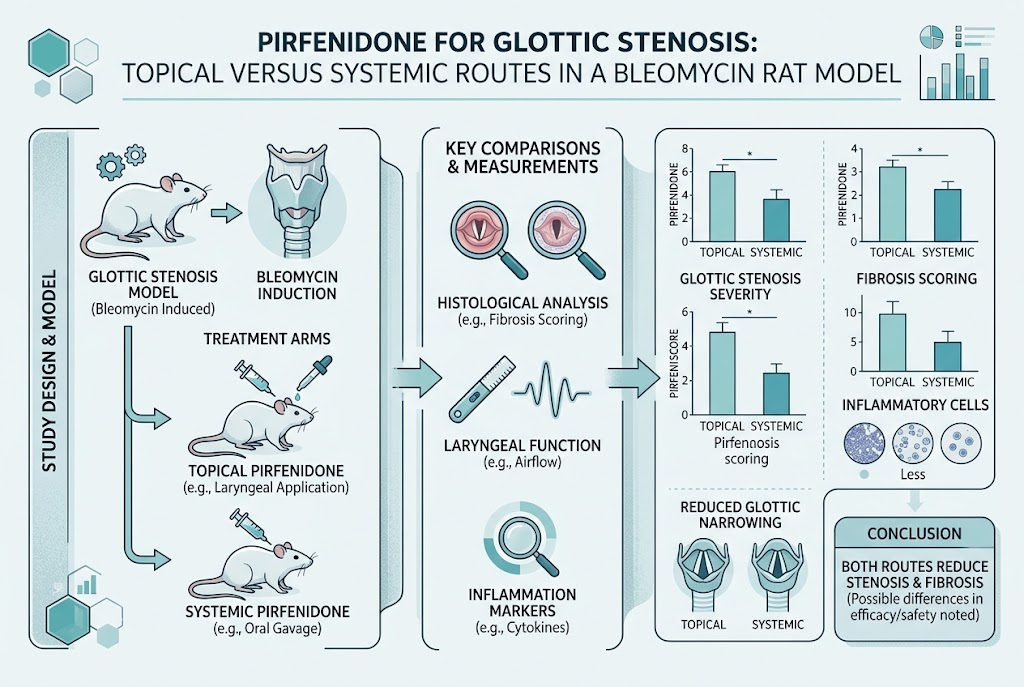
2. Pirfenidone, an antifibrotic agent, was evaluated in a bleomycin-induced rat model of glottic stenosis via two administration routes: topical and systemic.
3. Both topical and systemic pirfenidone significantly reduced macroscopic glottic stenosis compared to controls, but only systemic treatment showed significant reductions in histological fibrosis and collagen-1 expression.
4. These findings support further exploration of topical pirfenidone as a potentially less invasive treatment for glottic stenosis prevention.
Study Background
Glottic stenosis arises from abnormal wound healing in the larynx, typically following mucosal injury, leading to fibroinflammatory changes and excessive collagen accumulation causing airway narrowing. This condition can lead to significant morbidity including airway obstruction and compromised voice quality. Current treatments primarily involve surgical interventions, often complicated by recurrent fibrosis, highlighting a critical unmet need for effective pharmacological prophylaxis to modulate fibrotic remodeling.
Pirfenidone is an established antifibrotic agent with efficacy in idiopathic pulmonary fibrosis. It exerts effects through modulation of transforming growth factor-beta (TGF-β) signaling, inhibition of collagen synthesis, and anti-inflammatory properties. However, its utility in preventing laryngeal fibrosis and stenosis has not been comprehensively studied, particularly comparing systemic versus topical administration routes.
Study Design
This preclinical study utilized a bleomycin-induced glottic and subglottic injury model in male Wistar rats to simulate laryngeal fibrosis and stenosis. Thirty animals underwent endoscopic delivery of bleomycin to induce mucosal damage followed by randomization into three groups: topical pirfenidone (10 mg per application administered Days 0, 3, 7, and 14), systemic pirfenidone (40 mg/kg/day orally for 14 days), or untreated controls.
Primary endpoints included macroscopic grading of glottic stenosis by two blinded observers at four weeks and semi-quantitative histopathological scoring of tissue fibrosis, epithelial damage, and inflammatory markers. Immunohistochemical assessment quantified collagen type 1, TGF-β1, alpha-smooth muscle actin (α-SMA), and CD4-positive cells to elucidate antifibrotic and immunomodulatory effects. Statistical analyses employed Fisher’s exact test and Kruskal-Wallis tests with appropriate sensitivity analyses for mortality.
Key Findings
Of the 30 rats initially enrolled, 25 completed the study: 7 controls, 9 systemic pirfenidone-treated, and 9 topical pirfenidone-treated. Five deaths occurred (3 control, 1 systemic, 1 topical), with no statistically significant survival difference (log-rank p=0.386).
Macroscopic stenosis: Significant differences were observed overall (p=0.015). Both systemic (p=0.014) and topical (p=0.010) pirfenidone groups demonstrated significantly reduced glottic stenosis scores compared to controls, with no significant difference between the two treatment routes (p=0.531). Sensitivity analyses incorporating mortality as worst outcome confirmed these findings.
Histopathological fibrosis and collagen-1: Submucosal fibrosis scores differed significantly among groups (p=0.005), as did collagen-1 immunoreactivity (p=0.001). However, pairwise analysis demonstrated a significant reduction only in the systemic pirfenidone group compared to controls. Topical treatment did not reach statistical significance for these parameters.
Other markers: There were no significant intergroup differences in epithelial damage, inflammatory infiltrate, or markers of fibrosis activation including TGF-β1, α-SMA, and CD4+ cell counts.
These results collectively suggest that both topical and systemic administration of pirfenidone ameliorate macroscopic glottic narrowing, but systemic administration exerts superior antifibrotic effects at the histologic and molecular levels.
Expert Commentary
These findings provide novel preclinical evidence supporting pirfenidone as a pharmacological strategy to reduce laryngeal fibrosis and stenosis. The equivalence of topical and systemic routes in reducing gross stenosis is encouraging, given the appeal of topical delivery for targeted therapy with potentially fewer systemic side effects.
However, the absence of significant histological improvement with topical pirfenidone raises questions regarding drug penetration, local bioavailability, and dose efficacy that warrant further optimization. The molecular analyses highlight the complex multifactorial pathogenesis of glottic stenosis where antifibrotic agents must effectively reach and modulate collagen synthesis pathways to ensure histologic remodeling.
Limitations include the small sample size, animal model differences from human laryngeal disease, and limited pharmacokinetic data for topical pirfenidone. Additionally, the lack of significant changes in inflammatory and myofibroblast activation markers suggests the model may predominantly reflect collagen deposition rather than an active inflammatory phase responsive to antifibrotic treatment.
Future studies should investigate optimizing topical formulations, dosing frequency, and combination with anti-inflammatory agents, as well as translation into larger animal models or clinical trials.
Conclusion
The study demonstrates that pirfenidone, administered either systemically or topically, significantly reduces macroscopic glottic stenosis in a bleomycin rat model. Systemic administration additionally reduces histological fibrosis and collagen-1 deposition, indicating a more robust antifibrotic effect. Topical pirfenidone shows promise as a potentially safer, less invasive approach, though further research is required to confirm and optimize dosing strategies for effective tissue penetration and fibrosis modulation.
These findings contribute to the growing evidence base for pharmacological management of laryngeal fibrosis and highlight pirfenidone as a candidate for innovative therapies aimed at preventing debilitating glottic stenosis, with potential clinical implications in otorhinolaryngology.
Funding and ClinicalTrials.gov
No funding source was reported in the study abstract, and as a preclinical animal study, no clinical trial registration applies.
References
1. Onder SS, Yilmaz B, Mengi K, Ekici AID, Surmeli M, Yilmaz AAS. Pirfenidone for Glottic Stenosis: Topical Versus Systemic Routes in a Bleomycin Rat Model. The Laryngoscope. 2026 Sep 15; PMID: 42742058.
2. King TE Jr, Bradford WZ, Castro-Bernardini S, et al. A phase 3 trial of pirfenidone in patients with idiopathic pulmonary fibrosis. N Engl J Med. 2014;370(22):2083-2092.
3. Hu J, Dai C, Li L, Liu Y. Transforming growth factor-β and fibrotic diseases. Front Pharmacol. 2020;11:315.
4. Schweiger C, Makrutzki M, Falcone V, et al. Advances in understanding and managing tracheal stenosis. Front Med (Lausanne). 2020;7:589944.
This article was created using several editorial tools, including AI, as part of the process. Human editors reviewed this content before publication.